Quick Summary
Corporate training succeeds when it is treated as an ongoing system rather than a one-time event. The five steps below cover the full process, from identifying training needs and choosing a scalable delivery method to launching the program and improving it over time.
Why Corporate Training Programs Matter
Organizations invest heavily in training every year because the returns can be substantial when programs are designed well. The evidence shows up in both business performance and employee retention:
- Companies with comprehensive training programs see 218% higher income per employee according to research by the Association for Talent Development (ATD).
- Profit margins are 24% higher among organizations that prioritize training, as documented in the same ATD research
- 94% of employees say they would stay longer at a company that invests in their career development, a primary finding from LinkedIn's Workplace Learning Reports.
Yet despite those benefits, most training programs never deliver on their promise. According to Harvard Business Review, only 12% of employees apply what they learn in training back on the job. The gap between those two outcomes often comes down to how training is designed and delivered rather than the content itself.
The companies that close that gap share a common approach: they treat training as a system tied to measurable outcomes, think about delivery from the start, and focus on behavior change rather than completion rates.
The five steps below will help you build that kind of program, from identifying training needs and choosing the right delivery model to measuring results and refining what works.
Why Listen to Us
Scaling training is one of the core problems we built eWebinar to solve. By working with customer success and training teams across B2B SaaS, we’ve seen firsthand how organizations roll out education programs, where engagement drops off, and what separates successful programs from the ones employees forget a week later.
That firsthand perspective is what informs this guide.
Five Steps to Building an Effective Corporate Training Program
Most training programs fail because execution breaks down somewhere between planning, delivery, and measurement. The five steps below will help you avoid those pitfalls and build a program that lasts.
Step 1: Assess Training Needs and Define Success
Before anything gets built, the program needs a clear answer to a deceptively simple question: what is training supposed to accomplish?
This sounds obvious, but many programs skip it. A manager notices a performance gap, HR schedules training, and content gets created before anyone stops to ask whether training is actually the right intervention or whether the issue stems from knowledge, process, or motivation. Training can address knowledge and skill gaps, but other issues often require a different solution.
A proper needs assessment usually involves three perspectives:
- Leadership: What business outcomes are falling short, and how does employee capability contribute to that gap?
- Managers: Where are teams struggling, and what would help them perform more effectively?
- Employees: Through surveys or interviews, where do people feel underprepared and what support would make the biggest difference?
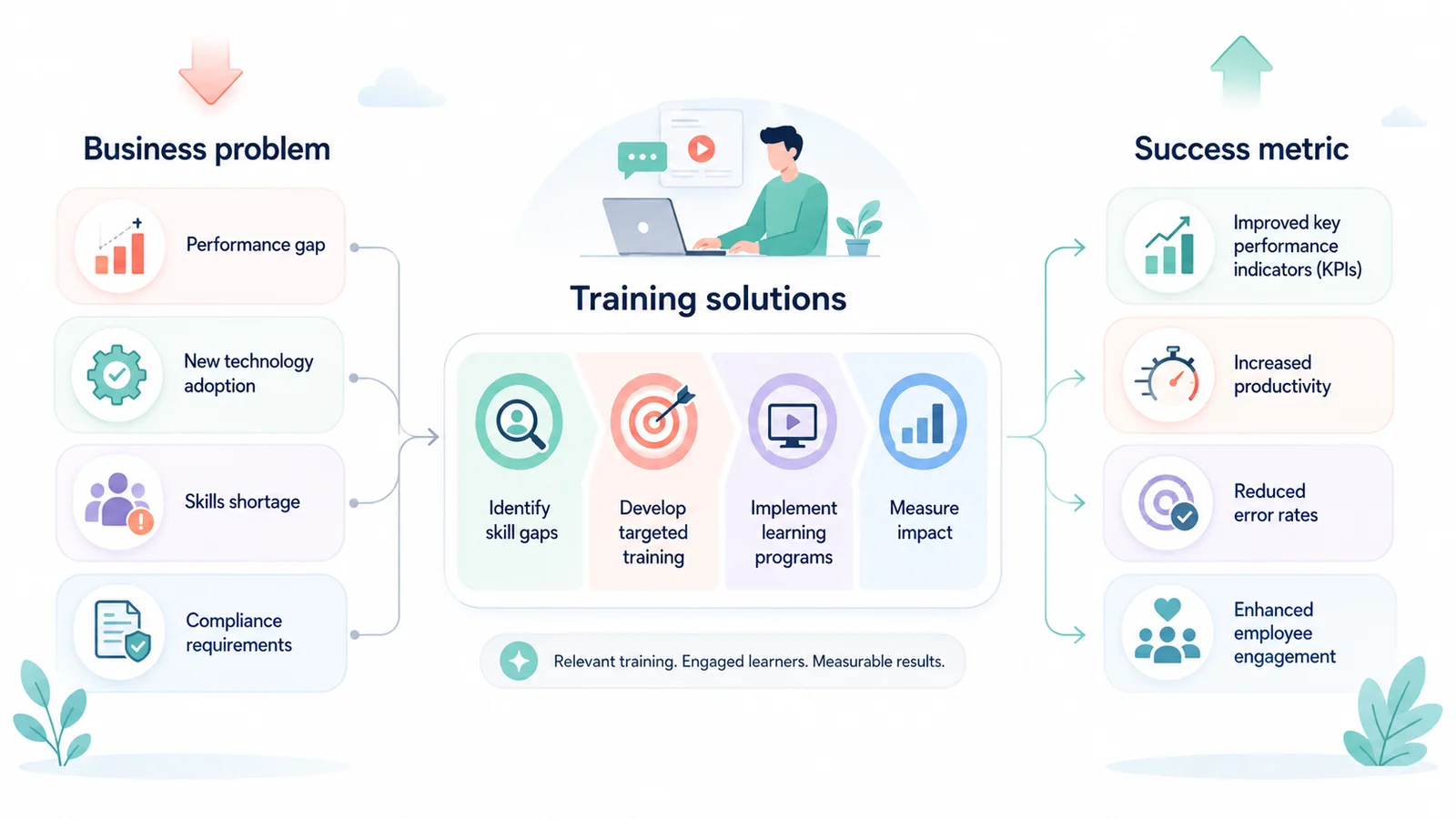
The output of this step is a clear definition of who needs to do something differently, why it matters to the business, and how success will be measured. Without that definition, it becomes almost impossible to determine whether the training delivered meaningful results.
Step 2: Choose Your Delivery Strategy
This step comes before content creation for a reason. The way training will be delivered shapes everything about how the content gets built. Building content before choosing a delivery model often means rebuilding it later.
Most corporate training programs rely on a mix of three delivery approaches:
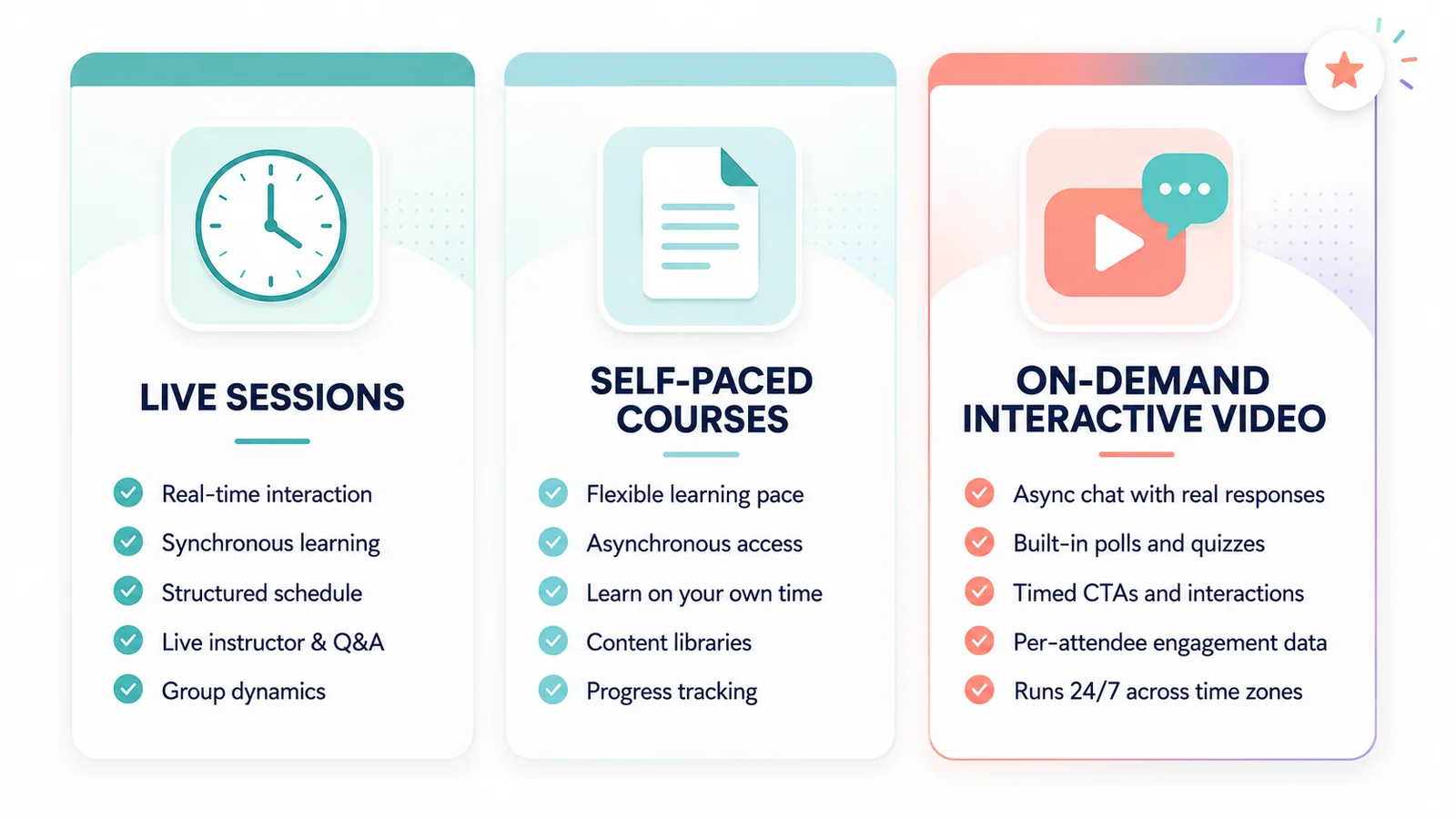
- Live instructor-led training: Best for leadership development, workshops, and situations where discussion is part of the learning experience. The challenge here is scale, since every session requires a trainer and attendance is limited by schedules.
- Self-paced LMS courses: Well suited for compliance training, certifications, and structured learning paths. The main limitation is engagement, as learners often abandon courses when there is no scheduled time or opportunity to ask questions.
- On-demand interactive training: Designed to combine the scalability of self-paced learning with the engagement of a guided session.
Organizations often find themselves choosing between the engagement of live training and the scalability of self-paced learning. We built eWebinar to address that middle ground, giving organizations a way to deliver guided training at scale without sacrificing interaction.
For a broader comparison of the category, see our guide to interactive training software platforms.

Instead of requiring a trainer to deliver the same session repeatedly, eWebinar allows employees to access training on demand, ask questions through asynchronous chat, and engage with polls and knowledge checks built directly into the experience.
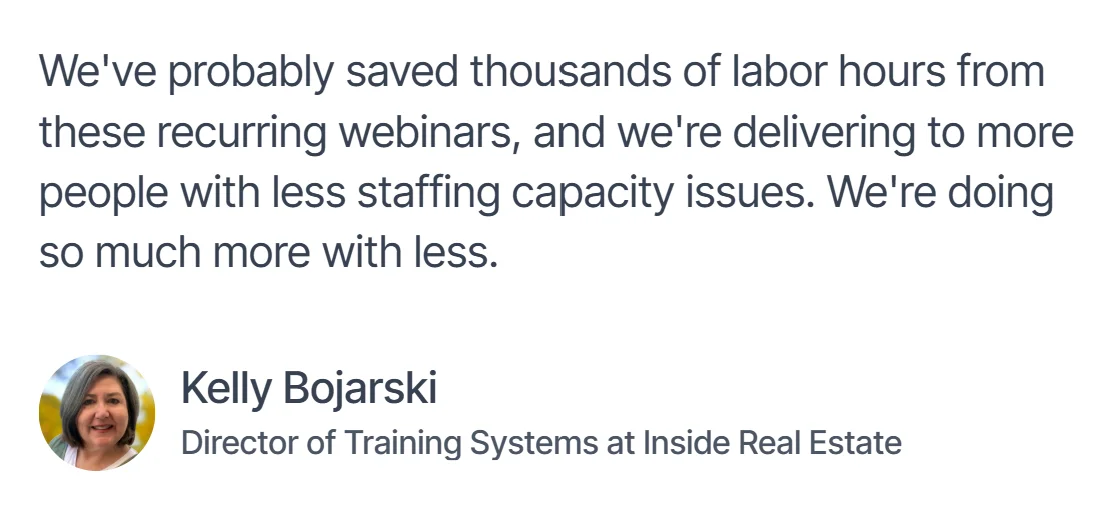
The scalability advantage becomes especially clear once training programs grow beyond a handful of sessions. One example is Inside Real Estate, an eWebinar customer that provides real estate software and services to thousands of agents across North America. Before adopting eWebinar, its training team was repeatedly delivering the same live sessions across time zones.
Moving those sessions on demand allowed the team to reach more people while focusing their time on coaching and support that required human interaction.
Two common ways teams use eWebinar for training include:
- Consistent delivery at scale: Record the training once at its best and make it available on demand. Every employee receives the same experience regardless of location, time zone, or trainer availability.
- Webinar Series for structured learning journeys: The best webinar series platforms sequence multiple sessions into a complete training program, with watch-time requirements and knowledge checks between sessions to encourage participation before employees move on.
The delivery decision made at this stage will shape how the training content gets created in the next step.
Step 3: Build the Training Content
With the delivery strategy established, content can now be designed for the way employees will actually experience it.
The most important principle at this stage is that training should be built around behavior change, not information transfer. The goal is not simply to tell employees something new but to help them do something differently afterward. That distinction shapes every decision that follows.
Here are a few practices that consistently improve training content quality:
- Break content into focused modules: Each session should cover one topic well rather than several topics superficially. Shorter, focused content is easier to complete and easier to retain.
- Build in practice and application: Employees learn by doing, not by watching. Polls, scenarios, exercises, and knowledge checks help reinforce concepts while revealing whether the content is actually landing.
- Use real examples from inside the organization: Generic examples are easy to forget. Content built around actual processes, challenges, and language is more immediately relevant and easier to apply.
- Design for the delivery method: Content that works in a live workshop will not automatically work on demand. For eWebinar sessions, every important concept should be explained clearly within the experience itself, with interactions placed throughout to maintain engagement and check understanding.
Remember, the goal is not to get everything perfect before launch. Building content with iteration in mind makes it easier to improve individual sections as feedback comes in rather than rebuilding the entire program from scratch.
Step 4: Launch the Program
Training content does not create results sitting in a folder. The launch step is about making sure the right people receive the training, understand why it matters, and complete it.
Three factors have an outsized impact on whether a training launch succeeds:
- Communication: Employees need to know the training exists, why it was created, what they will be able to do afterward, and what is expected of them. Vague announcements generate vague participation. Clear communication from managers and leaders who explain the relevance to employees’ roles generates engagement.
- Timing: Even relevant training can struggle if it launches during a product release, end-of-quarter push, or major organizational change. Choosing the right moment often has a bigger impact on participation than the content itself.
- Accountability: Someone needs to own the program and track participation. Completion tracking, automated reminders, and manager visibility are not administrative extras. They are what turn training from an initiative into a standard part of how the organization operates.
Launch is where participation begins, not where the work ends. The most effective programs create multiple opportunities for employees to engage with the material rather than relying on a single announcement.
Step 5: Measure Results and Improve
Most training programs have a launch date but no review date. The content runs, participation happens or does not, and the program gradually becomes outdated without anyone noticing. Products change. Processes evolve. New employees arrive with different needs than the ones the training was originally designed to address.
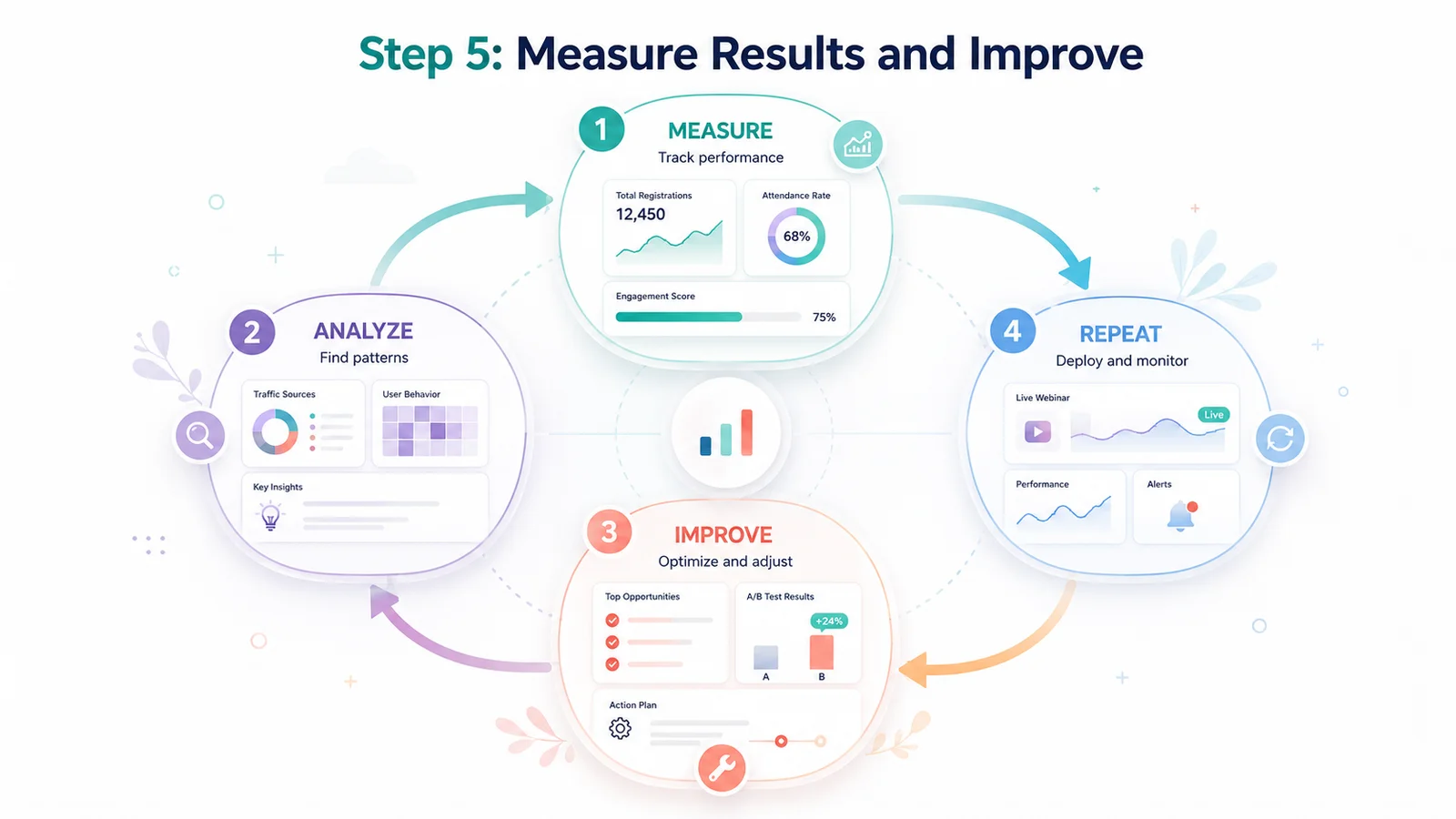
The fix is treating measurement as an ongoing part of the program rather than something that happens after the fact.
Four metrics are worth tracking consistently:
- Completion: Who finished the training and who did not.
- Engagement: Often more useful than completion alone. Drop-off points, knowledge-check performance, and chat questions reveal whether employees actually understood the material.
- Behavior change: Improvements in performance data, manager feedback, or reductions in the errors and questions the training was designed to address.
- Business impact: The outcomes identified in Step 1, whether that is faster onboarding, higher productivity, stronger compliance, or another measurable result.
The value of these metrics comes from what they reveal. For example, if a large percentage of employees consistently miss the same knowledge-check question, the issue may not be with the learners but with how that concept is being explained. That insight gives the training team a clear place to improve rather than guessing which part of the program is underperforming.
Build a quarterly review into the program calendar. Look for patterns in completion rates, and question volume and employee performance. Afterward, use those insights to update outdated content, improve weak sections, and retire material that no longer reflects how the organization operates.
The moment training stops evolving, it starts becoming less relevant. The most effective programs are treated as living systems that evolve alongside the business rather than projects that end once the content is published.
Putting It Together
Effective corporate training is rarely the result of a single workshop or course. It comes from identifying the right problem, choosing a delivery model that can reach people consistently, building content around behavior change, and continuously improving the program as the organization evolves.
Get those pieces working together and training stops being a one-time event. It becomes a repeatable system that helps employees perform better, adapt faster, and stay aligned as the business grows.
If your training program relies on the same session being delivered repeatedly, eWebinar can help automate that part of the process while keeping employees engaged through interactive on-demand experiences. Watch the demo to see how it works.
FAQ
What is a corporate training program?
A corporate training program is a structured system for improving employee knowledge, skills, or performance. It can cover onboarding, compliance, leadership development, product education, or role-specific training. The strongest programs are tied to a specific business objective and measurable outcome.
How long does it take to build a corporate training program?
The timeline depends on the scope. A focused onboarding or role-based program can often be built in a few weeks, while a larger multi-module initiative may take several months. Most successful programs continue evolving after launch based on employee feedback and results.
What is the difference between a training program and a training plan?
A training program is the overall system, including the audience, content, delivery method, and goals. A training plan is the roadmap for executing it. In simple terms, the program defines what will be delivered, while the plan defines how and when.
How do you measure the effectiveness of a corporate training program?
Start with completion and engagement metrics, then look at behavior change and business outcomes. Completion shows who received the training. Performance improvements, reduced errors, and progress toward the original business objective reveal whether the training actually worked.
When should a company use on-demand video training instead of live sessions?
On-demand video training works best when content needs to be delivered consistently across locations, time zones, or recurring employee cohorts. Live sessions are better suited to coaching, discussion, and situations that require real-time interaction rather than standardized delivery.
Curious to see how eWebinar can help run your demos, onboarding, and training sessions on autopilot?
Watch a one-minute explainer video for a quick overview of the eWebinar platform. Or, better yet, join our on-demand demo to learn more!