Quick Summary
Sales training software helps startups turn new hires into productive reps faster. This guide compares seven leading tools across onboarding, practice, coaching, and enablement, highlighting where each one fits and how eWebinar supports the process before formal sales training begins.
Our top three picks at a glance:
# | Tool | Best For |
1 | Trainual | Building the playbooks and SOPs a growing team runs on |
2 | Hyperbound | AI roleplay for objection handling and cold call practice |
3 | Gong | Turning real sales calls into training material |
Why Listen to Us?
We’ve spent 6+ years working with B2B SaaS companies, proptech firms, and high-growth startups on scalable training, onboarding, and sales delivery. Our customers include Inside Real Estate (500,000+ agents across the US and Canada), Proposify, Gem, SkySlope, Follow Up Boss, and hundreds of other sales-led organizations. That experience gives us a clear picture of what separates teams that ramp fast from ones that stay stuck. We've used that picture to build this list.
Scaling Your Sales Training Processes With eWebinar
Here's a question most teams don't think about until it's a problem: who runs your sales training every time a new rep joins?
If your training happens live, someone has to show up and run it. With five people, that's fine. With fifteen, the person running training is repeating the same session week after week. With thirty, it turns into a full-time job.
And it gets worse. When training relies entirely on a person, it disappears when they do.
If your top rep or onboarding manager leaves, their knowledge goes right out the door with them. Because nothing was documented, your next hire is stuck waiting around while someone tries to rebuild the training from memory. You didn’t just lose an employee—you lost your playbook.
That’s where eWebinar comes in
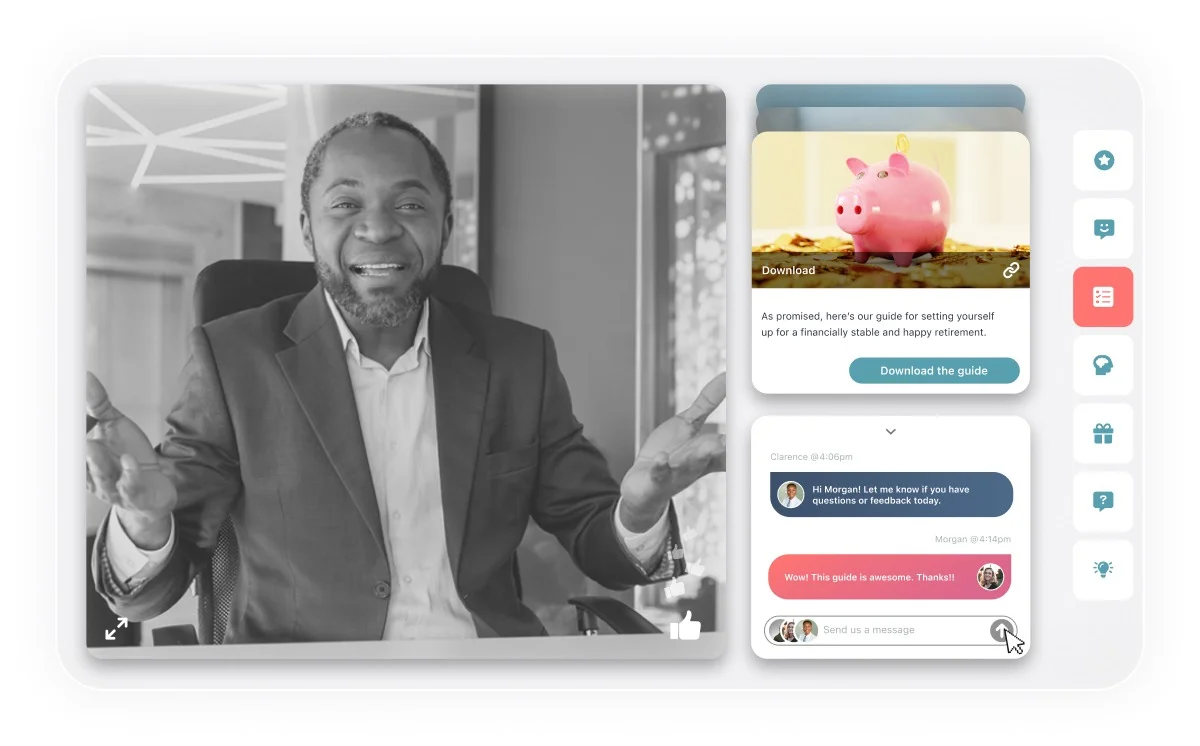
eWebinar is an on-demand video platform with chat. You record your sales training once. You add things like polls, quizzes, and questions to keep reps engaged and check that they're following along. Then you put it on a schedule that runs on its own.
Now every new rep watches the training when they start, anywhere in the world, not when the trainer happens to be free. They can rewatch any part, any time. And if they have a question while watching, they ask in chat. Your trainer answers when they get a chance, not in the moment. Every question gets answered. Nobody has to sit and monitor it.
The change this makes is big. SkySlope went from one or two training sessions a week to six a day, five days a week, with the same team. Gem now delivers over 1,000 hours of training a year. Kelly Bojarski runs training across 500,000 agents at Inside Real Estate, and she put it this way: "We've probably saved thousands of labor hours from these recurring webinars, and we're delivering to more people with less staffing capacity issues. We're doing so much more with less."
There's a bonus, too. When the routine training runs on its own, your team gets time back for the reps who need extra help. As Bojarski put it: "Using eWebinar for scalable, recurring webinars has freed up our time to do more one-on-one trainings, so that we can give that elevated service to folks that need additional hand-holding."
The idea is simple. Let eWebinar handle the training you repeat. Keep your team's live time for the moments that really need a person.
Many sales teams still rely on a founder, sales leader, or product expert to run the same walkthroughs live week after week. Others record a video and hope people watch it. eWebinar provides a more structured approach by turning those sessions into interactive on-demand experiences, complete with polls, quizzes, and chat for questions.
Teams commonly also use eWebinar for:
- Product onboarding
- Product update sessions
- Advanced feature training
- Competitive positioning refreshers
- Partner and channel enablement
- Other repeatable training that benefits from both video and interaction
When used alongside sales training software, eWebinar handles the repeatable knowledge-transfer portion of enablement. This approach shares many of the advantages of asynchronous learning platforms, allowing every rep to learn on their own schedule before moving into live coaching.
From there, platforms like Trainual and Scribe help document processes, while Hyperbound, Second Nature, Spekit, Salesloft, and Gong support practice, coaching, and continuous improvement.
The goal is not to replace sales training. It is to make sure every rep, partner, and prospect-facing employee receives the same high-quality training experience without requiring a trainer to deliver it live every time.
Top 7 Sales Training Software for Tech Startups: Full Comparison Table
# | Tool | Category | Best For | Capterra Rating | Starting Price |
1 | Trainual | Documentation and Playbooks | Building SOPs and onboarding playbooks fast | ⭐4.8 | Custom |
2 | Scribe | Documentation and Playbooks | Auto-generating step-by-step process docs | ⭐4.8 | Custom (Free plan available) |
3 | Hyperbound | AI Roleplay and Practice | Cold call and objection handling practice | N/A | Custom |
4 | Second Nature | AI Roleplay and Practice | Mastering the product pitch before real calls | ⭐5.0 | Custom |
5 | Spekit | Live Execution and Coaching | In-app guidance inside the CRM | ⭐4.6 | Custom |
6 | Salesloft | Live Execution and Coaching | Engagement sequences with embedded coaching | ⭐4.5 | Custom |
7 | Gong | Live Execution and Coaching | Turning real calls into coaching insight | ⭐4.8 | Custom |
1. Trainual
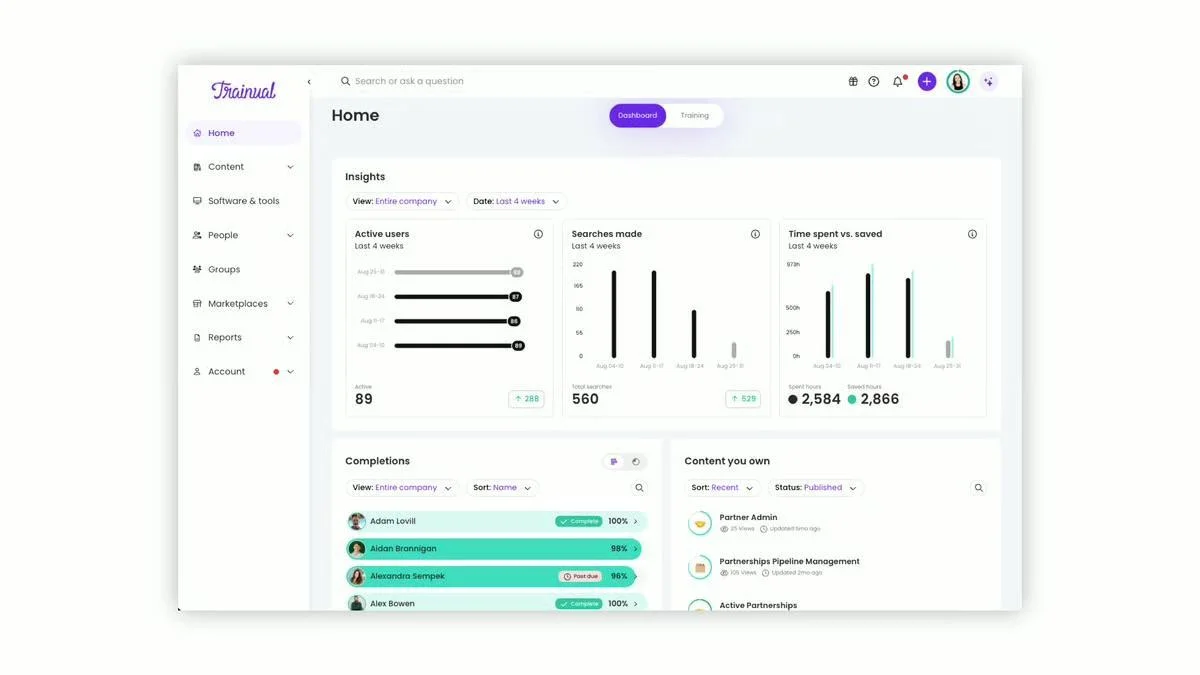
Best for: Early-stage teams building their first sales playbook and onboarding process
Trainual is a documentation and training platform for growing teams that need to codify how the business actually operates. For sales teams, that means turning your playbook, your qualification framework, your CRM process, and your objection handling guide into structured, assignable training content that new reps can actually find and work through.
The value here is giving your tribal knowledge a home. Many startups’ sales playbooks live in a manager's head or in a six-month-old slide deck nobody updates. Trainual gives you a structured system where new hires can be assigned a learning path on day one, complete it at their own pace, and get tested.
Key Features:
- Role-based training paths: Assign content automatically when reps join a role or department, so new hires inherit the right training from day one without manual setup.
- AI content builder: Generate SOPs, training paths, and quiz questions from prompts or existing documentation in a fraction of the time.
- Progress tracking and e-signatures: Monitor who has completed which modules and collect acknowledgments for policy or compliance-sensitive content.
- 500+ templates: Access pre-built content templates across every department to speed up initial documentation.
Pros:
- Fast to set up without a dedicated training team
- Keeps sales process out of one person’s head
- Tracks who has completed which training
Cons:
- Static content, no live practice or feedback
- Can become outdated if not maintained
- Limited value once content is built and stable
Capterra Rating
⭐ 4.8
Pricing
Trainual uses headcount-based tiers, with typical plans starting at $299 per month for up to 25 employees.
2. Scribe
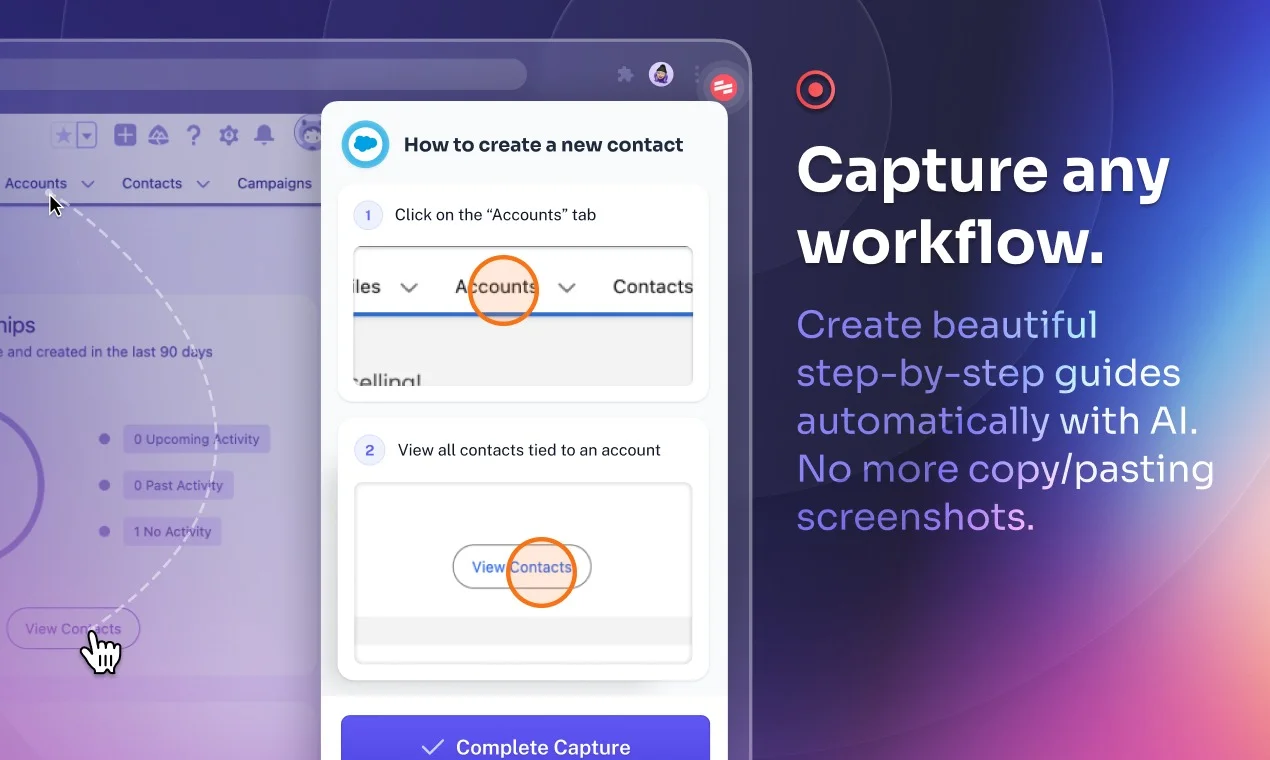
Best for: Teams that need step-by-step process documentation without writing it manually
Scribe is a workflow documentation tool that works differently from Trainual. Instead of writing documentation manually, you hit record, walk through the process on your screen, and Scribe generates an annotated, screenshot-based step-by-step guide automatically.
For sales teams, the use case is capturing any process that's easier to show than describe: how to log a call in the CRM, how to set up a sequence in your outreach tool, how to update deal stages correctly.
Key Features:
- Auto-capture documentation: Record any process in your browser or desktop app and get an annotated, illustrated step-by-step guide in seconds.
- AI documentation builder: Combine multiple Scribes with AI-written narrative to generate comprehensive training guides, SOPs, and process manuals automatically.
- Customizable branding and redaction: Add your company branding, redact sensitive data, and control access by role before sharing.
- Integrations with knowledge platforms: Connect with Confluence, Notion, ClickUp, and LMS platforms including 360Learning and Docebo to embed Scribes wherever your team works.
Pros:
- Documentation creation takes minutes, not hours
- Stays current because it is easy to redo
- Useful beyond sales for any internal process
Cons:
- Best for process steps, not sales narrative or pitch
- Free plan limits number of guides
- No practice or coaching component
Capterra Rating
⭐ 4.8
Pricing
Features tiered pricing starting with a free version, scaling to paid plans from $23 per user monthly.
3. Hyperbound
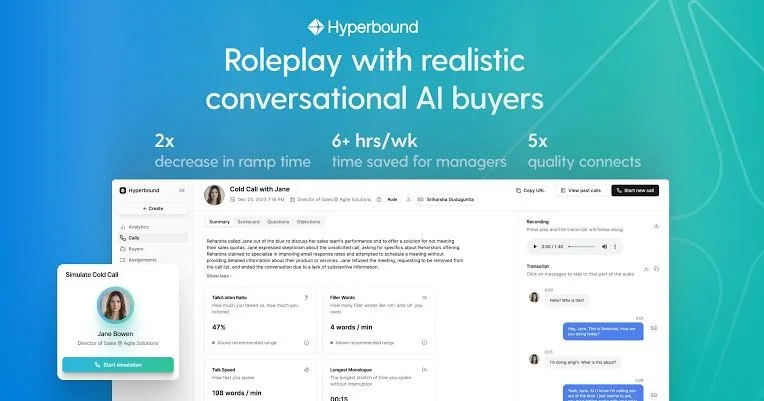
Best for: SDR and BDR teams that need unlimited cold call and objection handling practice
Hyperbound is an AI sales roleplay platform where reps practice cold calls, discovery, and objection handling against AI-generated buyer personas before going live. The AI personas are built from 2 million+ hours of real B2B sales conversation data, so they respond with realistic pushback rather than predictable scripts.
The core value is repetition without the cost of practicing on real prospects. A rep who has run fifty cold call practice sessions against a skeptical CFO persona is going to perform meaningfully differently from one who hasn't.
Key Features:
- AI buyer roleplay simulations: Practice cold, warm, and discovery calls against configurable AI buyers that respond in real time with ICP-specific objections and personalities.
- Custom scorecard builder: Align every roleplay session to your exact sales methodology, MEDDIC, SPIN, Challenger, or a custom framework, with objective, consistent grading.
- Real call scoring: Upload actual sales calls and have the AI grade them against the same rubric as roleplay sessions, so managers can coach at scale without listening to every recording.
- Multilingual support: Run roleplays in 25+ languages for internationally distributed sales teams.
Pros:
- Unlimited practice without burning real leads
- Realistic objections specific to your product
- Useful for both new hires and ongoing reps
Cons:
- Practice is not a substitute for real call feedback
- Newer platform with a smaller review base
- Best results require setup time to build accurate personas
Capterra Rating
N/A
Pricing
Pricing is customized, with standard software subscription estimates ranging from $24 to $69 per user, per month.
4. Second Nature
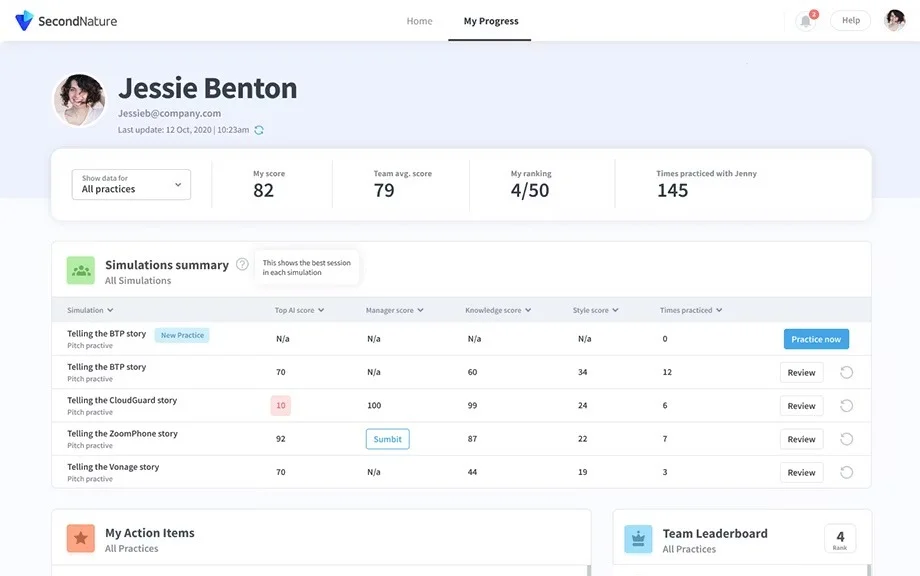
Best for: Teams that want reps to master the product pitch before talking to real prospects
Second Nature is an AI sales training platform that gives reps a virtual practice partner named Jenny. The idea is to help reps have realistic conversations with an AI avatar before they're in front of a real prospect.
Jenny is programmed to respond like an actual customer, ask about competition, push back on pricing, and probe for specific value claims. After each session, the platform scores the conversation and provides feedback on tone, confidence, clarity, and content coverage.
Key Features:
- AI roleplay partner: Practice pitches, objection handling, and discovery frameworks with a conversational AI avatar that responds dynamically to what the rep says.
- Instant session scoring: Receive feedback on tone, clarity, confidence, and content coverage immediately after each practice session.
- Manager performance dashboard: Track individual rep progress and skill development across the team without reviewing session recordings manually.
- Custom scenario builder: Upload your own sales decks, call recordings, and playbooks to create practice scenarios specific to your product and buyer personas.
Pros:
- Helps standardize the pitch across a growing team
- Practice feels conversational, not scripted
- Good fit alongside a documented playbook
Cons:
- Custom pricing makes budgeting harder for small teams
- Overlaps with Hyperbound if a team adopts both
- Requires reps to actually use it consistently to see value
Capterra Rating
⭐ 5.0
Pricing
Quote-based pricing, with estimated costs spanning from $99/month up to $199+/month for larger teams.
5. Spekit
Best for: Teams that want answers and guidance to appear inside the tools reps already use
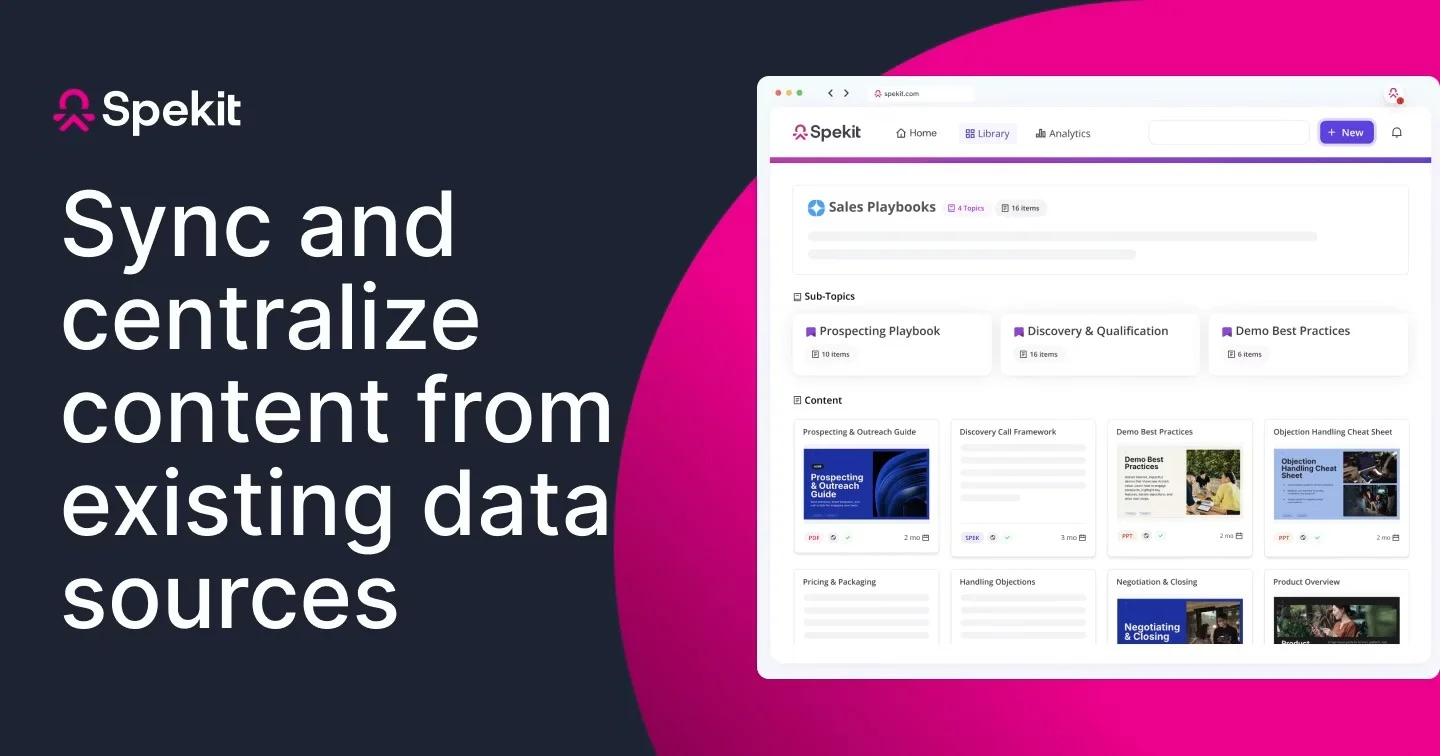
Spekit is a just-in-time enablement platform that surfaces training content inside the tools your reps already use. The model skips the separate learning system entirely and brings the information directly into Salesforce, Outreach, HubSpot, or whatever is in your stack.
In practice, a rep hovering over a deal stage field in Salesforce sees a pop-up explaining exactly what belongs there. A new hire reaching a stage they haven't handled before gets a tip card with the right next steps. For sales training, the model prioritizes reinforcement and in-context help over structured courses.
Key Features:
- AI Sidekick in-workflow coaching: Surface the right playbooks, battle cards, case studies, and next-best actions directly inside Salesforce, Gmail, Gong, Slack, and other rep tools without requiring a context switch.
- AI content builder: Generate and maintain battle cards, playbooks, and onboarding materials from existing content, with governance controls that detect and flag content decay automatically.
- Deal Rooms: Create branded, trackable spaces that deliver the right assets for each deal in a single shareable link, with engagement analytics showing who viewed what and for how long.
- Learning paths and knowledge checks: Structure onboarding content sequentially with comprehension checks embedded in the same platform reps use daily.
Pros:
- Reduces context-switching during live work
- Surfaces exactly what a rep needs, when they need it
- Analytics reveal knowledge gaps across the team
Cons:
- Requires content to be built and maintained
- Less useful before a rep is actively working in the CRM
- Custom pricing complicates budgeting for small teams
Capterra Rating
⭐ 4.8
Pricing
Quote-based model with costs typically ranging from $10 to $20 per user, per month.
6. Salesloft
Best for: Teams that want coaching and engagement built into the rep’s daily sequence work
Salesloft started as a sales engagement platform and has become one of the most comprehensive revenue tools in the B2B space. In December 2025, Salesloft merged with Clari to form a combined entity built around what they call a "Predictive Revenue System." The pitch is a single platform that covers sales engagement, conversation intelligence, deal management, and forecasting. The honest reality: as of mid-2026, the two platforms remain largely separate, with full integration on a multi-year roadmap.
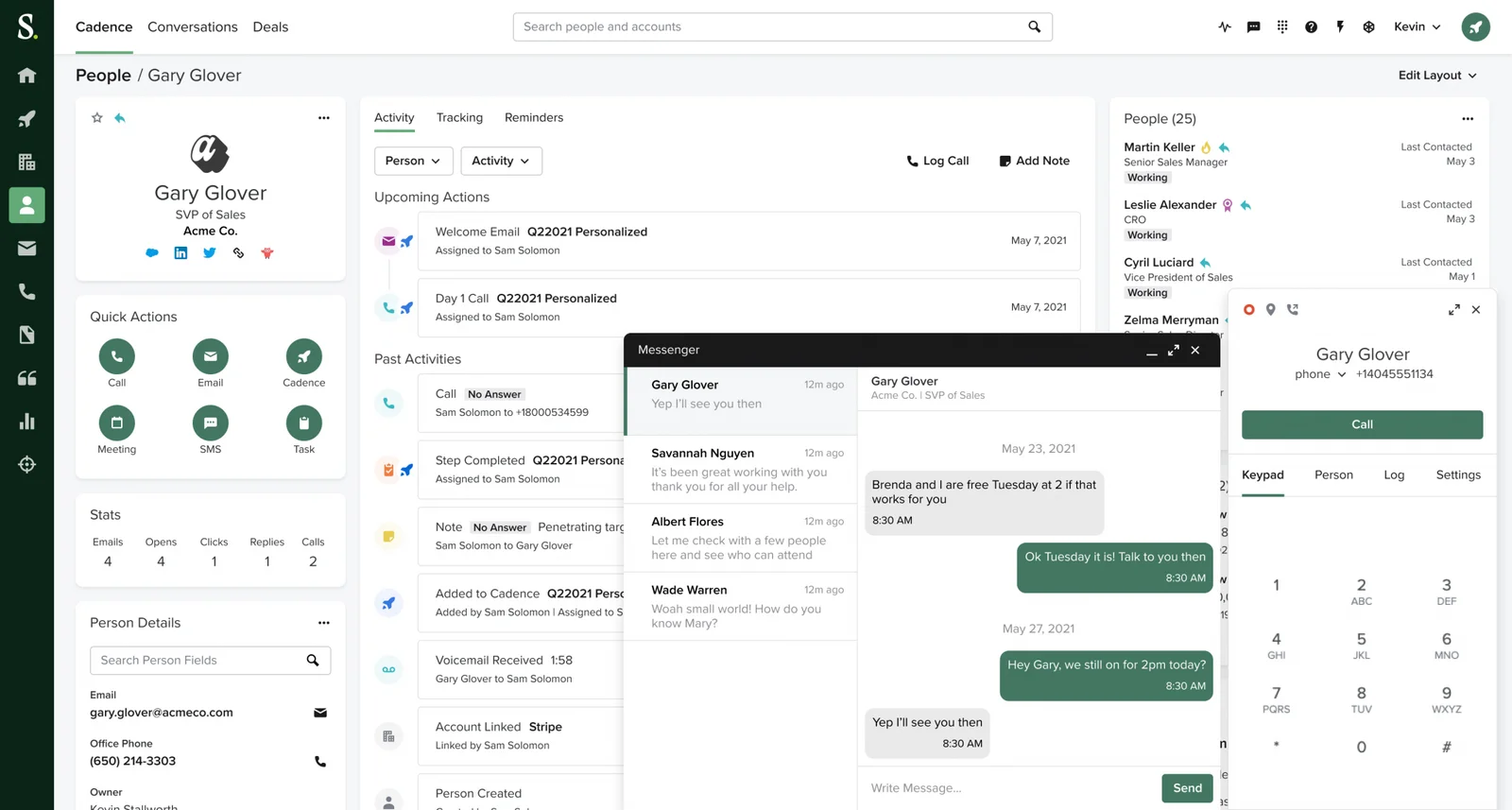
What Salesloft does well today is what it was already doing well before the merger. The cadence builder is best-in-class. The Salesforce integration is reliable. Conversation intelligence is native (no additional tool required). And Rhythm AI, Salesloft's biggest differentiator, builds a prioritized rep action queue based on live buying signals across every channel.
Key Features:
- Cadence builder: Create structured multi-channel outreach sequences (email, calls, LinkedIn tasks) with behavior-triggered step skipping and automatic priority surfacing.
- Rhythm AI: Build a real-time rep action queue that surfaces the highest-priority task at any given moment based on live buyer engagement signals across all channels.
- Conversation intelligence: Record, transcribe, and analyze sales calls natively, with coaching moments and deal risks flagged automatically for managers.
- Pipeline and forecasting (via Clari): Combine deal health scoring, activity signals, and AI-driven forecasting to surface pipeline risk before it becomes a miss.
Pros:
- Combines engagement workflow with coaching in one place
- Reduces tool sprawl for outbound-heavy teams
- Strong reporting on rep activity and outcomes
Cons:
- Broader platform than a pure training tool, which adds cost
- Coaching features work best alongside dedicated practice tools
- Implementation takes longer than single-purpose tools
Capterra Rating
⭐ 4.5
Pricing
Pricing is fully customized, with subscription costs typically ranging from $75 to over $200 per user monthly.
7. Gong
Best for: Teams that want to turn their best reps’ real calls into training material for everyone else
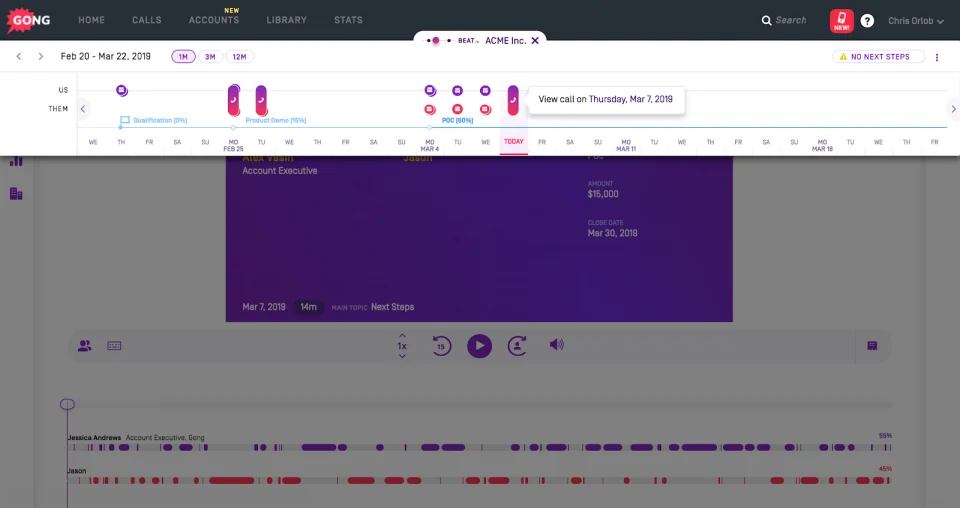
Gong is the category leader in revenue intelligence. It records sales calls, transcribes them, and analyzes what happened to surface coaching insights, deal risks, competitive mentions, and pipeline patterns. Managers get visibility into what's happening across every deal without listening to every call. Reps can learn from winning call libraries without waiting for a 1-on-1 coaching session.
In early 2026, Gong launched Mission Andromeda, a significant platform expansion that added Gong Enable (a new AI coaching product with an AI Call Reviewer), a sales-focused AI assistant, and MCP-based integrations with Microsoft Copilot, Salesforce Agentforce, and HubSpot.
Key Features:
- Conversation intelligence: Record, transcribe, and analyze every sales call automatically, with keyword tracking, competitive mention detection, and deal risk signals surfaced without manual review.
- Deal intelligence: Flag at-risk deals based on stakeholder engagement, deal velocity, and activity signals across the full pipeline.
- Gong Enable AI Call Reviewer: Grade completed calls against your methodology automatically, creating a scalable coaching feedback loop without requiring manager bandwidth for every recording.
Pros:
- Training material comes from real calls, not theory
- Helps managers coach based on evidence
- Scales best-rep behavior across the team
Cons:
- Only useful once reps are taking real calls
- Custom pricing can be steep for early-stage teams
- Volume of data can be overwhelming without a review process
Capterra Rating
⭐ 4.8
Pricing
Custom quotes, with total annual costs for a 10-person team typically around $20,000 to $25,000 in Year 1.
How We Evaluated
Tech startups rarely have the time, budget, or enablement resources of larger sales organizations, so we evaluated each tool based on what matters most in that environment.
- Setup speed: Whether a small team can get value without weeks of implementation
- Practice quality: Whether reps can build real selling skills, not just consume information
- Real-world grounding: Whether the training is grounded in real sales activity rather than theory
- Coaching usefulness: Whether managers get actionable insight, not just dashboards
- Cost fit: Whether pricing remains practical as the team grows
How to Choose the Right Sales Training Software
The best choice depends on where the biggest gap exists in your sales process.
- No documented process yet: Start with Trainual or Scribe. If reps are learning by asking around, the playbook needs to exist before any other tool adds much value.
- Reps freeze on objections or cold calls: Hyperbound or Second Nature lets reps practice before those conversations happen with real prospects.
- Reps are live but inconsistent: Spekit keeps guidance in front of them during the work itself, while Gong and Salesloft turn what is already happening on calls into something the whole team can learn from.
- Hiring multiple reps per quarter: This is often the point where repeating the same onboarding sessions starts consuming too much senior team time, making eWebinar a useful first step before the rest of the training stack
Final Word
Your sales training software won’t teach a new hire what your product actually does. Yet that foundation shapes how quickly a new rep can absorb the playbook, practice the pitch, and start contributing.
eWebinar helps teams deliver that product knowledge consistently and at scale, without repeating the same walkthrough for every new hire.
Join our on-demand demo to see how it works.
FAQs
What's the difference between sales training software and sales enablement software?
Sales training software helps reps develop skills, typically through documentation, practice, and feedback. Sales enablement software delivers the right content and guidance in the flow of work, during actual deals. The line blurs with tools like Spekit, which does both, but the distinction matters for buying decisions. If reps don't know the playbook, training tools solve it. If reps know the playbook but don't use it consistently, enablement tools solve it.
Do I need different tools for onboarding new reps versus training existing ones?
Often, yes. New-hire onboarding focuses on product knowledge, sales processes, and company context, while ongoing sales training focuses on improving skills through practice, coaching, and real-world feedback. Many startups use different tools for each stage.
Can eWebinar be used to train my sales team?
eWebinar is best used before formal sales training begins. It helps new hires learn the product through on-demand walkthroughs and training sessions, creating a consistent foundation before reps move on to playbooks, roleplay, and live sales coaching.
How much does sales training software cost for a small startup?
Pricing varies significantly by category. Documentation tools like Trainual and Scribe typically have accessible entry-level plans, while AI roleplay, conversation intelligence, and coaching platforms often use custom pricing based on team size and usage.
What is the difference between Hyperbound and Second Nature?
Both use AI-powered buyer simulations, but they focus on different parts of the sales process. Hyperbound is particularly strong for cold calling and objection handling practice, while Second Nature focuses more heavily on pitch delivery and consistency across the team.
Do I need a dedicated enablement team to get value from these tools?
For most tools on this list, no. eWebinar, Trainual, Scribe, and Spekit were built specifically for teams without dedicated enablement resources. Gong and Salesloft deliver the most value when an active manager or enablement lead is using the analytics to drive real coaching decisions and holding reps accountable to what the data shows.
Curious to see how eWebinar can help run your demos, onboarding, and training sessions on autopilot?
Watch a one-minute explainer video for a quick overview of the eWebinar platform. Or, better yet, join our on-demand demo to learn more!