The best way to learn about eWebinar is to watch our demo, because the demo is itself an eWebinar. Everything you experience there is what your own audience would experience.

We get a lot of questions in chat during the demo. These are the ones that come up most, answered in full. If yours isn't here, send us a message and we'll get back to you.
Why eWebinar?
What is eWebinar, exactly?Why can't we just run more live sessions?
Our live sessions work fine. Why change anything?
Why is the shift to on-demand happening now?
What actually changes when we make the shift?
What is eWebinar, exactly?
We turn any pre-recorded video into an interactive session with chat. Like the demo you just watched.
You record once. Put it on a recurring schedule, make it available on demand, or both. Your sessions then run when your audience is ready, not only when you are. Attendees participate through interactions built into the video, ask questions in chat, and hear back from a real person on your team.
Anything you find yourself delivering live over and over, or anything you wish you could deliver but assumed was impossible (due to time or bandwidth), eWebinar can do for you.
Why can't we just run more live sessions?
Because there's a ceiling, and it isn't a question of effort.
There's one of you. There are only so many hours in your week, only so many time zones you can show up in, and only so many sessions your calendar has room for.
Even if you could run more, you still wouldn't reach everyone. Doing something live requires both sides to be free at the same moment. That's where you lose people to scheduling conflicts, forgotten signups, and the ones who never registered at all because they couldn't commit to a specific hour.
The more you grow, the further behind you fall. Every new prospect needs the same demo. Every new customer needs onboarding. Every release kicks off the same round of training.
You're not slow and your team isn't underperforming. The format has a limit built into it.
Our live sessions work fine. Why change anything?
They probably do work. That's not the question.
The question is what isn't happening because live is the only way you deliver.
Live reaches around 40% of the people who register, at best. The other 60% wanted to be there. They signed up. They got the reminders. Life happened. And that 40% is only a share of the people who registered in the first place. The ones who wanted to see your product but couldn't commit to a specific hour never signed up at all.
None of the teams we work with thought their live sessions were failing. Cloze was running ten live sessions a week and serving customers well. Inside Real Estate had a training program people liked. They just found out how much more was possible once the repeatable part stopped consuming the calendar.
Every quarter you keep delivering everything live is a quarter your audience walks past you. Prospects you could have closed. Customers you could have reached.
So the real question isn't whether live works. It's whether reaching a fraction of your audience is enough for the business you're trying to build.
Why is the shift to on-demand happening now?
The first livestream was thirty years ago, and it felt like the future, because it was. For the first time, one person could reach thousands from their desk.
But over the last fifteen years, almost every kind of content in your life moved to on-demand. Netflix replaced scheduled TV. Spotify replaced waiting for your song on the radio. News apps replaced the morning paper.
People now expect content to run on their schedule rather than someone else's. That includes your customers.
Business content is the outlier. People are still expected to get on a call at 2pm on a Tuesday to hear something one person could have recorded once.
Your audience already lives on demand. Most companies' content doesn't. That gap is the opportunity. The’s the gap eWebinar can help you close.
eWebinar helps your business catch up, and communicate with your audience the way they prefer.
What actually changes when we make the shift?
Across 2.5 million sessions on our platform, customers average an 83% attendance rate for on-demand sessions. The industry benchmark for live sits between 30 and 40%.
Beyond attendance, customers typically see watch times climb toward 90% and conversion rates rise two to three times. Many now run 50 times more sessions than they ever could live, without adding a single person to the team.
But the number that matters most is the one you can't see on a dashboard: the people who finally get in. Every person who wanted to be there, can be. That's what removing the ceiling actually buys you.
What would it mean for your business to get to 100% of your audience, prospects and customers?
Pricing
How much does eWebinar cost?
How do self-adjusting subscription levels work?
Is there a trial?
How much does eWebinar cost?
Plans start at $99/month USD after the free trial. You can see our plans here ewebinar.com/pricing.
Pricing is based on how many published eWebinars you have. A published eWebinar can have unlimited sessions and unlimited attendees. Drafts you're still working on don't count.
How do self-adjusting subscription levels work?
We only want you paying for what you're actually using. Your subscription level adjusts automatically as you publish or unpublish eWebinars. Here's a full explanation.
Is there a trial?
Yes, 14 days, no commitment, and no call with a salesperson. You can build your first eWebinar the same day you sign up for your trial.
Before you decide
Will my audience accept a session that isn't live?
Won't we lose the personal connection?
Does this mean we stop doing things live?
Is this going to replace my team?
Should I tell people the video is pre-recorded?
Will my audience accept a session that isn't live?
This is a question almost everyone asks, and it's the one our customers stop worrying about fastest once they try the product for themselves.
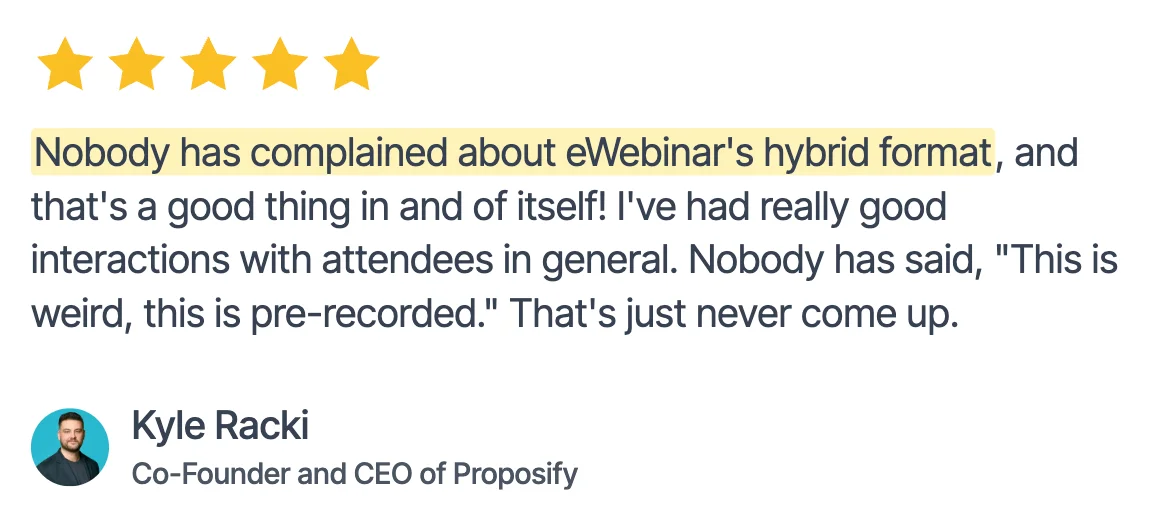
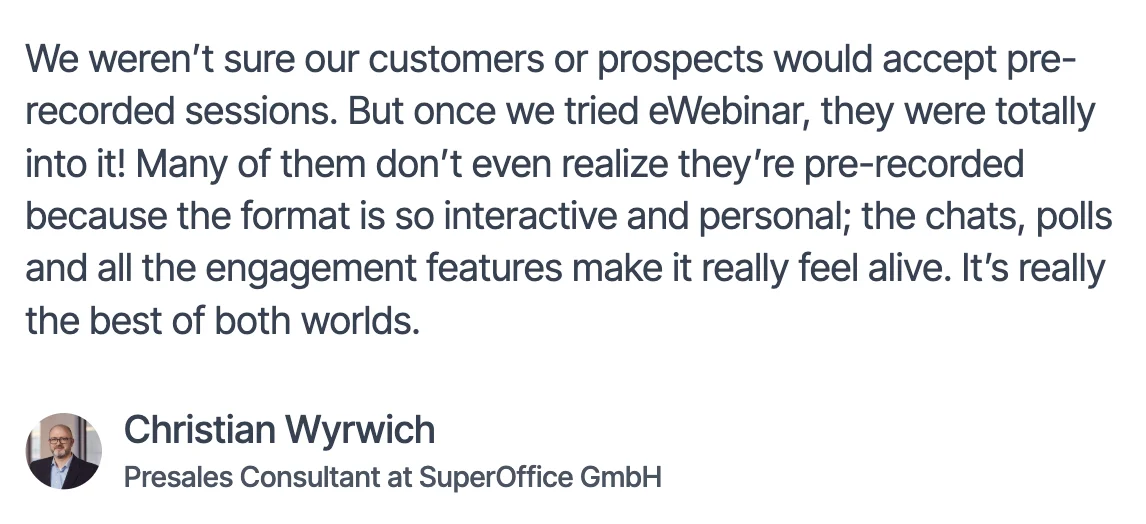
What we hear back, over and over, is that nobody complains. Not "few people complained." Nobody. People came for the content, not the format. They're already watching everything else in their life on demand, so a session they can join at 9pm on a Tuesday night doesn't strike them as strange.
Whether your audience values your session has almost nothing to do with whether you're presenting it in real time. It has everything to do with whether it's worth their time and whether they can get a question answered.
Won't we lose the personal connection?
Think about what actually creates connection. It isn't that a session happens in real time. It's that a real person responds when someone reaches out. It’s two people connecting.
That part doesn't change. Every chat message gets a human reply, right away when someone's around, by email when they're not.
Now think about the alternative. A live session with fifty, a hundred, sometimes hundreds of people muted in the audience, one host trying to watch chat while presenting, most questions never answered. How much personal connection is happening in that room?
In eWebinar, every attendee gets a private, one-on-one line to your team. In a moment where AI is handling so much of the customer experience, a human writing back has become more personal than it's ever been.
And because your team is no longer delivering the same session every week, they get the hours back for the conversations that genuinely need them.
Does this mean we stop doing things live?
No, and we'd tell you not to.
Live earns its place. A special guest. A time sensitive launch. A conversation with an important customer where the discussion is different every time. A Q&A. When the content changes every time you deliver it, live is the right format and nothing else will do.
eWebinar is for the sessions where you say the same thing every time. The demo every prospect needs. The onboarding every new customer gets. The training that runs every time you ship a feature.
The customers who get the most out of eWebinar are the ones who worked out the split. They keep live for what live is great at, use short static video for quick how-tos, and let eWebinar carry everything they used to repeat and can’t give up communication for.
Most of them end up doing more unique live sessions and calls, because they finally have room for it. eWebinar automates the repeatable so you can spend time doing the things only you can do.
Is this going to replace my team?
No. The repetition goes away. The people don't.
What we see is teams getting more productive once the repeatable work is off their plate. Creating deeper courses, sessions for advanced users, and different tracks for specific use cases or languages. The projects that never made it out of the “someday folder”.
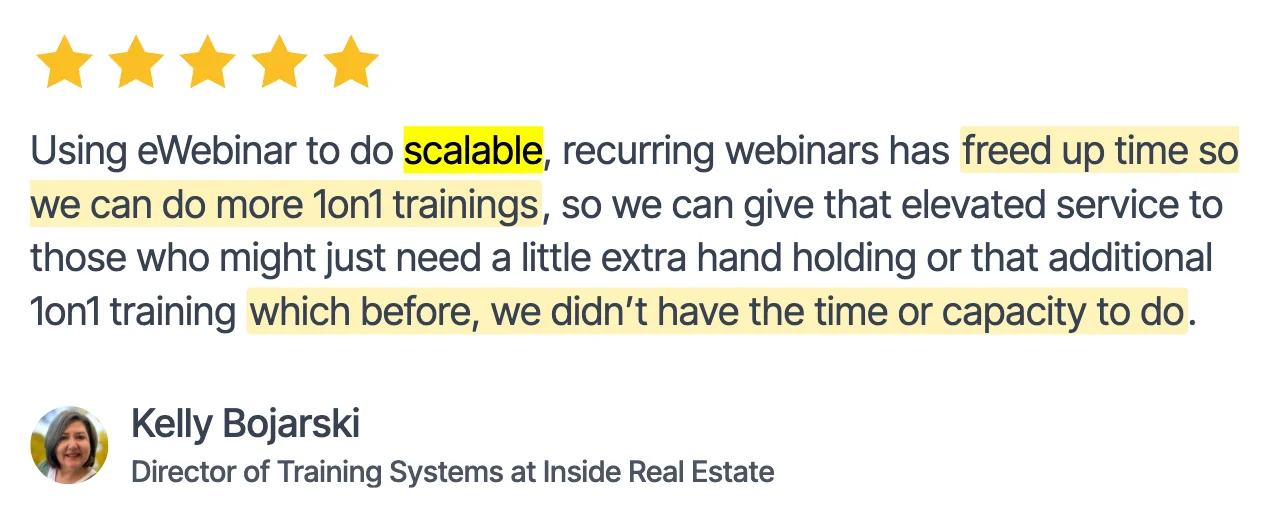
Jamie Mendelsohn at Cloze used the hours her team got back to build Cloze University, a learning program that didn't exist before. Kelly Bojarski at Inside Real Estate started offering the 1-on-1 training her team never had bandwidth for.
The work gets more interesting, not less. What disappears is the part nobody wanted to do for the 100th time.
Should I tell people the video is pre-recorded?
That's up to you, and plenty of our customers do.
The one thing we'd say firmly: don't claim a session is live when it isn't. People work it out quickly, and trust is hard to win back.
Beyond that, it often isn't a detail worth raising. In our own demo, Melissa opens by welcoming you without commenting on the format either way. People know that she’s not doing 5 demos a day at a fixed time, including right now (on-demand).
If you'd rather be explicit, a simple line at the start works well, something like: "Welcome. This video is recorded and I'll be watching the chat. If I don't get back to you right away, I'll follow up by email." That sets expectations about response time and gets it out of the way.
We built eWebinar so you never have to pretend. Other tools in this space were designed to trick people, with fake attendee counts and fake chat. That’s not a practice we can get behind as integrity is our top priority, which is a large part of why we built eWebinar in the first place.
How chat works
Does someone need to be monitoring chat all the time?
What if someone asks a question and nobody's around?
Can I answer chat from my phone?
Can AI answer chat for me?
How is this different from the "chat" in other automated tools?
Does someone need to be monitoring chat all the time?
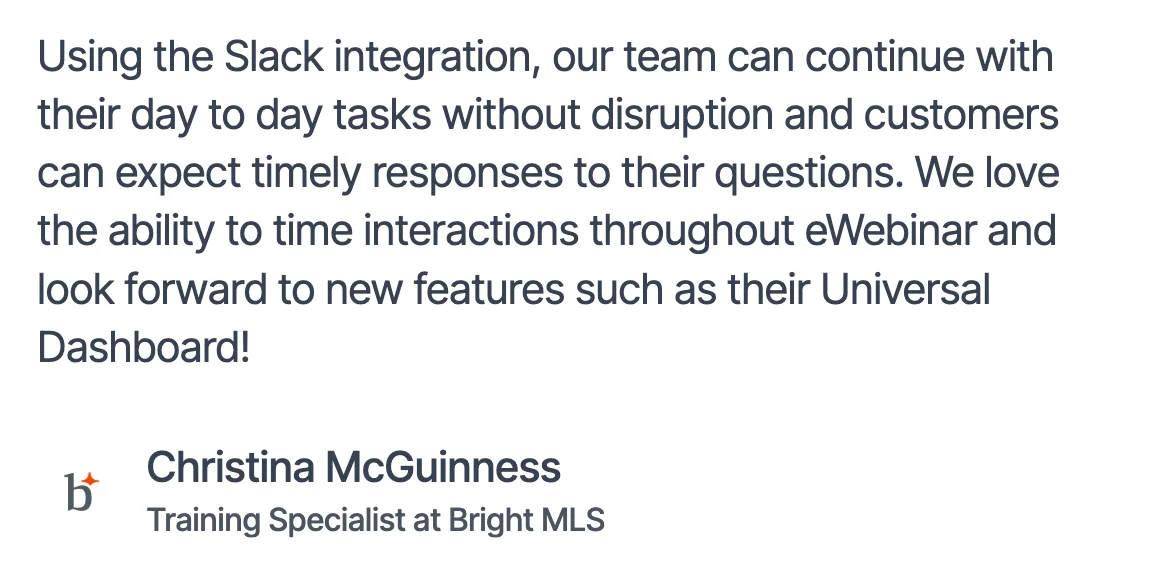
No. Our chat behaves like texting, or like the chat bubble on any website. When someone sends a message, your team gets notified by email, browser, or Slack (integration). Whoever's free picks it up. If nobody is, the attendee gets an auto-response you've customized, letting them know when to expect an answer.
Every question gets a real answer from a real person. It just doesn't have to be instant.
Worth knowing: on-demand sessions actually make chat easier to manage, not harder. A live session puts everyone in one room with questions arriving faster than anyone can read them. On-demand spreads that same (usually more) volume across days and weeks, so there’s only ever a few people at most in the same session.
 What if someone asks a question and nobody's around?
They get your auto-response, and your reply reaches them by email whenever your team picks it up.
Nothing gets lost, and nobody has to sit and wait.
Can I answer chat from my phone?
Yes. The chat admin works on mobile, and our Slack integration means your team can reply from dedicated Slack channels on their phones without opening eWebinar at all.
Can AI answer chat for me?
Yes. You can subscribe to our AI chatbot add-on (eChat), or connect a chatbot you already use.
Most customers still prefer a human on the other end because it’s become the more personal option in the world of AI. But the choice is yours, and plenty of teams use AI to respond until a human is required.
How is this different from the "chat" in other automated tools?
Most tools in this space don't have a proper chat system at all. They have a comment box that emails you when someone writes in, with no way to reply in real-time. Others let messages disappear once the session ends, so you can never get back to the person.
A few do offer real-time chat, but only if someone from your team sits through every single session as it's happening. Which defeats the point of automating it.
Chat that works asynchronously is the feature that makes any of this viable, and it's the reason eWebinar exists. Melissa went looking for it, couldn't find it anywhere, and built the company around it.
Choosing between live, video, and eWebinar
When should I use each one?
What's the difference between a video on a landing page and an eWebinar?
I tried an automated tool before and it didn't work. Why would this be different?
Does it replace my LMS?
When should I use each one?
You probably need all three. They do different jobs.
Live is for things only live can do. Special guests. Launches. Conversations that go somewhere different every time. Real-time Q&A where you don't know what's coming.
Static video, meaning a plain recording on a landing page or a video host, is for things that don't need a conversation. A short how-to. A Loom instead of a meeting. A brand video. Get in, get out, no back and forth.
eWebinar is for everything in between. The content you'd normally schedule a live session for, where you say the same thing every time, and where there's enough depth that a two-minute clip won't do it justice. Content you use to build a relationship, so engagement and communication can't be sacrificed.
None of these replaces the others. It's about the right tool for the job.
What's the difference between a video on a landing page and an eWebinar?
We get versions of this constantly, usually phrased as "isn't it just a video?" or "why make people register for something pre-recorded?"
You’ve probably seen a gated video on a landing page being positioned as an “on-demand webinar”. It’s not a webinar. It’s simply a video on a landing page that collects your contact info.
There's no registration capturing who watched, no reminders bringing people back, no interactions holding attention, no chat, no per-attendee data, and no follow-up.
The same video can have completely different outcomes depending on their method of delivery, which is part of the content itself. It's the difference between someone watching thirty seconds and someone finishing and taking action.
Static video is great at short form, because short form doesn't have to hold attention. Or for content where you just need reach, like on YouTube.
Long form video where you require the attendee/viewer to engage and stay until the end is a different problem. A twenty-minute training or a thirty-minute demo doesn't survive on a static video page, because there's nothing bringing the viewer back when they drift.
I tried an automated tool before and it didn't work. Why would this be different?
We hear this a lot, and it's usually one of three experiences: the chat didn't really work, the experience felt outdated or cold, or the audience didn't take to it.
Here's what we’d say: the strategy wasn't the problem, the tool was.
Automated delivery is genuinely different from live, and how something is delivered is part of the content itself. Live gets adapted in the moment. Automated is built in advance, which means every attendee gets your best version rather than your Thursday afternoon version. Done properly, that's an advantage.
What makes it work is whether the attendee is delighted, can participate, and whether they can reach a human. That's what most tools in this space never solved, and it's what we spent years building.
We'd rather you didn't write off a real opportunity because of one bad experience with the wrong product.
Does it replace my LMS?
No. eWebinar works alongside it, and integrates with it.
An LMS is good at tracking, structure, and compliance. It tends to be weak at engagement and has no real way for a learner to ask a question and get an answer. eWebinar handles that part. Some customers embed eWebinar sessions directly inside their LMS as the on-demand webinar module.
Cloze built Cloze University on top of their eWebinar library rather than instead of it, as different learners learn differently.
Getting started
How long does it take to set up my first eWebinar?
Do I need to record a new video first?
What if we don't really do "webinars"?
We're a small team. Is this right for us now?
How long does it take to set up my first eWebinar?
Most people have one running the same day, and plenty do it in under an hour without reading a single instruction.
Do I need to record a new video first?
Not at all. Repurposing something you already have as an “interactive replay” is the fastest way to start, and it's what most people do.
Replays of live sessions work well. You already recorded them, your audience already found the content useful, and turning one into an eWebinar takes minutes.
What would make it better is if you can cut out the housekeeping in the beginning, and perhaps the exchange at the end where it’s not relevant to an on-demand attendee.
What if we don't really do "webinars"?
Neither did a lot of our customers.
You probably call them something else. Demos. Onboarding calls. Training sessions. Product walkthroughs. Career nights. Partner enablement. If your team delivers something live more than once and says roughly the same thing each time, eWebinar can carry it.
The label doesn't matter. The repetition does.
We're a small team. Is this right for us now?
Especially now.
When the team is small, every hour a founder or team lead spends running the same demo or onboarding session is an hour not spent on the things only they can do. Instrumentl had fifteen people when they started with us. Their Head of Growth described eWebinar as an extra set of hands.
The economics also compound. The session you record this month can still be running in a year, or longer!
How we made our demo
What did you use to record it?
What do you recommend for creating my own videos?
What best practices should I follow?
What did you use to record it?
We hired a videographer for Melissa’s part so it could be as high quality as possible, given this is our business. But you can get away with something much simpler.
For slides and final editing, Google Slides and Camtasia. Those two together, plus some animated GIFs, are how the animated sections were made.
One caveat: Camtasia isn't beginner friendly. Descript's editor lets you edit video by editing the transcript, which is easier if you're starting out. Or, hire a video editor from Upwork to help.
Having said that, we put a lot more time into producing this demo because it is our entire product. Typically, for other eWebinars, like our onboarding series, we just use Loom to record with screenshare.
The reason people like eWebinars is because it’s not produced. It feels more authentic when it’s “home made”.
What do you recommend for creating my own videos?
We wrote up our full software and hardware recommendations here.
What best practices should I follow?
We run an onboarding session on exactly this, covering how to plan your content, how to build in participation, what to record with, and more. You can register for it here.
Questions and resources
Who can I talk to before signing up?
Where can I find the resources shared during the demo?
Who can I talk to before signing up?
Email support@ewebinar.com, or use the chat on this site. Our team will get back to you.
Where can I find the resources shared during the demo?
Product- How our chat works
- Scheduling options
- Library of interactions
- Analytics
- Integrations
- Widgets and how to install them
- 30+ supported languages
- Pricing and subscription levels
Customer stories
Learn