If you’re looking for the best Zoom webinar alternatives, here are the top picks at a glance.
Tool | Best for | Starting price | G2 Rating |
eWebinar | Automated, on-demand webinars with real-time and async chat | $99/mo | 4.9/5 |
Demio | Marketing-focused live and automated webinars | $63/mo | 4.6/5 |
GoTo Webinar | Enterprise teams already using the GoTo ecosystem | $59/mo | 4.2/5 |
Zoom Wasn’t Built for the Webinars You Run Every Week
Zoom handles live calls and one-off presentations well, but it starts to fall short when your team needs to deliver the same session every week. Zoom’s Simulive feature lets you schedule pre-recorded videos, but engagement stops at basic chat and Q&A. Also, attendees can’t watch on demand at their own time.
If you’re looking for a Zoom alternative that handles automation, engagement, and on-demand delivery, this guide compares 8 webinar platforms. We break down where each one stands on pricing, features, and who it’s built for.
Why Listen to Us?
We’ve built eWebinar, an automated webinar platform serving sales, marketing, and customer success teams, since 2019. Across the platform, our average on-demand eWebinar attendance rate is 83%, compared with a 40% industry average for live webinars.
Dusty Jostes at Flexmls told us that eWebinar increased their attendance rate from 30% to 70% compared to Zoom, and made them more accessible to customers. We’ve seen firsthand what teams need from a Zoom webinar alternative, and we’re using that experience to evaluate the options in this guide.
What is Zoom Webinars?
Zoom Webinars is the webinar add-on to Zoom’s video conferencing platform. The feature is designed for live, one-to-many presentations and supports registration, custom branding, Q&A, polling, and attendee reporting.
It can scale to 100,000 attendees, depending on your plan, and integrates with tools like Salesforce, HubSpot, and Marketo. Zoom also recently added Simulive, a feature that lets you broadcast pre-recorded content at a scheduled time.
However, Zoom Webinars is still primarily designed for live broadcasting.
Where Zoom Webinars Falls Short
1. Zoom’s Automation is Surface-Level
Zoom’s Simulive feature lets you broadcast pre-recorded content at a scheduled time, but that’s about all the automation it offers. You can’t run on-demand sessions where attendees watch whenever they want.
The chat and Q&A tools only work during the broadcast window. So, even if your team runs the same product demo or training session every week, Zoom still needs someone to be there. Otherwise, attendees have to wait for the next scheduled time.
2. Engagement Tools Don’t Go Beyond the Basics
Zoom Webinars offers chat, Q&A, polling, and hand-raising, which covers the basics. But there’s no way to insert timed interactions, quizzes, CTAs, special offers, or qualifying questions at specific moments in the presentation.
For teams that want attendees to actively participate and answer questions throughout, rather than just passively watch, the engagement toolkit doesn’t go deep enough.
3. No True On-Demand Viewing for Attendees
With Zoom, attendees either show up at the scheduled time or miss the presentation. There’s no built-in option for people to watch when it suits them, which is limiting for teams whose audience spans multiple time zones.
The industry average attendance rate for live webinars is around 40%. A big part of that gap comes from people who registered but couldn’t make the scheduled time.
8 Best Zoom Webinar Alternatives
All eight Zoom Webinar alternatives compared on pricing, focus, and user ratings.
1. eWebinar
Create interactive, automated webinars that amplify attendance and engagement rates
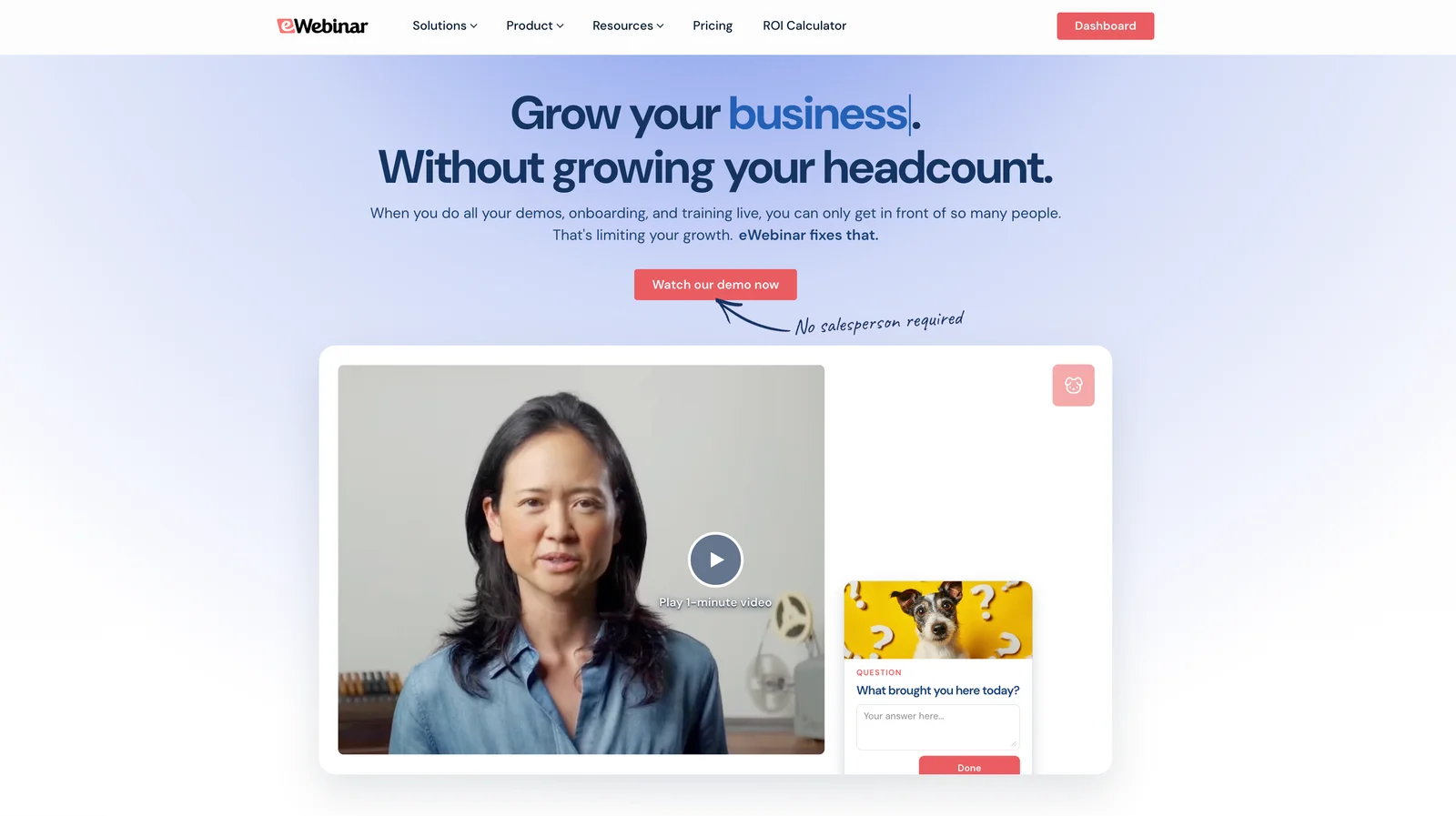
eWebinar is one of the top-rated automated webinar platforms available, with a consistent 4.9-star rating on Capterra and G2 since its debut 6 years ago.
Users love eWebinar because:
- Our platform packs a lot under the hood, but it's still user-friendly enough for anyone to produce professional webinars.
- It’s available worldwide and supports time zone adjustments during scheduling, so you'll reach audiences regardless of their location.
- Our solution saves teams serious time, and not just by freeing up the hours they'd spend hosting repeat webinars. It also lets teams run webinars 24/7 across all time zones. Between recurring schedules and on-demand viewing, you can serve hundreds of sessions in a single day. That's not possible when you have to host every event live.
- Our automated tools create consistency for everybody engaging with your brand. Every attendee gets the same high-quality content and interacts with the same polls, quizzes, and calls to action. That eliminates concerns about host slip-ups and takes the pressure off the people who'd otherwise be presenting live every week.
- It improves attendance rates and engagement because attendees can join at a time that works for them, when they can fully focus on the content.
Automation also improves conversation quality. Attendees join when their interest is highest, and hosts pre-program interaction features before the eWebinars start. Freed from managing logistics, hosts can focus on thoughtful conversations with attendees through chat.
We work with sales, customer success, marketing teams, and L&D teams across SaaS, real estate, financial services, education, and more. Our pricing is built for teams of all sizes.
Below, we'll walk through our platform's features and show how easy it is to create eWebinars. At the end, there's a mini-demo and a link to the full walkthrough, so you can experience what it’s like to hop into an on-demand session at your convenience.
Key features
- Chat (real-time and async): Reply to attendees in real-time during sessions or by email afterward. No message goes unanswered
- 25+ interactive elements: Place polls, quizzes, CTAs, special offers, and qualifying questions at exact moments in your recording
- Three scheduling modes: Set availability to on-demand, recurring, and just-in-time sessions all at once, so attendees always have a way to watch
- Custom branding: Upload your logo, set your brand colors and fonts, and host webinars on your own domain
- Per-attendee analytics: See who watched, how long they stayed, what they answered, and where they dropped off
- Automated notifications: Send registration confirmations, pre-session reminders, and post-session follow-ups without any manual work
- Multi-session trainings: Build structured training programs from multiple webinars, with progress tracking to keep people moving through
Our tools to create and run automated webinars
You don't need to be a video editing pro to create great webinars in our system.
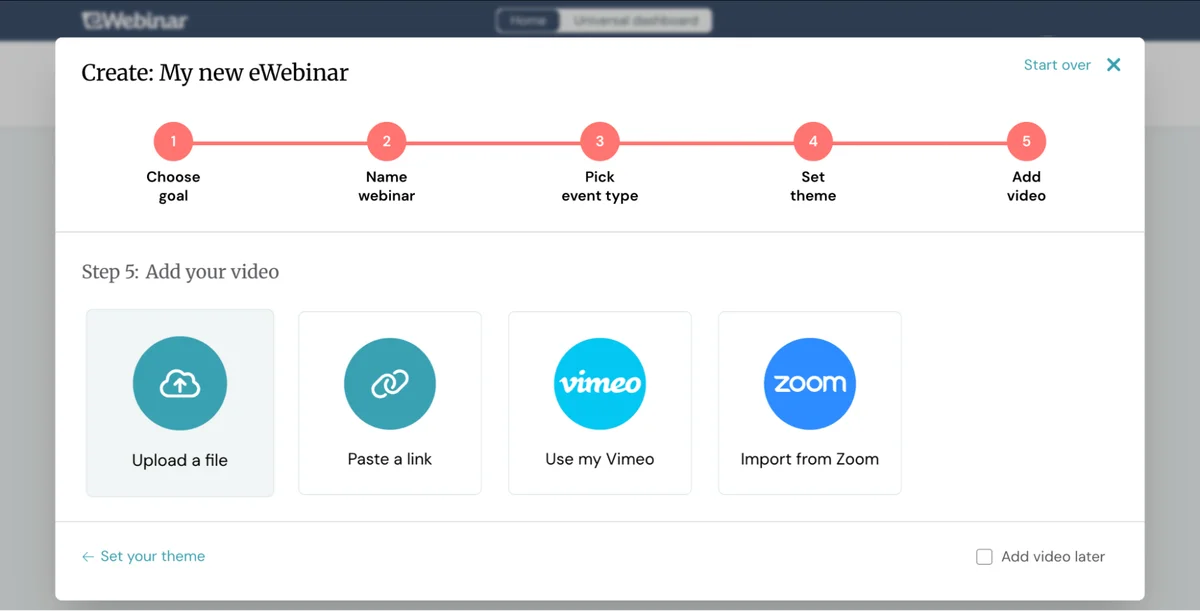
1. Upload the recording you want to use for your webinar
We've got a range of options for adding video content:
- Upload files from your device
- Import recordings from Zoom or Vimeo
- Pull video projects in from Descript's editing tool
When you upload a recording, the system will prompt you to:
- Choose the goal of your eWebinar project (meeting request, trial sign-up, or purchase)
- Name your eWebinar
- Select the event type, if it's a one-time event, recurring, only available on specific dates, or on-demand only
- Set your theme (from branding elements, below)
- And finally, upload or import your video
Read more: What Best Practices Should I Follow to Record High-Quality Videos for an Automated Webinar?
2. Add your company's branding elements
You'll only do this during the initial setup. Afterward, these branding elements appear across eWebinars, registration pages, landing pages, and notifications.
Our platform lets you upload your brand logo and specify your brand's colors, font, font size, and button style. You can even host webinars on your domain, so attendees see a fully branded page.
3. Schedule your eWebinar
eWebinar's scheduling system is built to make attending your eWebinar as convenient as possible:
- On-demand availability. Attendees can join a session instantly, at their moment of peak interest, rather than waiting days or weeks for a scheduled time.
- Recurring schedules. Running automated webinars on a recurring schedule lets you capture registrants who can't watch right away. The schedule adapts to each attendee's local time zone.
- eWebinar replays. People can register for replays directly, rather than no-showing just to get a replay link. They'll still be able to message you through chat if they have questions.
eWebinar lets you enable all three scheduling options at once (on-demand, recurring, and replays). That way, people always have a way to attend your webinars.
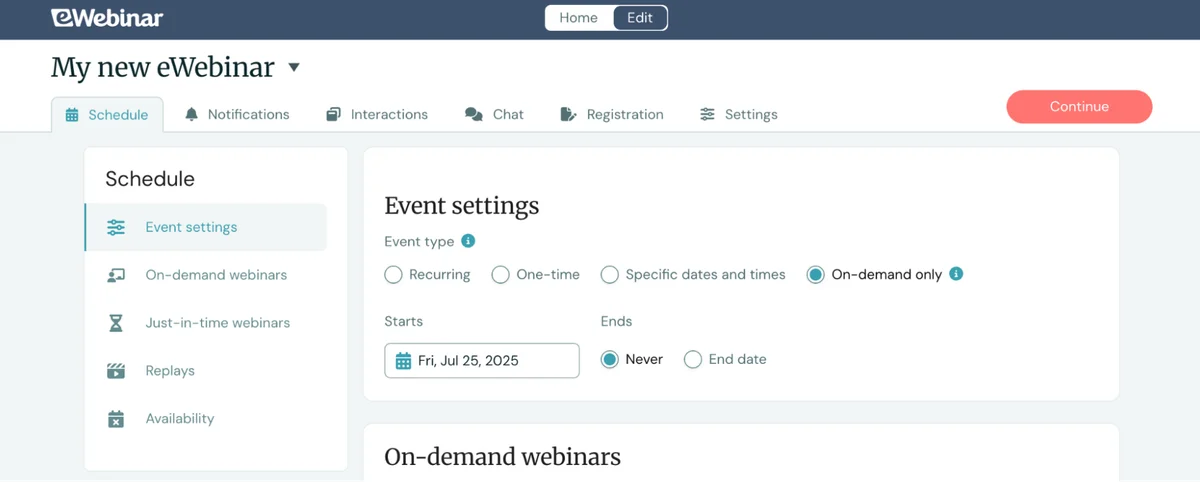
That flexibility translates to strong attendance: the average attendance rate on on-demand eWebinars is 83%, with many customers reporting above 90%. That’s well above the 40% industry average for live webinars.
4. Insert interactive elements throughout the eWebinar
Our timeline editor lets you select the exact second you want an interaction to appear and insert it into the presentation. You can also add subtitles from video transcriptions for viewers watching without sound.
As we've mentioned, our system features the most extensive gallery of interactions (over 25!) to encourage engagement and longer watch times. These include polls, quizzes, questions, links, special offers, agenda items, contact forms, testimonials, feedback requests, private messages, and more.
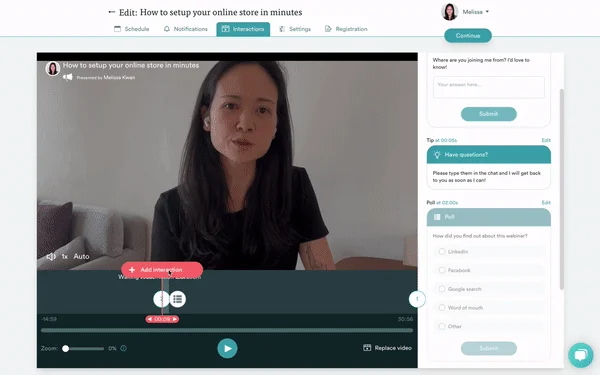
Of course, our chat feature is available by default across all webinars. We'll cover this more in the next section.
5. Manage eWebinars as they run, without having to moderate chat in every session live
Attendees can join your eWebinars instantly via on-demand viewing or select a scheduled session. Our system sends automated registration confirmations, reminders before webinars, and follow-ups after. There's no manual work involved.
Once attendees join, eWebinar's interactive tools and chat make sure every person gets personalized attention. No message goes unanswered, whether your team is responding in real time or sleeping.
Every attendee gets an automated welcome message with their name and details, so it feels like a one-on-one session. Then, they can keep conversations going with hosts via chat. (If no one's available to reply, the auto-response will set expectations.)
On the moderator side, eWebinar provides:
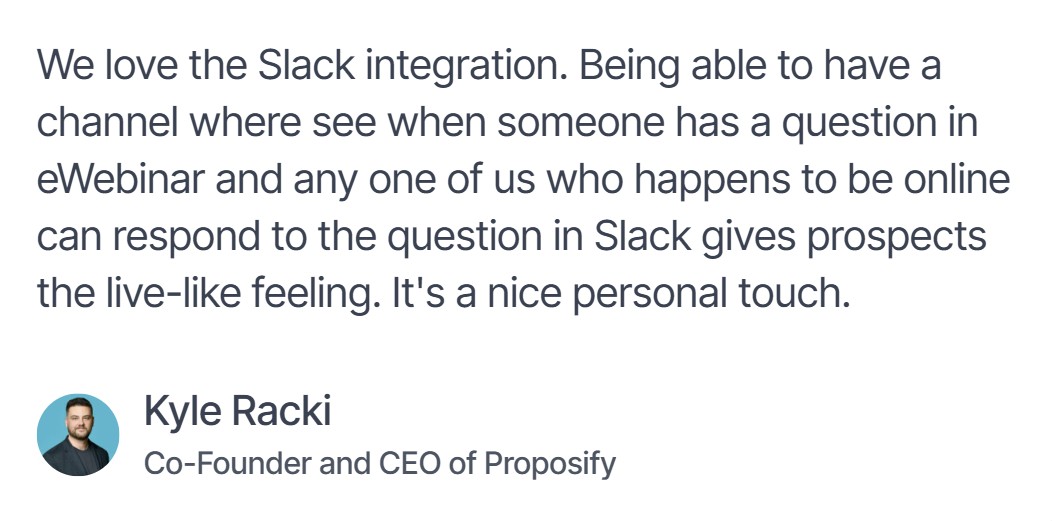
- Instant message notifications. Whenever attendees send a message in the chat, any assigned moderators are notified via email, browser notifications, or Slack alerts (if the integration is active).
- Chat plus email responses. Hosts can respond in real-time through chat or by email after the session ends. We also integrate with Slack, so chats show up right in the tool your team already uses.
We’re the only automated webinar platform with asynchronous chat. Hosts can reply in real-time or get back to attendees later. Describing what he loves most about the eWebinar platform, Kyle Racki at Proposify told us, “Anyone on the team can respond from Slack, so to the viewer it looks like someone’s there live.”
eWebinar analytics dashboards
We provide detailed breakdowns of each eWebinar’s performance. You can view attendance and engagement metrics on a session-by-session and overall basis.
You can see watch times, completion rates, conversions per session, and engagement heatmaps. That makes it easy to spot what content resonates and what isn’t working.
There's also a built-in counter that shows how many hours of eWebinars were delivered without you. It automatically tallies every session your eWebinars have run. You can see exactly how many hours your team would have spent hosting those sessions live.
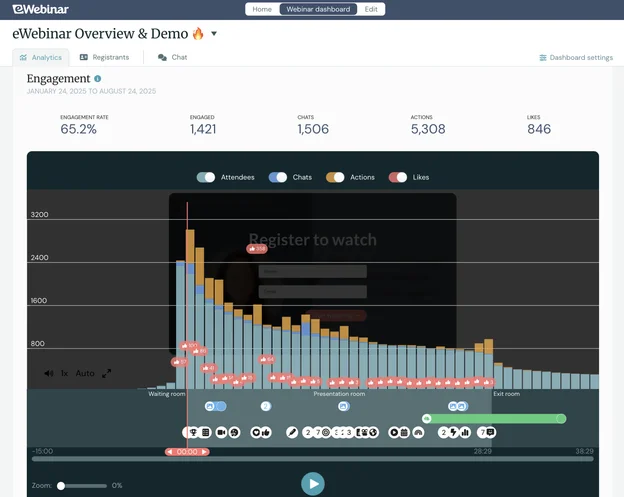
Our Universal Dashboard aggregates performance data across all (or any combination) of your webinars so you can spot trends and success patterns.
eWebinar mini demo
You'll see all of this in action in our one-minute demo below.
You can also watch our full demo here. It's a great way to see the platform from an attendee's perspective.
eWebinar packages and pricing
Our packages are based on how many webinars you're running and how many attendees you've got:
- Level 1 ($99/month) supports one active webinar and 1,000 registrants per month
- Level 2 ($199/month) supports five active webinars and 3,000 registrants per month
- Level 3 ($299/month) supports 15 active webinars and 5,000 registrants per month
If you need more registrants at any level, you can add them in increments of 1,000 for $49/month.
Our multi-session trainings feature lets you build structured programs from a group of eWebinars. Each registrant gets a personalized series page that tracks their progress, completion, and even certification.
Rating
Capterra rating: 4.9/5 (68 reviews)
Pros
- Average on-demand attendance of 83% (many customers report 80-90%)
- Two-way chat that works during and after sessions
- All three scheduling modes (on-demand, recurring, and just-in-time) run at the same time
Cons
- No live hosting option for teams that need to present on camera in real-time
- Built specifically for pre-recorded content, so it won't suit teams whose presentations change every session
- The entry-level plan supports only one active webinar
2. Demio
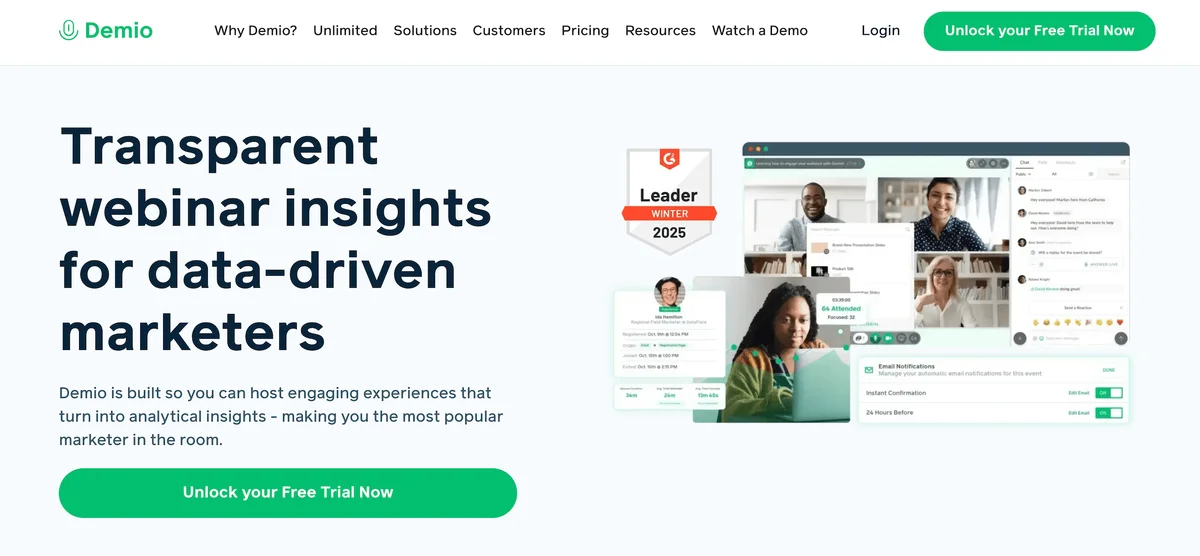
Demio is a modern webinar platform with tools to deliver both live and automated webinars. Demio started with a focus on live, high-engagement sessions, but it's now shifted priorities to offer strong tools for automated webinars too.
Reviews consistently praise Demio's ease of use, straightforward event creation, and reliable performance. Engagement features like polls, interactive offers, and personalized reminders also get high marks.
It works nicely for recurring training, evergreen sales pitches, and onboarding, freeing up time that'd otherwise go to repeat presentations. And with its intuitive setup, it's accessible even for teams that haven't run webinars before.
That said, there are some drawbacks we've noticed with Demio:
- High pricing, as pricing climbs sharply as attendee room capacity increases.
- The scheduling tools aren't super flexible; you can have recurring or on-demand but not both, and there's no way to sign up for replays.
- Chat is only active while webinars run, so hosts can't check messages or respond to attendees after webinars end. They have to sit in each session and respond in real-time. You don’t truly step away from the repetitive hosting that automation is supposed to solve.
- Limited customization tools; for example, full white-labeling is only available in the top-tier premium plan.
- Lacking analytics depth. Demio shows attention scores, poll responses, and drop-off points, but there aren't detailed heatmaps or segment-based data.
For these reasons, Demio is best suited for smaller or mid-sized teams that want to run repeat webinars more easily. It's less ideal for teams focused on scaling content production or accommodating large audiences.
Features
- Live, automated, and on-demand webinars
- Replays and recordings
- Customization options and branding tools
- Interactions: chat (public/private), Q&A, polls, offers, links, CTAs, and attendee participation with mics and cameras
- Scheduling tools (single or recurring events, time zone adjustments)
- Marketing tools like automated email reminders
- Analytics dashboards
- Integrations with marketing and CRM software
- Mobile apps (for iOS and Android)
Pricing
Demio offers a 14-day free trial and three packages (differentiated mainly by attendee room capacities):
- The Starter plan ($63/month) supports a single host and 50 attendees. This plan is recommended for small businesses and solo entrepreneurs.
- The Growth plan supports multiple hosts and up to 3,000 attendees. Packages range from $117 to $855 per host per month. This is the most popular package.
- The Premium plan also supports multiple hosts and up to 3,000 attendees, and comes with dedicated account support. Demio doesn't reveal all pricing info here, but we can see this plan starts at $196 per host per month.
Read more: Best Demio Alternatives
Rating
G2 rating: 4.6/5
Capterra rating: 4.7/5
Pros
- Clean, browser-based interface that simplifies setup for first-time users
- Strong attendee engagement tools including polls, interactive offers, and personalized reminders
- 14-day free trial; test the full platform before committing to a paid plan
Cons
- Chat is only active while the webinar is running; no responses after the session ends
- Pricing scales sharply as you increase attendee room capacity
- Smaller teams on lower plans get limited control over their branding
3. EasyWebinar
EasyWebinar is another leader in the automated webinar space. The platform has long catered to creators who want smooth, high-quality live sessions, but its standout features are built around automation. You can pre-record webinars and schedule them for every attendee. It's a popular pick for marketers, coaches, and sales teams that want to drive business through webinars without presenting live every time.
EasyWebinar offers just-in-time and on-demand events to capture viewers at their moment of interest, plus smart time zone scheduling and engagement tools. Like Zoom, it also offers automated/live hybrid hosting options.
EasyWebinar's fairly straightforward to learn, and customer support is a consistent highlight in reviews. Questions and issues tend to get resolved quickly.
However, EasyWebinar shares some of the same drawbacks as Demio, including limited customization and high pricing. Its integrations with tools like HubSpot can also be tricky to set up or missing entirely. These gaps hit hardest when you're trying to scale your webinar efforts.
See more EasyWebinar reviews here
Features
- Live, automated, and on-demand webinar hosting
- EasyCast streaming (to broadcast your webinar simultaneously on platforms like YouTube Live and Facebook Live)
- Automatic replays and session recordings
- Branding customization options
- Engagement tools: public/private chat, emoji reactions, Q&A, polls, special offers, CTAs, "Buy Now" buttons, and attendee mic/camera controls
- Breakout rooms for smaller group discussions within webinars
- Contact box for automated webinars, allowing attendees to leave messages
- Scheduling tools, including one-time, recurring, just-in-time or on-demand webinars, plus automatic time zone adjustment
- Marketing automation features like scheduled email reminders and customizable follow-up sequences
- Comprehensive analytics dashboards
- Integrations with CRM, marketing software, LMS, and more
- Mobile-friendly attendee page
Pricing
EasyWebinar offers four plans in total, but only three of these plans include automated webinar features. Pricing varies by feature, number of supported webinars, and attendee capacities.
- The Automated Webinars plan supports 200 to 10,000 attendees and costs between $59 and $399 per month.
- The Automated + Live plan supports between 50 and 2,000 live webinars and 200 to 10,000 automated webinars. It starts at $79 per month, and EasyWebinar provides custom quotes as you move into upgraded plans.
- The Enterprise plan supports up to 500,000 attendees and includes SSO, GDPR compliance tools, full white labeling, and large-scale event support. EasyWebinar provides custom quotes for this tier.
The Live Webinar plan costs between $39 and $299 per month.
Read more: Best EasyWebinar Alternatives
Also see EasyWebinar vs Demio vs eWebinar Comparison Guide
Rating
G2 rating: 4.4/5 (92 reviews)
Pros
- Just-in-time and on-demand scheduling options capture viewers while their interest is highest
- EasyCast lets you extend reach to YouTube Live and Facebook Live
- Customer support is reportedly responsive with fast resolution
Cons
- Some third-party integrations like ActiveCampaign can be tricky to set up
- Customization options are limited compared to others’, especially on lower-tier plans
- Pricing adds up as you scale; the jump between tiers is steep
4. WebinarGeek
WebinarGeek is a flexible webinar platform to help businesses host engaging webinars in live, automated, or hybrid formats. It stands out amongst competitors for:
- Ease of use. It's very easy to build and schedule automated webinars without extensive training on the platform.
- Customization tools. The platform offers comprehensive branding controls, including custom domains, real-time page editors, and custom CSS, enabling a more professional and on-brand presentation.
- Extensive integrations. It plugs into thousands of business tools to work with your existing tech stack and tie webinars into other workflows.
- New AI-powered functionality. The tool can help optimize scheduling, pull performance insights, and automate admin tasks.
- Fast, personal, accessible customer support. You can easily get assistance via chat or phone if you encounter issues while setting up or adjusting the platform.
WebinarGeek is intuitive, and most teams can build professional webinars in a few hours. But its engagement tools are limited to standard polls, quizzes, and chat, without much beyond that.
Overall, WebinarGeek is a strong fit for teams new to webinars that want a user-friendly option and responsive support. It also stands out for:
- Teams serving smaller audiences.
- Teams focused on saving time by hosting repeat automated sessions, rather than scaling large webinar programs.
- Teams that want to run paid webinars, as WebinarGeek integrates with Stripe and Mollie to monetize webinars.
Check out more WebinarGeek reviews here.
Features
- Live, automated, on-demand, and hybrid webinar hosting
- Paid webinars
- HD video streaming (browser-based, no downloads needed)
- Automated replays and session recordings
- Custom branding tools and webinar channels (custom pages listing upcoming and on-demand webinars)
- Extensive customization options, including real-time page editor, custom domains, and custom CSS
- Engagement features, including chat, Q&A, polls, quizzes, CTAs
- Scheduling options and time zone adjustments
- Marketing automation tools like automated and customizable email reminders
- Analytics dashboards
- Integrations with 6,000+ outside tools, including CRM, marketing, and workflow apps
- GDPR-compliant data processing and attendee privacy
- Mobile-friendly pages
Pricing
WebinarGeek offers three plans based on features and attendee capacity. Prices are listed in euros by default, though the site also lets you view pricing in USD, GBP, and other currencies.
- The Basic plan (€49/month) supports live and on-demand webinars, as well as 50 viewers.
- The Premium plan (€69/month and up) includes everything in the Basic plan, plus automated webinars, interactions, and custom branding.
- The Enterprise plan unlocks full feature access and supports up to 5,000 attendees. Plans start at €349/month and require custom quotes as you upgrade.
Rating
G2 rating: 4.5/5 (446 reviews)
Pros
- Very user-friendly; many users can build professional webinars in under a few hours without formal training
- Connects to 6,000+ tools through native integrations and Zapier
- Built-in payment processing through Stripe and Mollie; monetize paid webinars directly on the platform
Cons
- Interaction tools are limited, compared to eWebinar
- Automated webinar features are only available on the Premium plan and above
- Pricing is listed in euros by default, which can stall budgeting for US-based teams
5. GoTo Webinar
Next on our list is GoTo Webinar. GoTo offers a wide range of business applications, including communications, customer service, and IT management. Their webinar solution is one of the better-known parts of that suite, and it's been around for a long time.
The GoTo brand typically appeals to enterprises already invested in the fuller software ecosystem. It's also a top enterprise choice because of its security features, including SSO, GDPR compliance, and encrypted video streams.
You'd expect GoTo's automated webinar tools to match its broader suite. However, compared to platforms like eWebinar, they fall somewhat short.
GoTo Webinar makes it easy to create webinars from pre-recorded content, and its flexible scheduling lets you reach viewers across all time zones.
However, interactions are fairly standard (chat, emoji reactions, polls, Q&A, and handouts), and it caps room capacity at 3,000 viewers even on the top-tier plan.
GoTo Webinar is typically best for large organizations that want to automate employee training, streamline sales demos, or simplify customer onboarding. But it isn't the strongest pick if you're looking for deep interactivity, because its engagement tools don't go far beyond the basics.
Read more GoTo Webinar reviews here.
Features
- Live, automated, on-demand, and hybrid webinar hosting
- Unlimited cloud recordings and automatic replays
- GoToStage for post-event on-demand webinar hosting
- Custom branding and registration page customization
- Engagement tools, including chat, public/private Q&A, polls, handouts, automatic surveys, and attendee participation (raise hand, emoji reactions)
- Breakout rooms
- Multi-presenter support (up to 6 presenters/video feeds)
- Scheduling, including one-time events, recurring series, and on-demand webinars
- Analytics dashboards
- Source tracking links for campaign attribution
- Integrations with CRM, marketing, and workflow tools (including Salesforce, HubSpot, Marketo)
- Strong security, including end-to-end encryption, GDPR compliance, SSO options
- Mobile apps for iOS and Android (hosting and participation)
Pricing
GoTo Webinar offers four plans based on webinar room capacities:
- The Lite plan ($59 per organizer per month) supports up to 250 participants.
- The Standard plan ($129 per organizer per month) supports up to 500 participants.
- The Pro plan ($249 per organizer per month) supports up to 1,000 participants.
- The Enterprise plan ($499 per organizer per month) supports up to 3,000 participants.
GoTo's Standard, Pro, and Enterprise plans all include GoTo Meeting as a free add-on. That's worth noting if you also need a video conferencing tool for internal meetings.
Rating
G2 rating: 4.2/5 (795 reviews)
Pros
- Part of the GoTo ecosystem, so it connects directly with any GoTo products your team already uses
- Security features for regulated industries including SSO, GDPR compliance, and strong encryption
- Flexible scheduling options plus GoToStage for hosting on-demand webinar recordings
Cons
- Interaction tools are basic; no options for live quizzes, timed CTAs, or qualifying questions
- Top-tier plan caps at 3,000 attendees, which may limit large-scale virtual events
- Per-organizer pricing adds up for teams with multiple presenters
6. Livestorm
Livestorm is a multi-purpose solution for webinars (both live and automated) and video meetings. The platform has a modern, polished look, and it's easy enough for beginners to pick up and host professional webinars quickly. Small teams new to webinar production tend to gravitate toward it, but mid-market companies and enterprises like Sony, Dolby, and Verizon use it too.
Reviews of Livestorm also praise:
- Its customization and branding tools, in particular, customers like the email, registration page, and event room customization features.
- Direct CRM integrations to sync data between Livestorm and Salesforce, HubSpot, and other major systems.
- The straightforward analytics dashboard that helps focus on key metrics and identify areas to improve webinar performance.
However, like GoTo Webinar above, Livestorm's interactive features aren't its strongest suit. It offers chat, polls, and file sharing, but that's about it.
Livestorm positions its automated tools for course delivery, sales demos, and employee/customer training. Because interactions are simpler, it's not the best choice if you're after deeper engagement or advanced interactivity.
Find more Livestorm reviews here.
Features
- Live, automated, on-demand, and hybrid webinar hosting
- Multi-presenter support with video and screen sharing
- Restreaming to multiple social media platforms like YouTube and Facebook
- Custom branding, including registration pages, email templates, and event room customization
- Engagement tools, including chat, polls, Q&A, file sharing, calls-to-action
- Breakout rooms
- Scheduling, including one-time, recurring, just-in-time, and on-demand events
- Automated email sequences, including registration confirmations, reminders, and follow-ups
- Analytics dashboards
- Integrations with CRM, marketing, automation tools, and Zapier
- Security features, including TLS encryption, GDPR-compliance
- Multi-language support and dial-in options for global audiences
Pricing
Livestorm uses a per-attendee credit pricing model. You buy a pool of attendee credits and use them flexibly across your webinars over a 12-month period. One credit is used for each unique participant per session, and team members don't count against your credits.
- The Pro plan costs €2.50 per attendee credit on yearly billing. So 400 attendee credits, for example, would run about €1,000 per year.
- The Enterprise plan requires a custom quote.
Read more: Best Livestorm Alternatives
Rating
G2 rating: 4.4/5 (1,719 reviews)
Pros
- Modern, polished interface; easy for beginner teams to learn
- CRM integrations sync data directly with major platforms without manual exports
- Trusted by well-known enterprise brands including Sony, Dolby, and Verizon
Cons
- The per-attendee credit pricing model can make budgeting harder as your audience grows
- Customization options are reportedly limited for branding and registration page
- Business and Enterprise plans require a custom quote after talking to sales
7. BigMarker
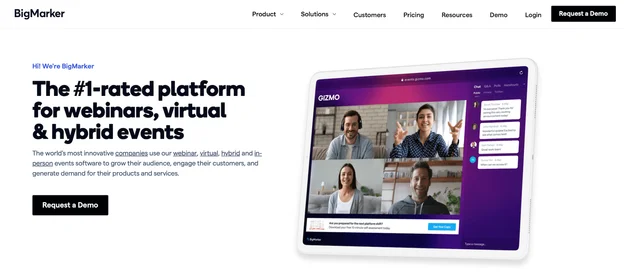
BigMarker is a more advanced solution for webinars, virtual and hybrid events, and online meetings. It's best known for branded webinar setups and large virtual events like multi-day summits, supporting up to 50,000 attendees.
It goes further than starter platforms with marketing automation, detailed analytics, and built-in ticketing and payment processing for paid webinars. It also covers the full event lifecycle, from registration to post-event follow-ups.
BigMarker's webinar solution supports a variety of session types, including live, automated, on-demand, evergreen, breakout sessions, series/multi-session events, and 24/7 live streaming. It also provides convenient multi-presenter tools, allowing teams running large events to have multiple hosts.
Where other platforms fall short on interactivity, BigMarker does well. It offers public/private chat, polls, Q&A, offers, handouts, surveys, and more.
However, the trade-offs are a steep learning curve and high pricing. BigMarker's best suited for mid-size or enterprise organizations that host large virtual events or paid webinars. Smaller businesses are typically priced out early.
BigMarker's automated tools are solid, but they're not meaningfully better than what dedicated platforms offer at a lower price. If your main goal is automating repeatable content rather than running large-scale events, a purpose-built platform will likely serve you better.
Read more BigMarker user reviews here.
Features
- Live, automated, on-demand, and hybrid webinar hosting
- Multi-presenter support with video and screen sharing
- Restreaming to multiple social media platforms like YouTube and Facebook
- Custom branding, including registration pages, email templates, event room customization, and virtual backgrounds
- Engagement tools, including chat, polls, Q&A, offers, handouts, surveys, and file sharing
- Breakout rooms and roundtables
- Scheduling, including one-time, recurring, just-in-time, on-demand
- Automated email sequences, including registration confirmations, reminders, and follow-ups
- Analytics dashboards with detailed reporting on attendance, engagement, and conversion funnels
- Integrations with CRM, marketing, automation tools, Zapier, and API access
- Ticketing and payment processing for paid webinars
- Security features, including SOC 2 Type 2 certification, TLS encryption, GDPR-compliance, role-based permissions
- Multi-language support, dial-in options, and AI-powered networking tools
Pricing
BigMarker offers a variety of plans and packages under the Webcast, Event Packages, and Media Hub umbrellas. All pricing requires a custom quote.
Read more: Best BigMarker Alternatives
Rating
G2 rating: 4.7/5 (447 reviews)
Pros
- Supports massive events (i.e., conferences and multiday summits) with up to 50,000 attendees per session
- Built-in ticketing and payment processing simplifies running paid webinars and virtual events
- Engaging interaction tools including chat, polls, Q&A, offers, handouts, and surveys
Cons
- Steep learning curve for teams that are new to virtual event platforms
- No published prices; get custom quotes after talking to sales
- Occasional technical issues as attendee counts increase during live sessions (i.e., video lag and audio desynchronization)
8. Webex Webinars (by Cisco)
The final entry in our guide, Webex Webinars (formerly Webex Events), is our top enterprise solution.
Webex Webinars is part of Cisco's broader collaboration suite, which includes video conferencing, team messaging, and phone systems. The webinar product is built for hosting large-scale interactive sessions.
Like GoTo, Webex Webinars is a natural fit for teams already in the Cisco ecosystem. It connects automatically with other Webex products, so you can use them together.
Webex Webinars supports live, automated, on-demand, and hybrid sessions, with recording and automatic replays. Event sizes range from small groups to 100,000 attendees. Engagement tools include chat, emoji reactions, hand raising, polls, Q&A, and event games.
Webex Webinars is built for teams running virtual events at massive scale, whether live, automated, or hybrid. It includes multi-presenter tools, translated captions, and AI-powered notes and summaries after events.
Some (perhaps obvious) concerns are the high pricing and complex setup. Small businesses or teams new to webinar software may find it's unaffordable or too difficult to learn.
And if your primary goal is to automate webinars, Webex isn't the most cost-effective route. It offers solid automation tools, but they're not particularly differentiated compared to specialized platforms like eWebinar.
Check out more Webex Webinar reviews here.
Features
- Live, automated, on-demand, simulive, and hybrid webinar hosting
- Multi-presenter support with video and screen sharing
- Restreaming to social media platforms and RTMP destinations
- Custom branding, including registration pages, email templates, event room customization, and virtual backgrounds
- Engagement tools, including chat, live polling (native and Slido), Q&A, hand raising, emoji reactions, event games, and gesture recognition
- Breakout rooms
- Scheduling, including one-time, recurring, just-in-time, and on-demand events
- Automated email sequences, including registration confirmations, reminders, and follow-ups
- Analytics dashboards
- Integrations with CRM, marketing, and workflow tools (Salesforce, Eloqua, Webex Meetings)
- Security features, including FedRAMP, SOC 2 Type II, TLS encryption, GDPR compliance, HIPAA/BAA, and role-based access controls
- Multi-language support, real-time translation, closed captioning, screen reader, high contrast modes, and dial-in options
- Webex Assistant, including AI-powered transcription, notes, and highlights for post-event workflows
- Webcast mode for large-scale broadcast-style events
- (Some) advanced production controls, including practice sessions, speaker pages, custom stage layouts
Pricing
Webex offers two packages here, Webex Webinars and Webex Events. For automated webinar capabilities, choose Webex Webinars (Events is for in-person, virtual/live, or hybrid events).
From there, pricing is by attendee capacity. The entry-level tier supports up to 1,000 attendees, but you can upgrade if you need support for over 10,000.
Webex no longer publicly lists pricing for Webex Webinars on their website. You'll need to contact their sales team for a quote, and it's worth asking about any active promotions.
Rating
G2 rating: 4.6/5 (1,078 reviews)
Pros
- One of the largest-capacity webinar platforms available; supports up to 100,000 attendees
- AI-powered tools including real-time transcription and post-event summaries cut down post-production work
- Enterprise-grade security (FedRAMP, SOC 2 Type II, HIPAA/BAA) and strict regulatory compliance
Cons
- Complex setup and steep learning curve compared to purpose-built webinar platforms
- Pricing requires a sales call; no way to estimate costs upfront
- Automation features aren’t differentiated from lower-priced, dedicated automated webinar platforms
Selection Criteria
How We Evaluated Each Zoom Alternative
We compared these eight Zoom Webinar alternatives across the factors that matter most when you’re moving away from Zoom. The criteria we weighed most heavily were automation depth, engagement tools, chat functionality, scheduling flexibility, and value for money.
For each platform, we asked: can you set it and let it run? Or, does someone still need to host the session?
We also looked at ease of setup, CRM integrations, analytics, branding options, and attendee capacity limits. We pulled pricing directly from each vendor's site, and ratings reflect the latest G2 and Capterra scores at the time of writing.
How to Choose Based on What You Need
The right Zoom alternative depends on what you’re actually trying to do. Ask yourself a few questions before you start comparing features.
If your team runs the same demo, onboarding session, or training every week, eWebinar is built for that. You record the best version once, add timed interactions, and let it run on demand with two-way chat.
If you run a mix of live and automated sessions and want a 2-in-1 tool, Demio and EasyWebinar are both worth a look. Demio is cleaner and easier to learn, while EasyWebinar offers more flexibility for marketing funnels and streaming to YouTube or Facebook. That said, we'd recommend picking the best tool for each job. Live and automated prioritize different things, which makes them different products, and it's like asking for a bike that's also a motorbike. Whichever one takes the back seat is the one that suffers.
Teams that already use GoTo tools will find that GoTo Webinar is the path of least resistance, especially for organisations that need strong security.
If your main need is large-scale virtual events or paid webinars, BigMarker or Webex are better fits. BigMarker is geared toward summits and multi-day conferences, while Webex is the choice for regulated industries that need strong FedRAMP, SOC 2, or HIPAA compliance.
Finally, if you’re a smaller team just getting started with webinars, WebinarGeek or Livestorm are both approachable options with clean interfaces and good support. Livestorm also offers a free plan with a shorter duration and fewer attendees.
FAQs
Can you run automated webinars on Zoom?
Zoom’s Simulive feature lets you schedule pre-recorded content to broadcast at a set time, but it’s not truly automated. Attendees can’t watch on demand, and engagement tools only work during the broadcast. A dedicated automated webinar platform offers on-demand scheduling, timed interactions, and async chat that Zoom doesn’t.
What is the difference between Zoom Meetings and Zoom Webinars?
Zoom Meetings is built for two-way conversations between small groups, where everyone can share their camera and mic. Zoom Webinars is built for one-to-many presentations, where one or more presenters broadcast to a large, view-only audience. Webinars include registration, attendee tracking, and Q&A tools that Meetings doesn’t have, but they’re also a paid add-on, not part of the standard Zoom plan.
Is there a free Zoom webinar alternative?
eWebinar and Demio offer a 14-day free trial. For full automated webinar capabilities, most platforms require a paid plan. Demio starts at $63/month, and eWebinar starts at $99/month, both affordable entry points for teams that need automation beyond Zoom.
Do automated webinars get lower engagement than live?
Not when the automation is done well. eWebinar’s platform-wide average attendance is 83%, well above the 40% live industry average. Attendees join when it actually suits them. Timed polls, quizzes, and chat keep engagement high even without a live presenter. Kyle Racki at Proposify told us, “It’s the perfect blend of both. You feel like it's live, but it's also on demand. It’s whenever the user wants to attend it.”
Can I use my existing Zoom recordings in another webinar platform?
Yes, most automated webinar platforms let you import Zoom recordings directly. eWebinar, Demio, and EasyWebinar all support uploading recorded video files. You can take an existing Zoom recording and turn it into an automated, interactive webinar with built-in scheduling and engagement tools.
Why Automated Webinars are Worth the Switch from Live
Switching from live to automated webinars isn't just about saving time. There's a whole list of benefits.
- You'll reach a global audience across different time zones, including viewers you couldn't reach during standard operating hours.
- You can scale operations and generate more leads, sales, and revenue without needing an army of hosts or extra spend.
- You'll create a more engaging setup than hosting live. Attendees join when their interest is highest, and hosts can pre-program interactions without the stress of presenting.
- Maintain a consistent, professional, polished presentation across every webinar and session you run.
- You'll save substantial time by recording content once and setting it to run on a recurring or on-demand schedule.
And the simple truth is that if the presentation feels live, attendees treat it that way. They care about getting the information they need, not whether it's pre-recorded. With eWebinar, they still get polls, questions, real chat responses, all the interactivity of a live webinar, plus the flexibility to watch whenever works for them.
Christian Wyrwich at SuperOffice told us, “Many people don’t realize our webinars are pre-recorded because the format is so interactive and personal."
Watch our free demo to see how eWebinar saves time and helps you deliver content to global audiences around the clock.
Zoom Webinar Alternatives for Hosting Live Events
Some teams need better automation to stop repeating the same webinars live. Others are looking for Zoom alternatives for live webinars that:
- Provide advanced production capabilities and customization tools for creating premium, studio-quality digital setups.
- Alternatively, are simpler and budget-friendly for occasional video conferencing with small audiences.
For high-production virtual events, consider ON24, RingCentral Events (formerly Hopin Events), and Adobe Connect Webinars. For budget-friendly, familiar alternatives for infrequent video calls and webinars, look at ClickMeeting, Microsoft Teams Virtual Town Halls, and Zoho Meeting.
Zoho Meeting even has a forever-free plan for teams who need the bare essentials.
Curious to see how eWebinar can help run your demos, onboarding, and training sessions on autopilot?
Watch a one-minute explainer video for a quick overview of the eWebinar platform. Or, better yet, join our on-demand demo to learn more!