Quick Summary
Thirteen client and customer onboarding tools compared across complexity, approach, and price point. The right choice depends on whether your product needs in-app guidance, webinar-based onboarding, or a structured project management layer between your team and the client.
Our top three picks:
| # | Platform | Best For |
| 1 | eWebinar | Scaling high-touch training |
| 2 | Appcues | Mid-market SaaS |
| 3 | Rocketlane | Professional services/B2B |
When In-App Onboarding Isn’t Enough
Most customer onboarding software focuses on what happens after a customer logs in. Tooltips, product tours, checklists. That works fine for simple products where the value is obvious the moment someone opens the app.
For complex products like CRMs or supply chain platforms, in-app guidance alone rarely drives full adoption. Customers don't know what they don't know. They click through tooltips without absorbing them, abandon the product within a week, and your CS team ends up explaining the same things on the same calls every day.
Real onboarding for a complex product happens before the customer ever touches the interface. They need to understand what the product does, why it works the way it does, and what the journey looks like. That's the context that makes every tooltip useful when they finally see it.
The 13 platforms in this guide were evaluated on how well they handle that work, not just the in-app layer.
Picking the platform is step one. Once your software is in place, check out these five practical ways to onboard new customers faster.
Why Listen to Us?
We built eWebinar after watching customer success teams hit the same wall: live onboarding sessions, however effective, collapses under their own weight. The calendar fills up, time zones create gaps, and the same content gets delivered live for the tenth time to a fraction of the audience.
We run our own onboarding through eWebinar. Every customer who joins us starts in the same on-demand session our prospects watch. Our experience, and six years of watching what works and what doesn't, is what shaped every pick on this list.
Our Top 13 Customer Onboarding Software: 2026 Comparison Table
| # | Tool | Best For | Onboarding Style | Setup Complexity | Starting Price |
| 1 | Appcues | Mid-market SaaS | In-App | Medium | $249/mo |
| 2 | Rocketlane | Professional Services/B2B | Project-Based | High | $19/user/mo |
| 3 | Pendo | Enterprise Data & Analytics | In-App | High | Custom |
| 4 | eWebinar | Scaling high-touch training | Video-Led | Low | From $99/mo |
| 5 | Arrows | HubSpot-native teams | Project-Based | Low | $500/mo |
| 6 | Userpilot | Growth-stage Product teams | In-App | Medium | $249/mo |
| 7 | WalkMe | Large Enterprise/Legacy IT | In-App | Very High | Custom |
| 8 | Userflow | Fast-moving startups | In-App | Low | $200/mo |
| 9 | UserGuiding | Budget-friendly self-serve | In-App | Low | $89/mo |
| 10 | Chameleon | Highly customized UI/UX | In-App | Medium | $279/mo |
| 11 | Whatfix | Employee/Internal training | In-App | High | Custom |
| 12 | Userlane | Enterprise Digital Adoption | In-App | Medium | Custom |
| 13 | Stonly | Self-serve support and ticket deflection | In-App | Low | $49/mo |
1. Appcues
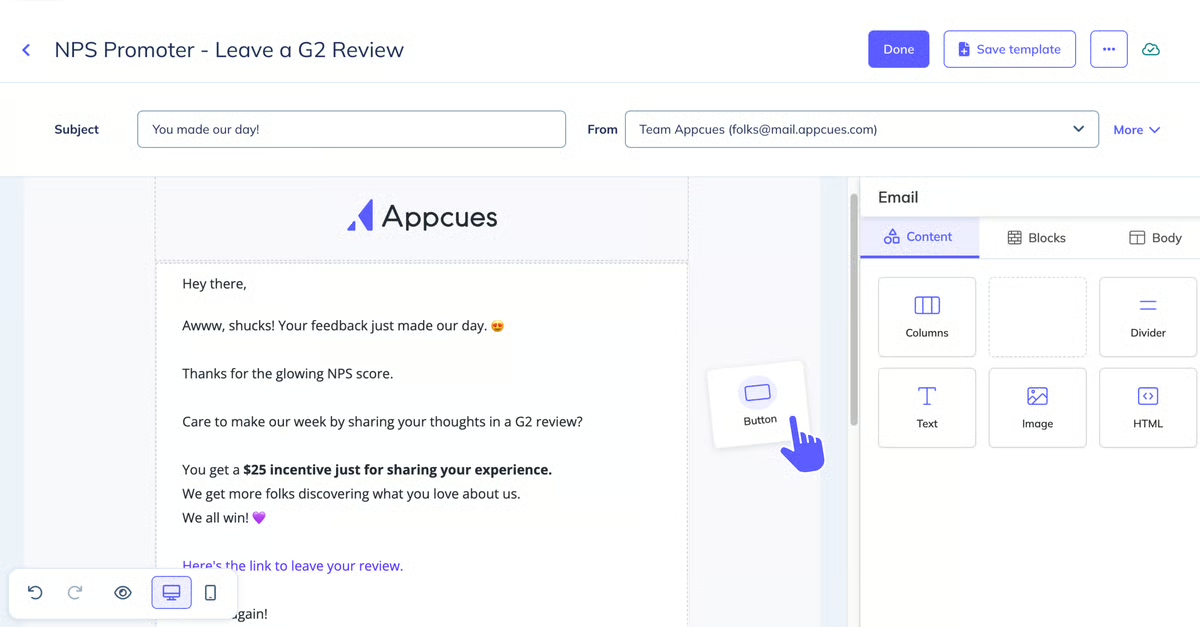
Appcues is a product adoption platform for both mobile and web-based applications. The drag-and-drop Chrome extension builder is easy to use, allowing for steps like modals, slideouts, tooltips, or hotspots. Custom themes ensure brand consistency across flows regardless of who built them.
Mobile onboarding is supported without code, and integrations with Amplitude, Mixpanel, and Heap sync customer data across platforms.
Key Features:
- No-code Chrome extension builder with drag-and-drop editor
- Modal, slideout, tooltip, and hotspot step types
- Mobile app onboarding without coding
- Events Explorer for tagging and tracking UI engagement without code
- Integrations with Amplitude, Mixpanel, Heap, and Google Analytics
Pros:
- Strong no-code builder, easy for non-technical teams
- Solid mobile onboarding support with QR code preview
- Deep analytics integrations, including Amplitude, Mixpanel, Heap
Cons:
- Checklists and NPS surveys require Appcues Studio, not the Chrome extension, causing workflow friction
- Pricing scales steeply with MAUs
Capterra Rating
⭐ 4.9
Pricing:
Essentials from $249/month (2,500 MAUs, billed annually)
2. Rocketlane
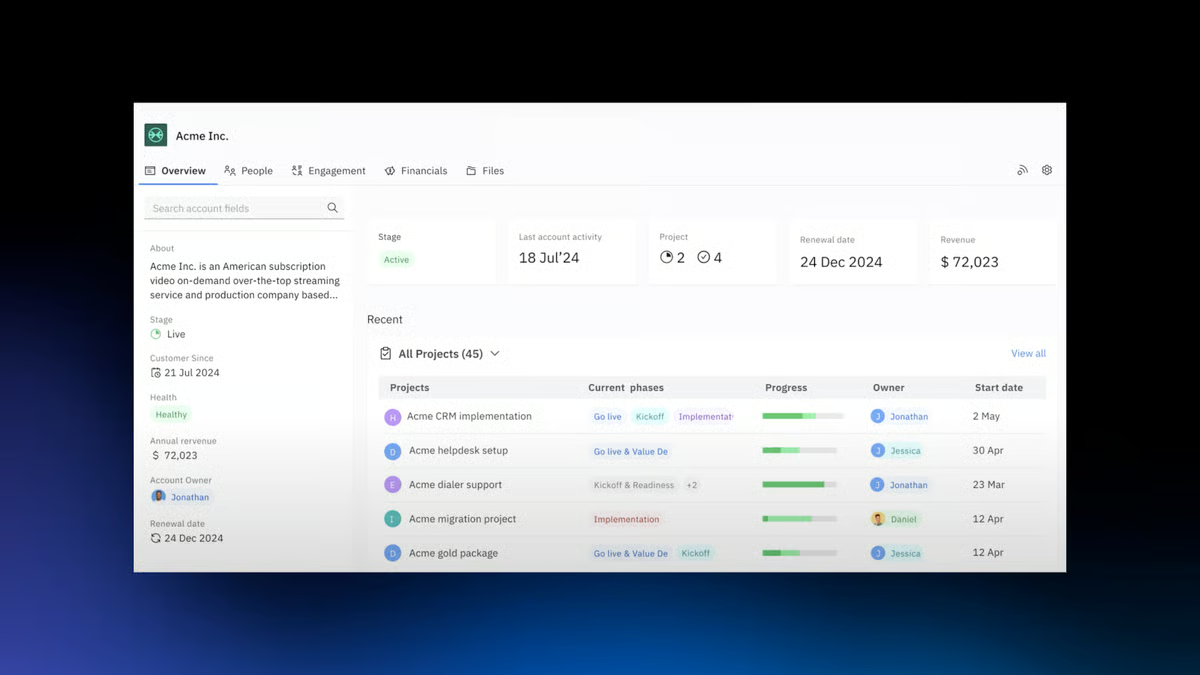
Rocketlane is a client onboarding and project management platform built specifically for B2B companies running structured, collaborative onboarding with their customers.
Rocketlane focuses on the project coordination layer. It provides a shared workspace where both teams and clients manage tasks, milestones, and timelines together.
Key Features:
- Shared customer portal giving clients real-time visibility into onboarding progress
- Project templates for standardizing onboarding workflows
- Status pages and embedded documents
- Integrations with Salesforce and HubSpot
- Milestone and task tracking across internal and external stakeholders
Pros:
- Purpose-built for collaborative client onboarding rather than not adapted internal project management
- Shared customer portal reduces back-and-forth on progress and next steps
- Strong CRM integrations, including Salesforce and HubSpot
Cons:
- Project management focus. It won’t replace in-app guidance tools like Appcues or WalkMe
- Best suited for structured, multi-stakeholder onboarding. Overkill for simpler products
G2 Rating
⭐ 4.7
Pricing:
Essentials from $19/user/month | Professional and Enterprise custom
3. Pendo
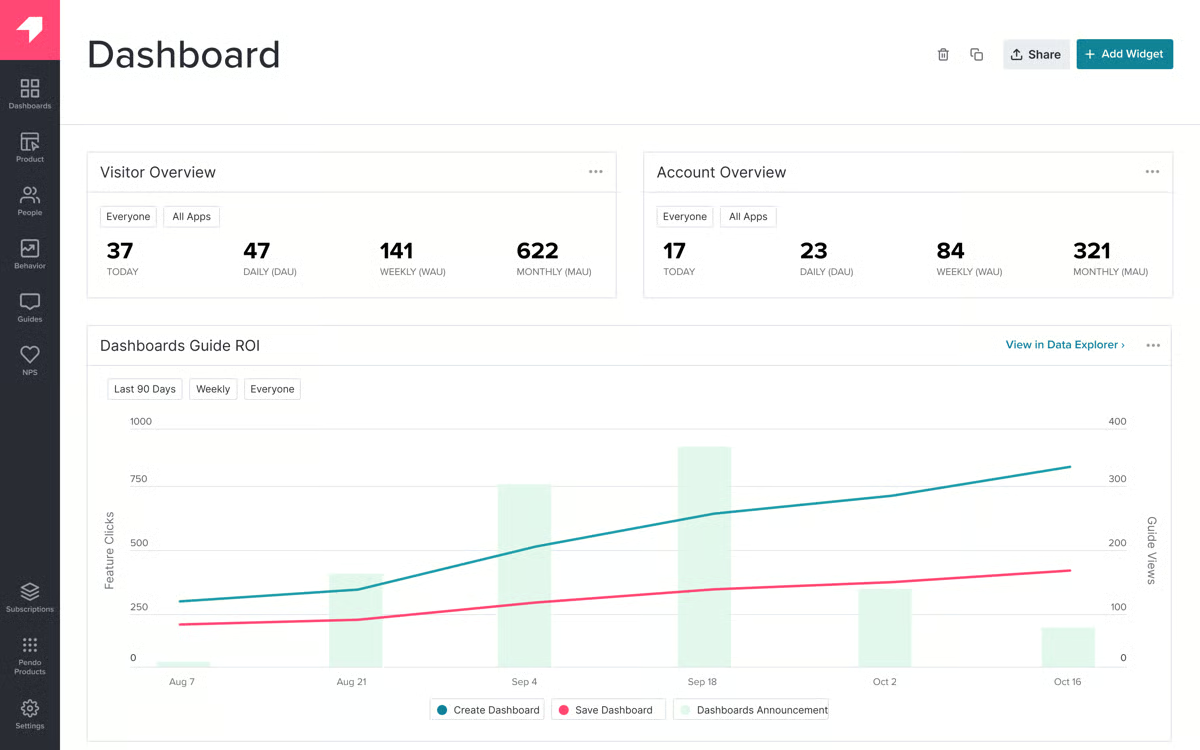
Pendo is a product adoption platform for both mobile and web-based applications. Analytics are its strongest suit, with multiple configurable dashboards covering user activity, feature adoption, guide engagement, funnel analysis, NPS, and more.
The experiments feature lets you measure guide impact against a control group. Mobile support via SDK lets you snapshot and edit pages directly from your phone.
Key Features:
- In-app guides using modals, banners, and tooltips with no-code templates
- A/B testing experiments to measure guide impact vs. control groups
- Analytics dashboards covering activity, adoption, engagement, funnels, and NPS
- Pendo for Mobile via SDK with page snapshot and editing
- Resource center for checklists, guides, and help content
Pros:
- Best-in-class analytics. Most detailed reporting in this category
- A/B testing for guide impact measurement
- Strong mobile onboarding support with SDK installation
Cons:
- Onboarding checklists buried inside the resource center. They’re not surfaced proactively
- Expensive entry point at $8,000/year for the Starter plan
Capterra Rating:
⭐ 4.5
Pricing:
Starter from $8,000/year (2,000 MAUs) | Higher plans custom quoted
4. eWebinar
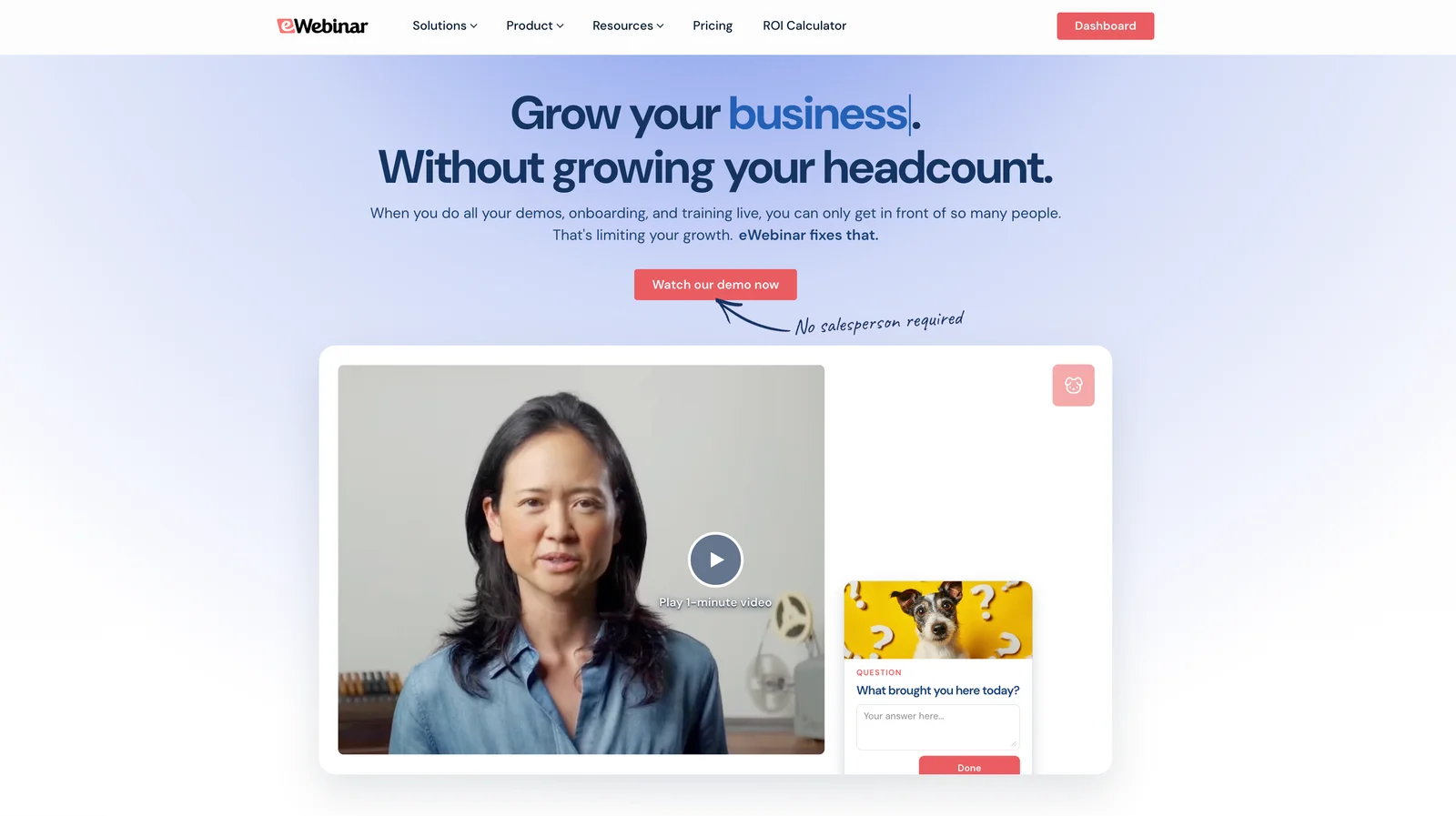
eWebinar is on-demand video platform with chat and the only tool on this list built specifically for scaling complex onboarding without scaling your team.
The problem with live onboarding sessions isn’t that they don’t work. It’s that they don’t scale. A small CS team can only run so many sessions per week. Scheduling conflicts, time zones, and the sheer repetition of covering the same ground with every new customer erode capacity fast.
eWebinar solves that by letting you turn your best pre-recorded onboarding session into an on-demand video, with all the engagement of a live session intact.
Key Features:
- On-demand, just-in-time, and recurring scheduling simultaneously in every time zone
- 25+ pre-programmed interaction types including polls, quizzes, tips, hotspots,, and conditional follow-ups
- Native two-way async chat with Slack, email and browser notifications
- Webinar Series for sequencing multiple sessions into a structured onboarding journey
- Per-attendee analytics showing exactly who watched, what they engaged with, and where they dropped off
- Direct CRM integration with HubSpot, Salesforce, and others
Average on-demand attendance with eWebinar: 85%. The live average sits at 40%. That difference isn’t just a metric — it’s the percentage of your customers who actually complete onboarding versus the ones who miss the session and never fully activate and adopt the product.
Best days & times to schedule webinars (across timezones)
Pros:
- 85% average on-demand attendance vs. 40% live average
- Real async chat allows attendees to get genuine answers, not pre-scripted messages
- Webinar Series for structured, sequential onboarding journeys
- Per-attendee analytics let CS teams track individual progress
- Scales without adding CS headcount
Cons:
- Video-first format requires a recorded presentation to get started
- Works alongside in-app guidance tools, not as a replacement for them
- I think we should write something here about how it’s not an in-app cues tool which is what the rest of the solutions on this list is
Capterra Rating
⭐ 4.9
Pricing:
Level 1 ($99/month) — 1 active webinar, 3k registrants/month
Level 2 ($199/month) — 5 active webinars, 6k registrants/month
Level 3 ($299/month) — 15 active webinars, 12k registrants/month
14-day free trial
See how eWebinar works by joining our on-demand demo here.
5. Arrows
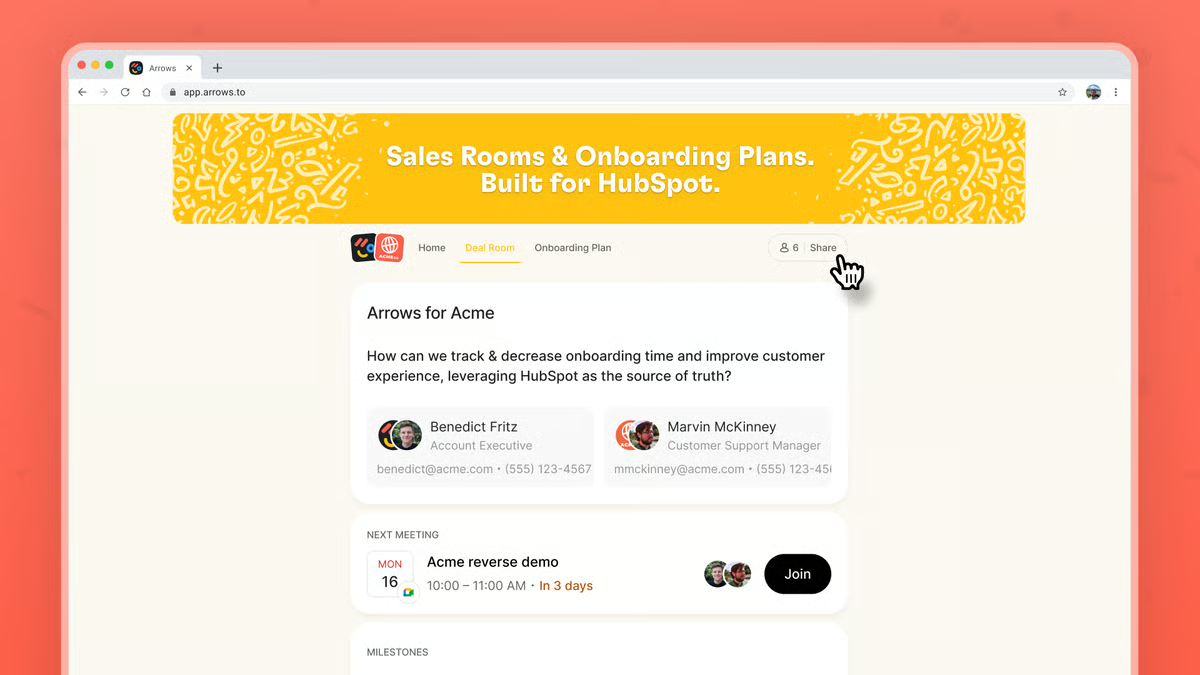
Arrows is a client onboarding platform built natively inside HubSpot. It is the ideal option for teams running their entire customer lifecycle from the HubSpot CRM. The core product is a shared onboarding plan where both your CS team and the customer have visibility into tasks, milestones, and progress.
Deal and contact data sync automatically, and onboarding progress tracks directly from existing CRM workflows.
Key Features:
- Native HubSpot integration, ensuring onboarding data lives directly in your CRM
- Shared customer-facing onboarding plans with task and milestone tracking
- Automated reminders to keep customers progressing without manual follow-up
- Deal and contact data sync from HubSpot automatically
- Progress tracking visible to both CS team and customer
Pros:
- Native HubSpot integration, preventing switching between tools
- Shared plans reduce back-and-forth and manual follow-up
- Automated task reminders keep customers moving without CS intervention
Cons:
- Only makes sense for HubSpot users as it is limited in value for teams on other CRMs
- $500/month starting price is steep for smaller teams
G2 Rating
⭐ 4.8
Pricing:
From $500/month
6. Userpilot
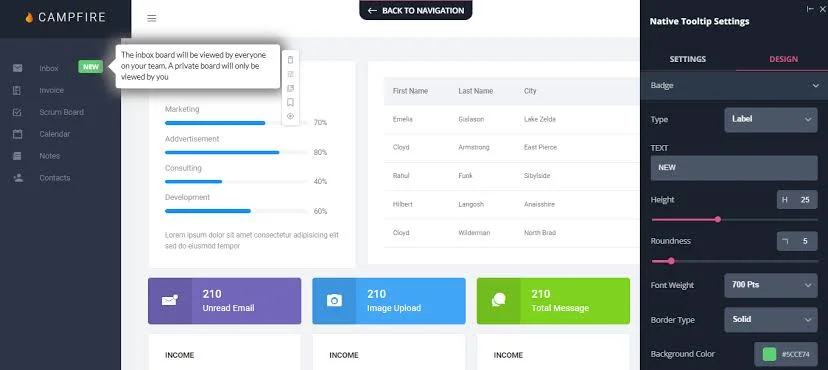
Userpilot is a product growth platform for web-based applications. The Chrome extension no-code builder supports modals, slideouts, tooltips, and driven actions. Native tooltips appear anywhere the element is visible across pages rather than being confined to one location.
AI-powered content localization supports 32 languages. However, this feature is only available on Growth and Enterprise plans.
Key Features:
- Chrome extension no-code builder with driven actions and native tooltips
- AI-powered content localization supporting 32 languages
- Resource center editor with checklists, flows, surveys, videos, and external links
- Hotspot option for drawing attention to specific UI elements
- SSO and SOC 2 compliance on Enterprise plans
Pros:
- AI-powered localization supporting 32 languages
- Native tooltips that follow elements across pages
- Flexible resource center with checklists, videos, and external links
Cons:
- Growth plan must be paid annually with no monthly option
- Localization features only available on Growth and Enterprise plans
Capterra Rating:
⭐ 4.6
Pricing:
Starter ($299/month) | Growth ($749/month, annual only) | Enterprise custom
7. WalkMe
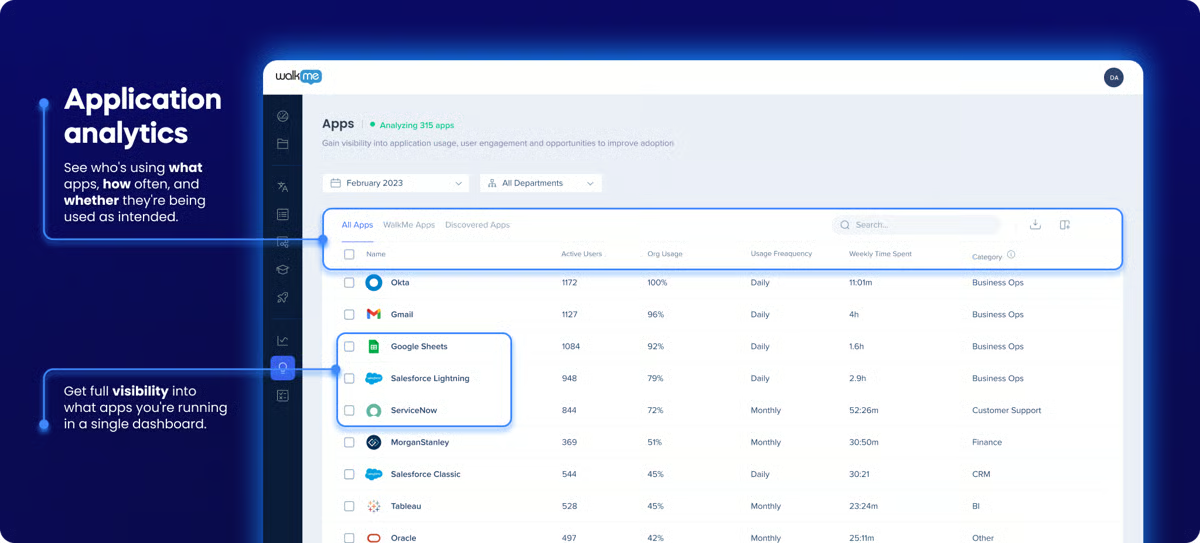
WalkMe is a digital adoption platform for both mobile and web-based applications. Its AI-based element recognition, which stems from the 2018 DeepUI acquisition, automatically adapts guides and analytics to UI updates without manual rebuilding.
WalkMe Workstation extends the platform to employee onboarding via a desktop hub with integrations for Confluence, Slack, Salesforce, HubSpot, and Zendesk.
Key Features:
- AI-based element recognition that adapts flows automatically to UI changes
- Interconnected and nested flow builder
- WalkMe Workstation for employee onboarding on Windows and Mac
- Enterprise integrations, including Salesforce, HubSpot, Zendesk, Confluence, Slack
- Mobile and web application support
Pros:
- AI-based element recognition adapts flows automatically to UI changes
- Covers both customer and employee onboarding
- Enterprise-grade integrations across the full tech stack
Cons:
- One of the most expensive platforms on this list. It is built for enterprise budgets
- Annual agreement required upfront, priced on projected usage, not actual
G2 Rating
⭐ 4.5
Pricing:
Custom quote only
8. Userflow
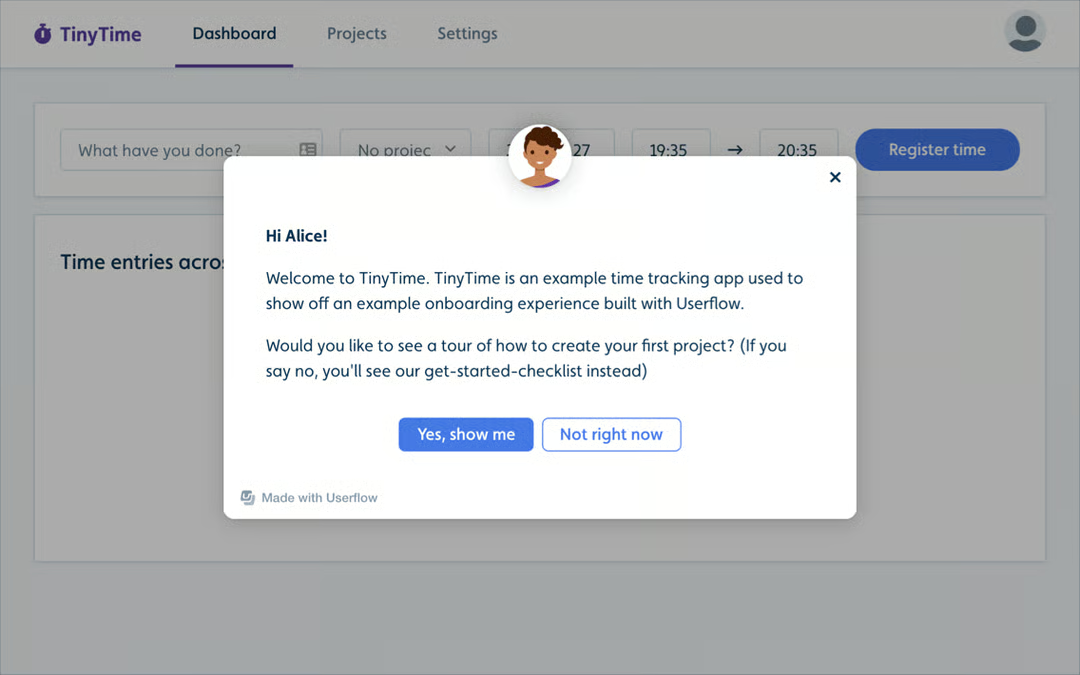
Userflow is a no-code product onboarding platform praised for balancing power with simplicity. It covers flows, checklists, launchers, and surveys at a price point well below enterprise-tier tools.
The visual flow editor makes branching logic straightforward. Checklists surface proactively within the product rather than requiring users to find them in a resource center, which is one of its most consistently praised features.
Key Features:
- No-code builder supporting modals, tooltips, and slideouts
- Visual flow editor with easy branching logic configuration
- Proactive checklists that surface automatically within the product
- Built-in NPS and CSAT surveys
- Integrations with Segment, Mixpanel, Amplitude, HubSpot, and Salesforce
Pros:
- Proactive checklists that surface automatically without requiring user action
- Clean visual flow editor with easy branching logic
- Strong value at $240/month compared to enterprise alternatives
Cons:
- Limited enterprise-grade features
- Mobile support more limited than web capabilities
G2 Rating
⭐ 4.8
Pricing:
Startup ($240/month, 3,000 MAUs) | Pro and Enterprise custom
9. UserGuiding
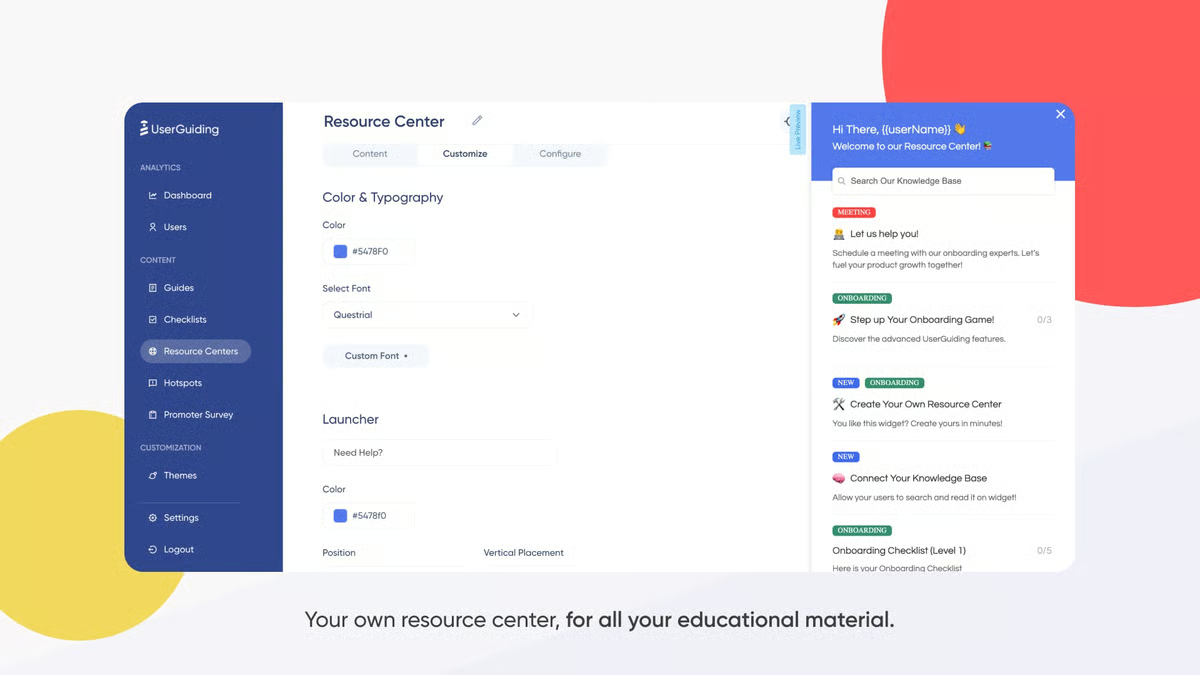
UserGuiding is a product adoption platform for web-based applications. Basic product tours are buildable via Chrome extension, but more complex flows require some coding, making it a low-code tool rather than fully no-code. Custom segments can be built using AND/OR filters or CSV uploads.
Despite its lower price point, UserGuiding integrates with Amplitude, Mixpanel, Segment, HubSpot, and Google Analytics on the entry-level plan.
Key Features:
- Chrome extension tour builder with modals, tooltips, and input fields
- Custom segmentation via AND/OR filters and CSV uploads
- Checklists and hotspots alongside standard guided flows
- Integrations with Amplitude, Mixpanel, HubSpot, Intercom, and Zendesk on entry-level plan
- Onboarding checklists with search and progress bar options
Pros:
- Most affordable option on this list at $89/month annually
- Strong integrations on the entry-level plan — no upgrade required
- CSV import for manual segment uploads
Cons:
- More complex flows require coding, as it is not fully no-code
- Basic plan limited to 20 guides, 2 checklists, and 1 survey with UserGuiding branding
G2 Rating
⭐ 4.7
Pricing:
Basic ($89/month annual | $129/month monthly) | Professional ($249/month annual | $399/month monthly)
10. Chameleon
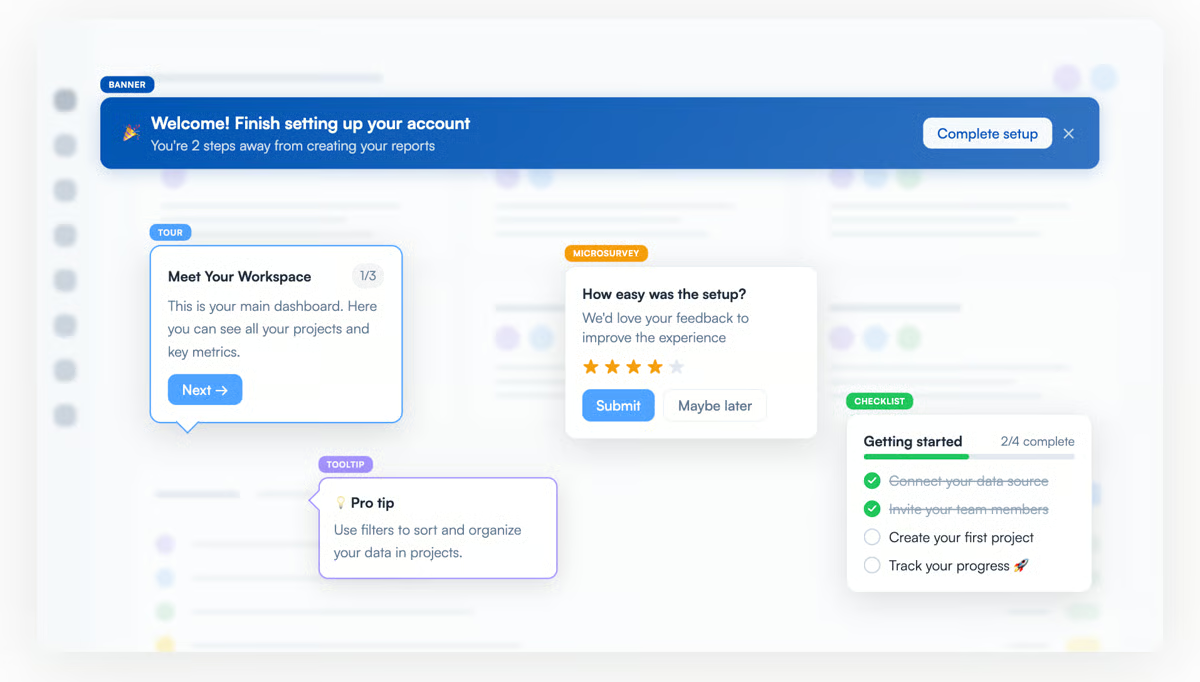
Chameleon is a product adoption platform for web-based applications. Tours come in two types: walkthroughs triggered manually and announcements that appear automatically when users meet defined conditions. This distinction gives precise control over when and why tours surface.
Outside of tours, Chameleon also creates standalone tooltips and launcher widgets for checklists and help centers. Microsurveys track NPS, CES, and CSAT with a Slack integration forwarding responses to specific channels.
Key Features:
- Walkthrough and announcement tour types with 19-step templates
- Standalone tooltips as badges, hotspots, and upsells
- Launcher widgets for onboarding checklists and help centers
- Microsurveys for NPS, CES, and CSAT tracking
- Free HelpBar with AI-powered help center search
Pros:
- Announcement vs. walkthrough distinction gives precise control over when tours appear
- 19 step templates cover a wider range of use cases than most competitors
- Free HelpBar with AI-powered search available without a paid plan
Cons:
- Growth plan is significantly more expensive than most tools on this list
- Startup plan limits microsurveys to 5 and launchers to 1
G2 Rating
⭐ 4.4
Pricing:
Startup ($279/month, 2,000 MAUs) | Growth from $1,250/month
11. Whatfix
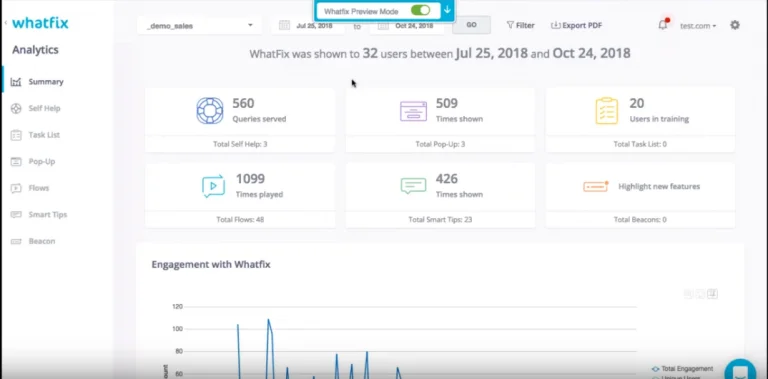
Whatfix is a digital adoption platform for both mobile and web-based applications. When you add a step and select an element, Whatfix automatically generates contextual text, eliminating manual writing for each step.
A unique feature is audio clip embedding with Auto Play, letting clips play automatically when a flow or tooltip becomes visible. Pop-up templates, a help center builder, Smart Tips, and beacons round out the feature set.
Key Features:
- Auto-generated contextual step text when elements are selected
- Audio clip embedding with Auto Play Audio
- 15 pop-up templates for onboarding, announcements, and surveys
- Smart Tips for contextual information and input validation
- Help center housing flows, articles, tutorials, and links
Pros:
- Auto-generated contextual step text speeds up flow creation
- Audio clip embedding. An uncommon feature in this category
- Smart Tips for contextual information and input validation
Cons:
- No published pricing and no free trial. It is primarily enterprise-focused
- Separate pricing for web vs. mobile, plus separate product analytics plans
G2 Rating
⭐ 4.6
Pricing:
Custom quote only. No free trial.
12. Userlane
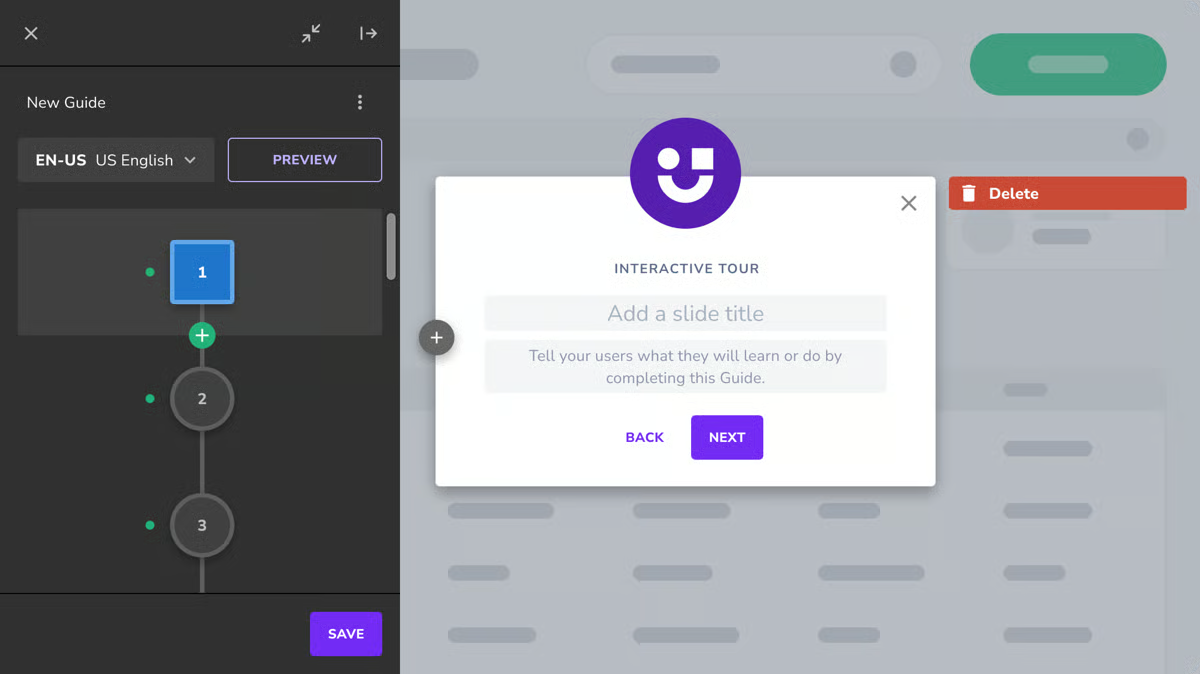
Userlane is a digital adoption platform for web-based applications. Its standout feature is the record-to-guide workflow whereby Userlane automatically converts every recorded action into guide steps, eliminating manual building.
Analytics follow Google’s HEART framework across happiness, engagement, adoption, retention, and task success, all color-coded from the main dashboard.
Key Features:
- Record-to-guide workflow that converts actions into steps automatically
- HEART framework analytics covering happiness, engagement, adoption, retention, task success
- Zendesk integration for surfacing help content within the in-app assistant
- Custom user segmentation and targeting
- Web-based application support
Pros:
- Record-to-guide flow enabling faster setup than manual step-by-step building
- HEART framework analytics give a holistic view of user experience
- Useful Zendesk integration for contextual help content
Cons:
- No published pricing, requiring a custom quote
- Fewer integrations than competitors
G2 Rating
⭐ 4.7
Pricing:
Custom quote only
13. Stonly
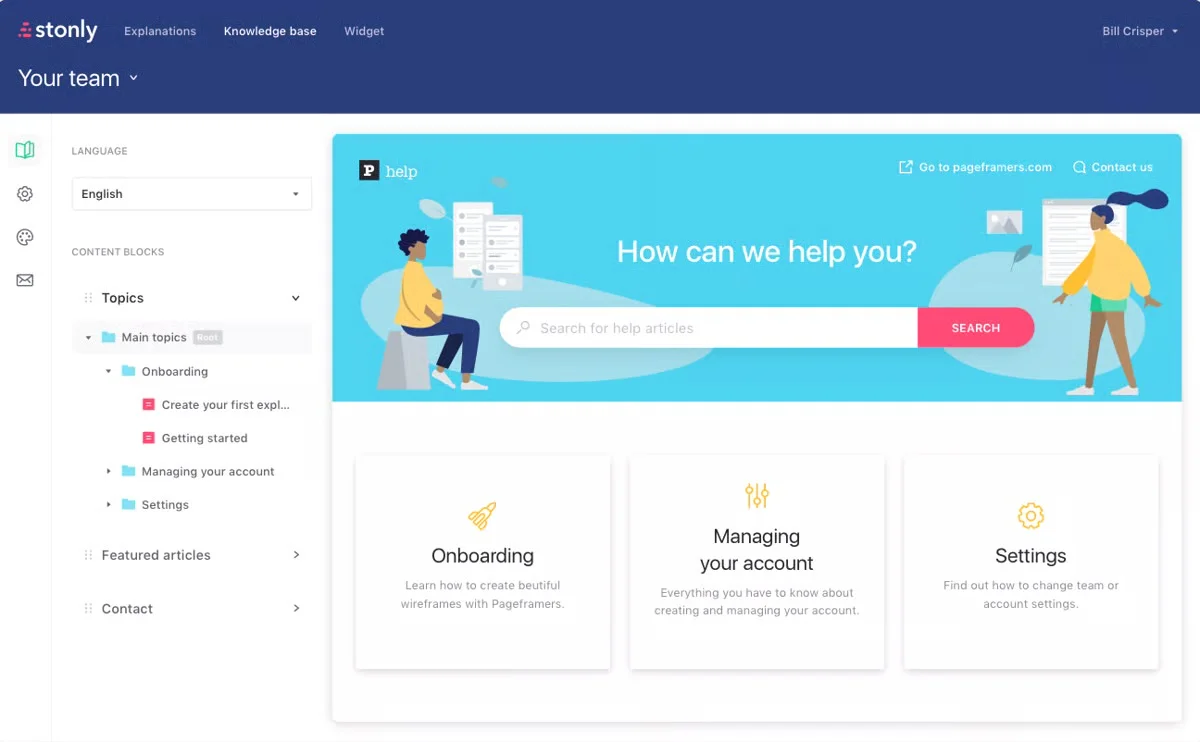
Stonly is a dedicated knowledge management and digital adoption platform that replaces static help articles with interactive, step-by-step decision trees.
It is perfect for customer success and support teams looking to build intuitive self-service troubleshooting flows and contextual in-app guidance without requiring any heavy engineering or developer resources.
Key Features:
- Interactive, decision-tree style troubleshooting guides and checklists
- Contextual in-app widgets for targeted user support
- Detailed analytics to track step-by-step user drop-offs
- Native integrations with helpdesks like Zendesk and Front
- Built-in translation tools for global user bases
Pros:
- Highly intuitive guide builder accessible to non-technical users
- Exceptional at deflecting support tickets through guided self-service
- Seamlessly embeds directly into existing knowledge bases or workflows
Cons:
- Deep in-app implementation can sometimes require engineering help
- Managing large volumes of translated content can feel tedious
G2 Rating
⭐ 4.8
Pricing:
Starts at $49/month
How to Choose the Right Customer Onboarding Software
Picking the right platform comes down to an honest assessment of how much context a new customer needs before in-app guidance can actually do its job.
For most B2B products, that context isn't optional. Tooltips assume the customer already understands what they're looking at, and for anything more complex than a basic SaaS interface, they don't. eWebinar is the only platform on this list built specifically for delivering that context with video.
In-app tools have their place as reinforcement once customers understand the product. Pair eWebinar with one of them depending on your stack and budget:
- Complex product, small CS team? eWebinar handles the education layer; pair with Appcues or Userflow for in-app reinforcement
- HubSpot-native team? eWebinar plus Arrows for collaborative onboarding plans
- Enterprise deployment with strict adoption tracking? eWebinar plus WalkMe or Whatfix
- High-touch services-led onboarding? eWebinar plus Rocketlane for project coordination
- Lightweight, simple product? Appcues or Userflow on their own may be enough
Onboarding fails when customers can't access the right content at the right time. Watch a demo and see how eWebinar closes that gap.
FAQs
What is client onboarding software?
Client onboarding software helps companies guide new customers from signed contract to active usage by providing in-app walkthroughs, project management platforms, and webinar-based tools.
What’s the difference between client onboarding software and customer onboarding software?
The terms are largely interchangeable. “Client onboarding” tends to be used in B2B contexts with named accounts and structured processes. “Customer onboarding” is broader and often used in product-led growth contexts with minimal human involvement.
When should I use webinar-based onboarding instead of in-app onboarding?
When your product is complex enough that users need context before they can meaningfully engage with in-app guidance. That said, the two don’t have to be mutually exclusive: use eWebinar for product walkthroughs and Userpilot for in-app tips.
What’s the best customer onboarding software for complex products?
For complex products with small CS teams: eWebinar to scale onboarding without adding headcount. For enterprise deployments: WalkMe or Whatfix for DAP-level adoption tracking. For HubSpot-native teams: Arrows for collaborative onboarding plans.
Can I use multiple onboarding tools together?
Yes. And for complex products, you should. eWebinar and an in-app tool like Appcues or Userflow are complementary. Customers who complete an onboarding session first engage with in-app guidance more effectively because they already understand the product.
Curious to see how eWebinar can help run your demos, onboarding, and training sessions on autopilot?
Watch a one-minute explainer video for a quick overview of the eWebinar platform. Or, better yet, join our on-demand demo to learn more!