Quick Summary
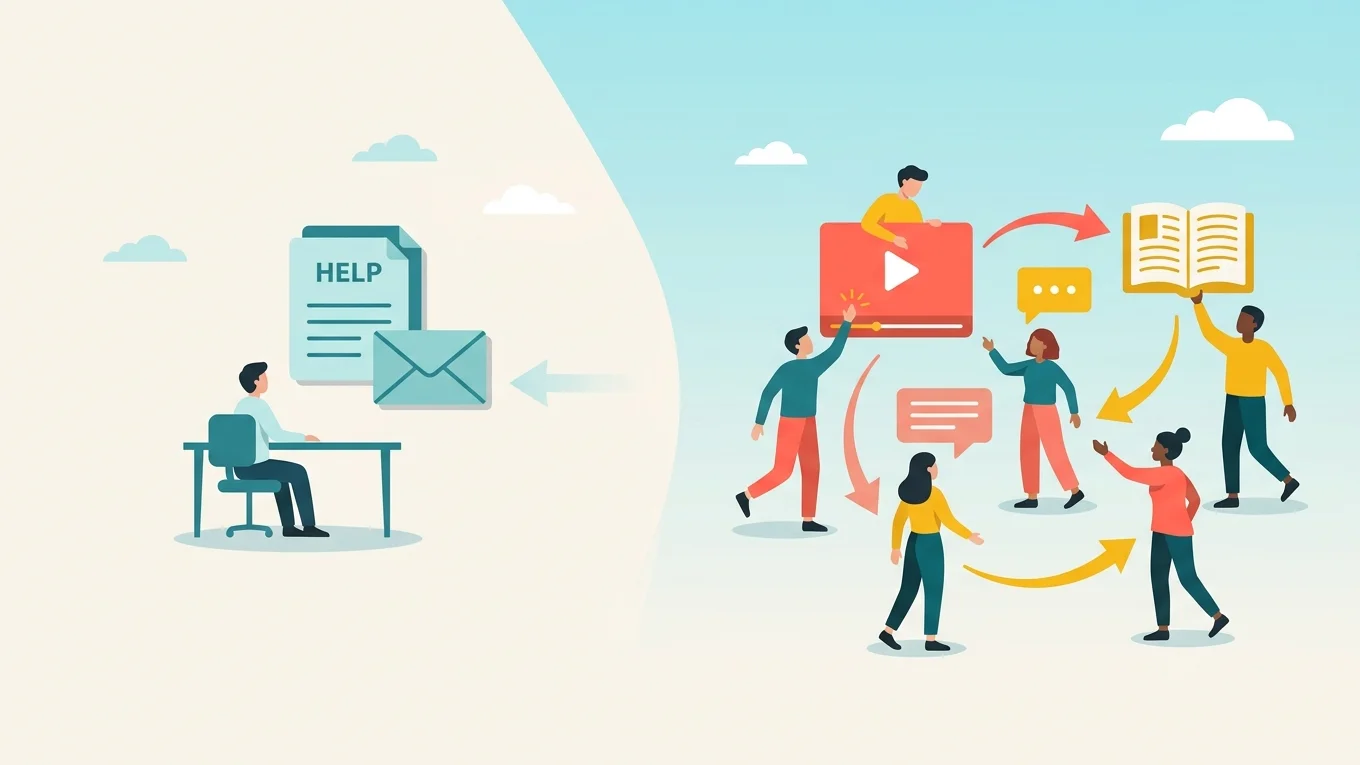
Reducing churn comes down to fixing the leak you actually have. For most teams that's onboarding, because customers who never reach value leave quietly in the first few weeks. After that, look at feature adoption, failed payments, and whether customers have an easy way to ask questions. The seven strategies below run roughly in order of payoff.
Churn Gets Decided Long Before Anyone Clicks Cancel
Keeping the customers you already have is the highest-ROI growth strategy available. Research by Bain & Company’s Frederick Reichheld, published in Harvard Business Review, found that boosting customer retention by just 5% increases profits by 25% to 95%. In fact, acquiring a new customer costs 5 to 25 times more than retaining an existing one.
Most teams understand the math. The challenge is knowing where to start, because churn isn't a single issue. It’s a series of small leaks scattered across your business. Fixing an onboarding drop-off requires a completely different playbook than fixing a failed credit card payment.
This guide outlines seven proven strategies to reduce churn, complete with the level of effort required for each and which ones deliver the fastest impact.
Why Listen to Us?
We built eWebinar for customer success teams trapped in a loop of running the exact same live onboarding sessions week after week, only to reach a fraction of their user base.
Moving to automated, on-demand sessions changes the math entirely. Our own automated webinars average an 83% attendance rate. compared to the typical 40% for live events. Sati Leavitt at SkySlope, for example, scaled her team's schedule from just one or two live sessions a week to six sessions a day, five days a week.
What Is Customer Churn?
Customer churn is the share of customers who stop paying you over a given period. If you started the quarter with 500 customers and 25 left, your quarterly churn rate is 5%.
There are two kinds, and they need completely different fixes.
- Voluntary churn is a customer deciding to leave. They didn't get value, they found something better, or their needs changed.
- Involuntary churn is a customer leaving by accident. A card expired, a payment failed, and nobody noticed until the account lapsed. These customers wanted to stay.
The distinction is crucial. Recurly's benchmark data puts median annual churn for software businesses at 3.22%, made up of 2.16% voluntary and 1.06% involuntary. In other words, roughly a third of software churn is just a payment processing issue disguised as a retention problem.
Finally, it's essential to track both customer churn and revenue churn. Losing ten micro-tier accounts vs. losing a single enterprise account might look identical on a subscriber-count chart, but they'll hit your bottom line very differently.
8 Ways to Reduce Customer Churn
1. Get New Customers to Value as Fast as You Can
Churn is usually decided in the first few weeks, long before anyone ever opens a cancellation form. Let’s talk numbers . A Wyzowl survey revealed that over 90% of customers feel companies could do a better job onboarding, while 80% admit to deleting an app simply because they couldn’t figure out how to use it.
In other words, a customer signs up, logs in, gets confused, and quietly stops returning. The cancellation three months later is just the formal paperwork catching up.
So the goal of onboarding is to get the customer to the moment where the product solves their problem, as fast as possible.
Tooltips and in-app checklists handle part of this well. They're good at nudging someone toward the next click, which is great for starters. Appcues, Pendo, and User Pilot are all good tools to implement this.
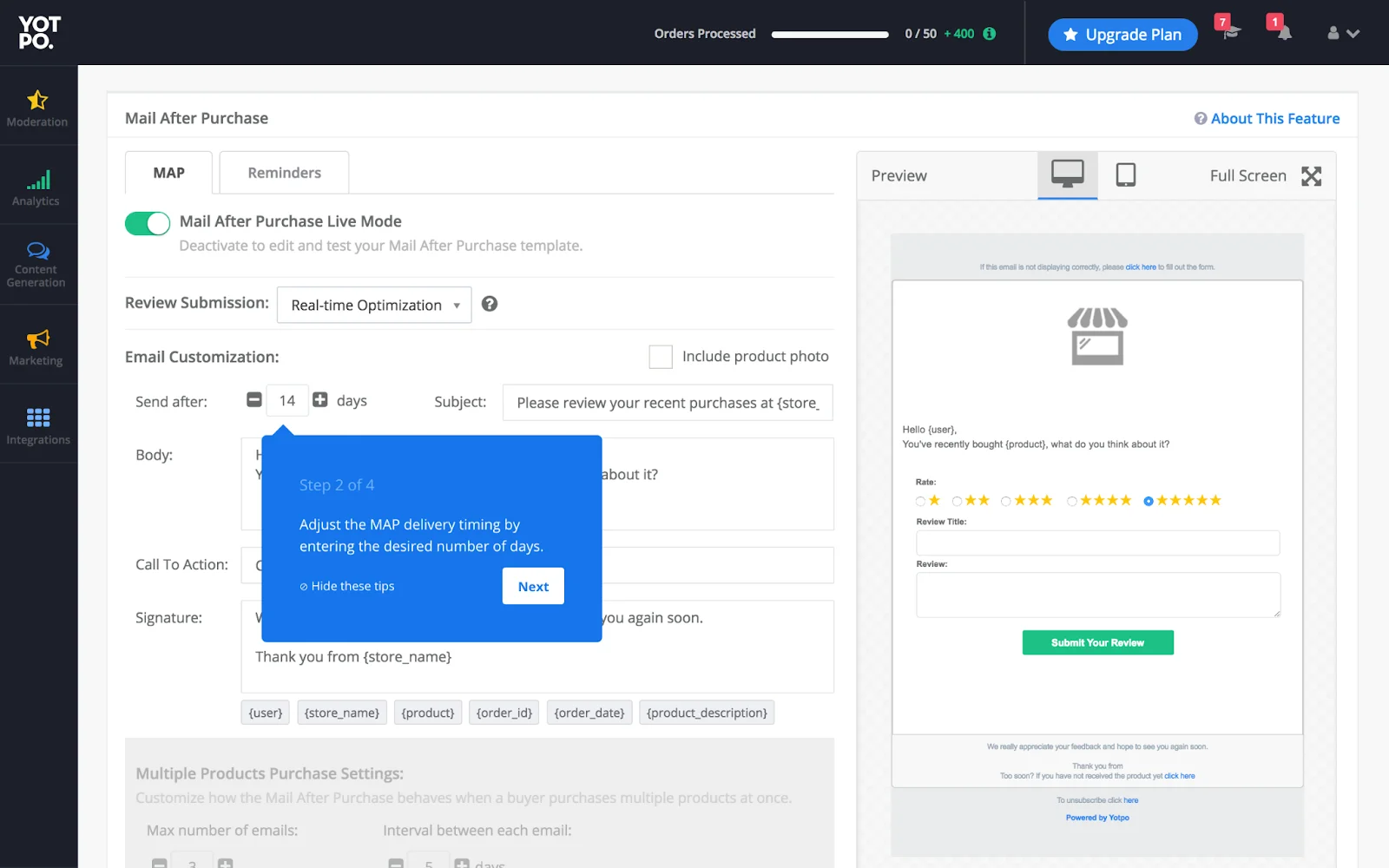
Where they run out of road is context. A tooltip can't explain why your product works the way it does, or what good looks like for someone in this customer's situation. For a complex product, that's the part that decides whether the customer sticks.
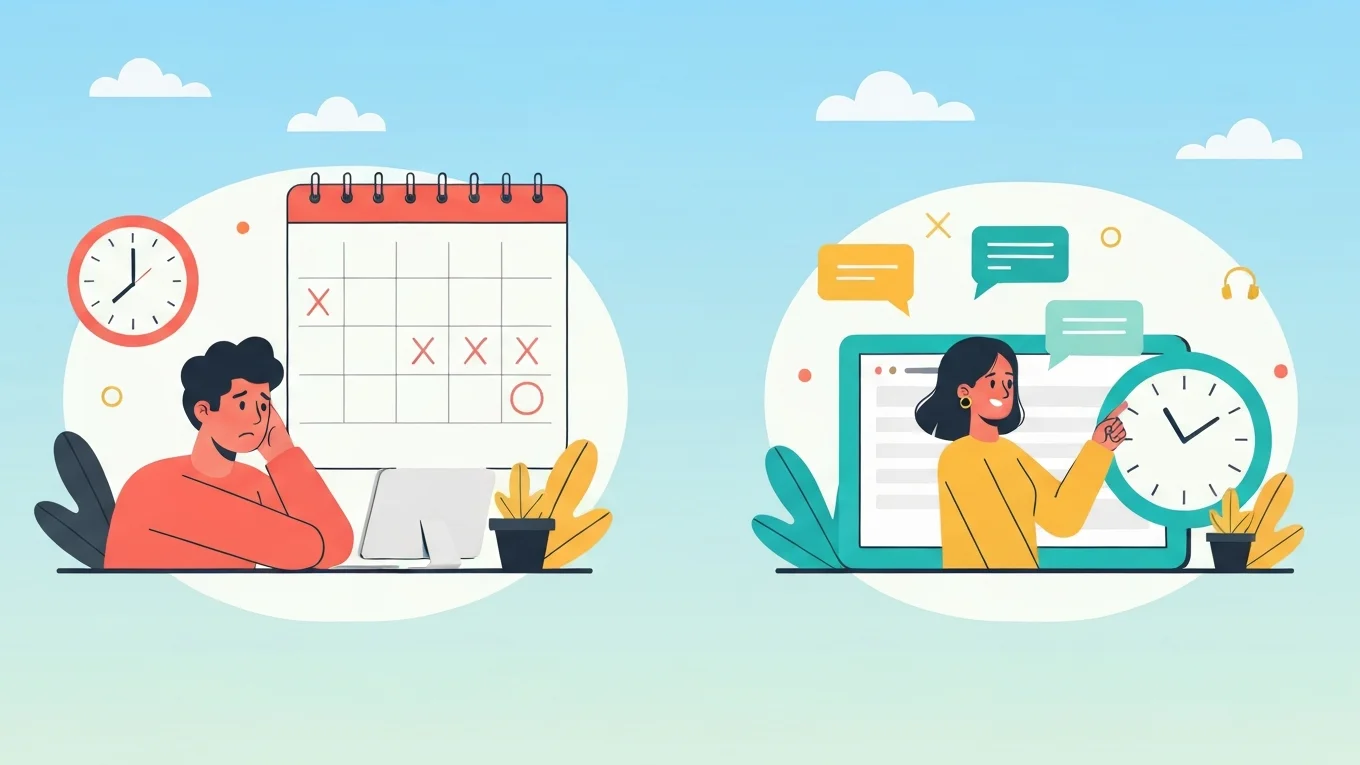
The traditional answer is a live onboarding call, which works and doesn't scale. A small customer success team can only run so many sessions a week before the calendar wins.
This is the gap eWebinar was built for.

You record your onboarding session once, add questions, polls, and prompts along the video timeline, then put it on a schedule that runs 24/7. Customers join when it suits them, in their own time zone, and ask questions in chat while they're watching.
Jamie Mendelsohn is VP of Customer Success and Experience at Cloze. Before switching, the team ran ten live sessions a week for brokerages across more than 70 countries. That was 15 to 20 hours a week, and close to half a person's time spent presenting the same material. Ren Blake at Gem put it more simply, saying they now "deliver personalized onboarding at scale and over 1,000 hours of training a year."
2. Make Sure You’re Bringing in the Right Customers
You can perfect your onboarding, nail your support, and still watch accounts churn every month if the people signing up were never a good fit to begin with. This is the churn lever most teams skip, because it feels like a sales and marketing problem, not a retention one. But by the time a wrong-fit customer reaches your CS team, the outcome is almost already decided.
Every company knows who their best customers are. They use the product for exactly what it was built to do. They're not price-sensitive, because they already feel the value. They tend to be a certain size, in a certain industry, with a specific problem your product solves better than the alternatives. When you focus your acquisition on getting more of those people into the funnel, churn stays low almost by default, because they're motivated and you're solving something they genuinely need.
The opposite is just as predictable. A customer outside your ICP signs up because the price looked right or a sales rep stretched the pitch to close the deal. They're cost-conscious from day one, so a competitor offering the same thing for $5 less pulls them away. Or they're too early-stage, too small, or running a use case your product was never designed for. When they cancel, it's rarely a verdict on your product. It's their own situation, and no amount of onboarding or support changes that.
Lincoln Murphy at Sixteen Ventures documented one case where just three bad-fit customers, worth $75k in combined ARR, churned and then actively discouraged 13 other prospects from signing. The total damage over three years came to $1.2 million in lost revenue. That's another cost: a wrong-fit customer doesn't just leave, they take future customers with them.
HubSpot ran into this early on. Their fix was structural. They changed their sales compensation so reps earned $2 per dollar of MRR only if the customer made it past the four-month mark. That one change realigned the entire team around acquiring customers likely to stay, not just customers likely to sign.
So before you optimize anything downstream, look at who's coming in. If your funnel is pulling in customers who were never going to stick, the best onboarding in the world won't save them.
3. Find Out the Point Customers Actually Leave
You can’t fix a leak you haven’t located, and relying on overall averages only hides where the damage is happening.
Start by breaking your churn down by
- cohort, plan tier,
- acquisition channel,
- and company size.
Chances are you’ll realize your churn numbers across these are wildly uneven. For example, customers from one marketing channel might churn at triple the rate of another, while your self-serve tier bleeds users even as enterprise accounts stay rock-solid. You might even find that adopting a specific integration predicts long-term retention better than any step in your onboarding flow.
Timing matters just as much as volume. A cluster of cancellations in month one points to an onboarding issue, whereas a drop-off at the twelve-month mark signals a renewal and value-demonstration problem. And these two challenges that require completely different solutions.
4. Ask People Who Leave Why, and Read the Answers
Exit feedback is the cheapest research you'll ever run, but sadly, most companies either skip it or bury it in a dropdown nobody reviews.
Put one open question in your cancellation flow, NOT a checklist of reasons, since customers will pick whichever one gets them out fastest. Ask what they were hoping to get done and what got in the way.
Not this…
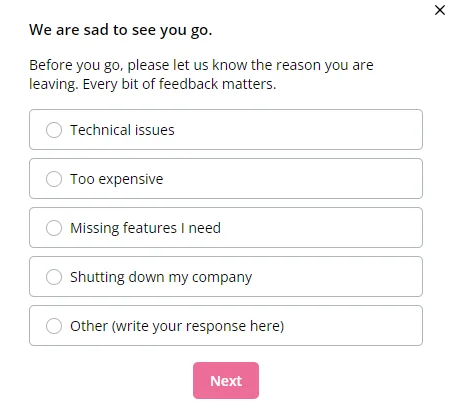
But this…
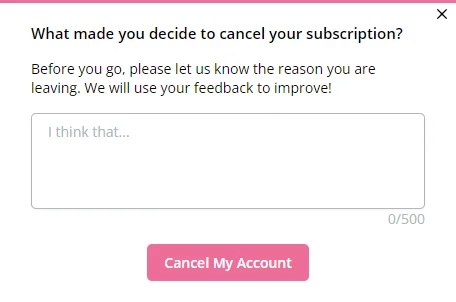
Then, read through the responses in batches, ideally out loud. Clear patterns will emerge almost immediately. You'll quickly spot two or three recurring stories behind most of your churn, and at least a few of them would be areas you can work on to improve your product.
If possible, follow up with a handful by email or a short call. Customers who've already left are unusually honest, because they've got nothing to manage.
5. Watch Usage for Early Warning Signs
By the time a customer tells you they're leaving, they’ve already made that decision weeks or months earlier. Their usage data will tell you this if you pay close attention.
Pick a small number of signals that genuinely predict retention for your product. Logins per week is too blunt on its own.
- Better candidates are the number of active users on the account.
- Another is whether the customer finished the setup step that makes the product sticky.
- A third is whether usage has dropped against their own baseline, not against an average.
An account running at half its normal usage for a month is a clearer warning than an account that's always been quiet. Then route those signals somewhere a person will see them. A health score nobody acts on is just a dashboard.
6. Teach Every New Feature You Ship
Shipping a feature isn't the same as customers using it, and unused features do nothing for retention.
The more of your product a customer uses, the harder it is for them to leave. That's just what happens when a tool becomes part of how someone works. So every feature launch is a retention opportunity, provided customers understand what it does and why they'd want it.

This is where a recorded training session with chat does the job. It's the same material your team already presents, captured once and left running. You run the rollout session once, put it on-demand, and every customer gets the same explanation whenever they're ready.
Kyle Racki at Proposify described the support team uploading training calls they'd already recorded, then adding polls and launching it. That training now runs 24/7 and they’ve been able to scale to training 20,000 customers.
7. Give Customers an Easy Way to Reach a Person
Plenty of churn comes down to a question nobody answered.
A customer hits something confusing, can't find the answer, and doesn't care enough to file a ticket. They just use the product a little less. Repeat that a few times and you've lost them, without a single support conversation to show what happened.
More one-to-one calls won't fix this, because that's the part that doesn't scale. What works is making sure there's always a low-effort way to ask a question and get an answer back.
Chat inside the moment of confusion works better than a support address. The customer doesn't have to change context or explain the situation from scratch. Inside an eWebinar session, chat works this way. Someone on your team gets notified in Slack, email, or the browser, and answers while the customer is still watching. If the whole team is heads-down, an auto-response you've written steps in, and the answer follows by email.
As Kyle Racki put it, "Anytime a customer wants to hop on a training, they can get access to it. Whoever's working support at the time can still assist them over chat if they have a question." That's the relationship-building part of customer success, running without a calendar invite.
8. Fix Failed Payments Before They Become Cancellations
Around a third of software churn is involuntary, going by Recurly's benchmarks above. These are customers who wanted to keep paying you.
The fixes are unglamorous and they work.
- Retry failed charges on a schedule that accounts for payday timing rather than hammering the same card daily.
- Use an account updater service so expired card details refresh automatically.
- Email customers before a card expires, not after it fails.
- Give them a way to update payment details that doesn't require logging in and hunting through settings.
Then make the overdue emails sound like a helpful heads-up instead of a debt notice, because the customer hasn't done anything wrong.
Keeping the Customers You Worked Hard to Win
Churn isn't a single problem with a single fix, which is why it resists the one-tactic approach. It's onboarding, support, billing, product, and sales all leaving marks on the same number.
If you only take on one of these, take on onboarding. It sits upstream of nearly everything else on the list. A customer who reaches value early gives you room to get the rest right.
After that, go where your own data points. Churn concentrated in the first 60 days is an onboarding and activation problem. Churn at renewal is a value-proof problem. Churn scattered evenly across the year, with a spike in failed payments, is a billing problem you can fix in a fortnight.
Start where your leak is biggest, which is often the first few weeks after signup. Get customers to value early, teach them properly when the product changes, and make sure there's always a straightforward way to ask a question.
Maybe your customer success team spends its week running the same onboarding and training sessions over and over. That's time you could hand back. See how eWebinar works, or join our on-demand demo to watch the format from a customer's side. We also have a generous 14-day free trial you can check out today!
FAQs
What's a good customer churn rate?
It depends on who you sell to. Recurly's benchmark data puts median annual churn for software businesses at 3.22%. Self-serve products with low prices tend to run higher, and enterprise contracts with annual terms tend to run lower. Your own trend line matters more than the benchmark.
How do I calculate churn rate?
Divide the customers you lost in a period by the customers you had at the start of it. If you began the month with 400 and lost 12, that's 3% monthly churn. Run the same calculation on revenue as well, since one large account can outweigh many small ones.
Is it cheaper to keep a customer than to find a new one?
Yes, by a wide margin. The research published in Harvard Business Review puts acquisition at five to 25 times the cost of retention. It also puts a 5% lift in retention at a 25% to 95% increase in profit.
How quickly does better onboarding show up in churn numbers?
You'll see leading indicators within weeks, in activation rates and first-month usage. The churn number itself lags by however long your average customer takes to leave. So expect a quarter or two before the trend is clear.
Can you reduce churn without hiring more CS people?
Usually, yes. Most CS teams lose a lot of hours to repeated live sessions covering the same material. Moving that to on-demand training with chat frees the team for the accounts that genuinely need a person. That's where their time was always meant to go.
What's the difference between customer churn and revenue churn?
Customer churn counts accounts. Revenue churn counts money. A business can lose 5% of its customers and only 1% of its revenue, if the people who leave are small. Or it can lose 1% of customers and 20% of revenue when one big account goes. Track both.
Curious to see how eWebinar can help run your demos, onboarding, and training sessions on autopilot?
Watch a one-minute explainer video for a quick overview of the eWebinar platform. Or, better yet, join our on-demand demo to learn more!