Quick Summary
New agents need more than paperwork and a first-day orientation. This new real estate agent onboarding checklist lays out a practical 90-day program covering preboarding, compliance, brokerage systems, lead handling, commissions, measurable milestones, manager support, and on-demand training. Every agent gets the same structure and human guidance they need.
Want to Learn How to Onboard New Agents?
In 2024, Relitix reported that 49% of agents who recorded their first closing in 2022 recorded no transactions in 2023. That's 21 percentage points higher than the average of 28% from 2017 through 2020.
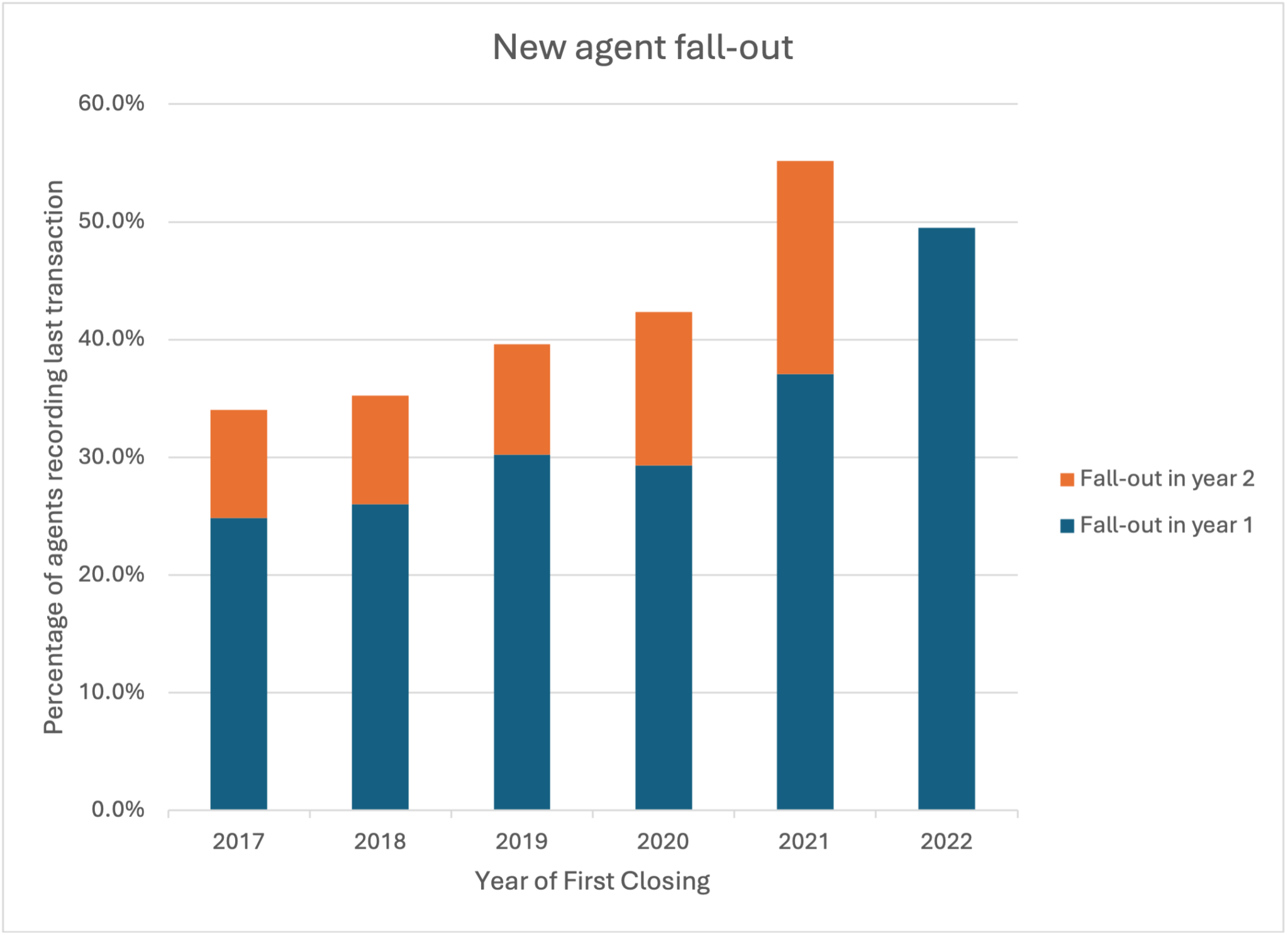
While the report does not examine why these agents stopped transacting, the data highlights an operational problem: a license and first closing do not automatically mean an agent can consistently follow brokerage procedures, serve clients, and progress without structured support.
This guide shows managers how to build a 90-day onboarding program to close that support gap. We cover what to complete before day one, what to teach in the first weeks, milestones to review, and how to provide recurring training around agents’ schedules.
Why Listen to Us?
The real estate experience behind eWebinar predates the platform. Co-founder Melissa Kwan previously founded Spacio, an open-house lead-generation and check-in platform used by brokerages and franchises. Since then, real estate organizations have used eWebinar to deliver recurring training to people working across different schedules and locations.
NextHome automated 20 monthly webinars for members across six time zones and reported a 169% increase in engagement. Flexmls by FBS, which uses eWebinar for real estate agent and MLS training, reported attendance rising from 30% on Zoom and GoToWebinar to 60–70%.
Those experiences inform the practical onboarding recommendations in this guide.
What is a New Real Estate Agent Onboarding Checklist?
The new-agent onboarding checklist is the blueprint that takes the agent from the signed contract to supervision and productivity. The list covers administration, compliance, brokerage systems, buyer and seller processes, performance standards, and 30/60/90-day evaluations, so the agent and manager know what “ready” means.
Do not provide the same onboarding list for every recruit. A newly licensed agent will need mentoring in consultations, showings, offers, and transaction files, while a seasoned agent transferring between brokerages will only need training on the brokerage’s specific processes for forms, systems, lead routing, and approvals. Shorten or remove a module only after the agent has shown proficiency in the particular area.
How to Onboard a New Real Estate Agent
1. Handle Preboarding Before The Agent’s First Day
The best onboarding starts before the agent walks in. If day one gets spent filling out paperwork and waiting for MLS access, you’ve already wasted their most motivated week.
Get the admin work done ahead of time so they can focus on learning the business from the start. Before their first day, make sure you’ve covered:
- Independent contractor agreement or employment paperwork. Document and sign the legal relationship before they arrive.
- License verification. Confirm their state license is active and transferred to your brokerage. Check whether they need a REALTOR association membership for MLS access.
- Errors and omissions insurance. Confirm whether applicable state law or brokerage policy requires individual E&O coverage, and whether the agent is covered under a brokerage group policy.
- MLS access. Applications can take days to process. Submit the request early so they can search properties on day one.
- Email and phone setup. A brokerage email address and working phone line, ready before they arrive.
- Office orientation. Whether it’s a desk assignment, key card, or virtual office login, sort the logistics in advance.
That’s the whole point. When they show up on day one, they’ll start learning the business right away.
2. Cover Compliance and Legal Requirements in The First Week
There’s more regulatory paperwork in real estate than most new agents expect. Since August 17, 2024, MLS Participants working with a buyer generally must enter into a written buyer agreement before touring a home, subject to state and federal law and limited exceptions. Your agents can’t walk into a first client meeting without knowing that.
In the first week, you’ll want to cover:
- Fair housing laws. Federal, state, and local fair housing rules apply to every interaction. Every agent needs to know what they can and can’t say, and the consequences of getting it wrong.
- Buyer-representation agreements. Walk agents through your brokerage’s specific agreement. Teach them how to present it to a buyer and what to do if a buyer hesitates. Because the practice change took effect in August 2024, agents covered by the requirement must be able to explain the agreement and its negotiable terms.
- Agency disclosure. Agency rules vary by state. Agents need to understand who they represent in a transaction and how to disclose it clearly.
- Wire fraud awareness. IC3 recorded more than $275 million in reported real-estate-fraud losses in 2025. New agents should know the warning signs and how to protect their clients.
- Agent safety. Review how the brokerage handles meeting new prospects, scheduling appointments, private showings, open houses, and tours of vacant properties. Agents need to know the check-in process, when others must accompany them, and who to contact if they feel threatened.
- Data privacy and client confidentiality. Client financial details and personal information can’t be treated carelessly. Spell out your brokerage’s policies on day one.
- Document retention. State regulators impose jurisdiction-specific transaction-record requirements. Train agents on what the brokerage must retain, where records belong, and the applicable retention period. Make sure they’ll know what to save and where.
Don’t treat compliance as a one-time orientation topic. The rules change, and agents forget. Schedule compliance refreshers and update modules whenever laws, forms, or brokerage policies change, not just at onboarding.
3. Set Up the Tech Stack and Teach Your Brokerage’s Systems
Many new agents won’t have much tech experience beyond their phone. Even experienced agents transferring from another brokerage need to learn your specific tools. If you skip this, they’ll either avoid the systems entirely or use them wrong, and both cost you deals.
Walk them through each system they’ll use daily:
- CRM. This is the tool they’ll live in every day. Show them how to add contacts, log activities, set follow-up reminders, and track their pipeline. If they don’t learn the CRM in week one, they probably won’t use it at all.
- MLS. Beyond basic property searches, teach them how to pull comparable sales, set up automated searches for clients, and use the MLS marketing features.
- Transaction management. Show them how to open a new transaction file, upload documents, track deadlines, and communicate with the other side’s team.
- E-signature tools. Walk through the full process of sending contracts, collecting signatures, and storing signed documents.
- Marketing tools. If your brokerage provides templates for social media posts, flyers, or email campaigns, show agents where to find them and how to customize them.
Hands-on practice matters more than a walkthrough. Have them set up a test contact in the CRM, pull comparable sales on a specific property, and create a mock listing file. They’ll remember the steps they do far better than the ones they watch.
4. Lay Out Lead Management, Sales Expectations, and Brand Guidelines
This is where onboarding goes from administrative to operational. The agent knows the rules and the tools. Now they have to learn how your brokerage runs day to day.
- Lead management. Explain how leads are assigned, what the expected response time is, and what happens to a lead that doesn’t get followed up. If your brokerage distributes leads, those rules need to be crystal clear from day one. Agents who don’t understand the system either miss opportunities or step on each other.
- Sales expectations. Be direct about what you expect in the first 90 days. How many contacts should they be making per week? How many showings? When should they have their first deal under contract? You’ll get vague results from vague expectations. Give them numbers they can measure against.
- Commission structure. Walk through the full split, any desk fees or transaction fees, and how and when they get paid. It's one of the first questions agents want answered. Surprises won't go over well.
- Brand guidelines. Your brokerage's reputation gets built one interaction at a time. Show agents how to use the logo correctly, what's allowed on social media, and which marketing materials need approval before they go out. If a new agent posts unapproved content under the brokerage's name, that's a problem you could've prevented.
5. Map Clear Milestones for the First 30, 60, and 90 Days
Without milestones, it'll feel open-ended. The agent won't know whether they're on track, and neither will their manager. A 30/60/90-day plan gives both of you a shared set of expectations to check against.
- First 30 days. They should've finished all compliance training and have full access to every system. They should be prospecting, attending open houses, and have at least one or two consultations scheduled. If they're not talking to potential clients by day 30, something in the onboarding broke.
- First 60 days. By now, they should be running their own showings, writing offers, and managing their pipeline independently. They should have a prospecting routine they follow every week. And they should be comfortable explaining buyer-representation agreements without reading from a script.
- First 90 days. They should have a deal in progress or recently closed, a steady pipeline, and a referral system in place. Schedule a formal review to look at performance and adjust the plan. It's also a good checkpoint to find gaps that need more training.
The 30/60/90 plan isn't a pass-fail test. It's a framework for conversations. An agent who's slightly behind on their first deal but has a strong pipeline is in good shape. One who's been passive for three months is a different conversation.
6. Put Your Training on a Schedule Your Agents Can Actually Follow
A structured checklist is only as good as the training behind it. And for most brokerages, that training depends on one person presenting it. Your managing broker runs the same orientation every time a new agent joins. The agent who started last week? They already missed it.
The harder question isn't what to teach. It's how you get that material to people who are out showing houses at 10 AM and sitting at a closing at 3 PM. When every agent has their own schedule, a fixed training slot will always miss someone. That’s where automation can help.
Automation doesn't remove managers from onboarding; it saves their time for the parts of training that require expertise. Policy overviews, system demonstrations, and standard processes can be delivered through automated webinars, while managers can focus on role-play, mentorship, file review, feedback, and performance conversations.
eWebinar lets brokerages automate onboarding and training with on-demand eWebinars that agents can watch whenever their schedules allow — even during after hours when teams are off work. They can also ask questions through private chat when they need help and the team can respond later by email during work hours. This way, every agent gets consistent training to get up to speed and producing fast, without a manager having to repeat the same presentations.

The Full Onboarding Checklist
Use this consolidated reference to build your own version for your brokerage.
Preboarding (before day one)
- Independent contractor agreement signed
- State license verified and transferred
- E&O insurance confirmed
- MLS access application submitted
- Email and phone set up
- Office or virtual workspace assigned
Week one (compliance and systems)
- Fair housing training completed
- Buyer-representation agreement training
- Agency disclosure review
- Wire fraud awareness session
- CRM setup and basic training
- MLS training on searches, comparable sales, and alerts
- Transaction management platform walkthrough
- E-signature tools training
First 30 days
- All compliance modules finished
- CRM in active use with contacts logged
- First buyer or seller consultations scheduled
- Attending open houses or floor time
- Brand guidelines reviewed
- Marketing tools and templates introduced
- Commission structure and fee schedule reviewed
Days 31 to 60
- Running showings independently
- Writing and submitting offers
- Weekly prospecting routine in place
- Pipeline tracked in CRM
- Buyer-representation agreements presented confidently
Days 61 to 90
- Transaction in progress or closed
- Active prospect pipeline maintained
- Referral system in place
- 90-day performance review with manager
- Additional training needs identified
Build the Onboarding System Your New Agents Need
A structured onboarding system can reduce confusion and give new agents a clearer path through their first 90 days. If you want agents to start selling and producing as soon as possible, give them a way to attend your onboarding program as soon as they join; try eWebinar free for 14 days.
Record your training once, add interactivity, and let your agents complete it on their own schedule. They can still ask you questions through chat, and you can respond in real-time on the platform, or later through email. Either way, every question gets answered and no agent feels ignored.
Frequently Asked Questions
How long should real estate agent onboarding take?
Plan for the first 90 days. You can cover the administrative and compliance basics in the first week. But building the skills and habits that make an agent productive takes longer. A one-day orientation cannot cover the full operational and compliance demands of an agent’s first 90 days. A 30/60/90-day plan keeps them on track and gives managers natural checkpoints to step in with support.
What is one costly onboarding mistake brokerages make?
Treating onboarding as a single event. A two-hour orientation cannot cover the daily operational and compliance demands of the role. Continue with regular check-ins, mentorship and refresher sessions beyond the first week. Give agents access to an on-demand series they can rewatch any time as a refresher.
Do new agents need compliance training if they just passed their licensing exam?
Yes. Licensing courses teach the legal minimum. They don't cover your brokerage's specific policies or how to present buyer-representation agreements in actual conversations with clients. Rules also change regularly.
How do you onboard agents who work remotely or across multiple offices?
On-demand training removes dependence on a single live training slot. Record your onboarding sessions so agents can complete them on their own time. Pair each remote agent with a mentor they can reach by phone or text. And schedule regular one-on-one video calls for the first 30 days to answer questions and check progress.
How do you know if your onboarding program is working?
Track three numbers. First, 90-day agent retention. Review early departures for patterns, but do not assume onboarding was the sole cause. Second, track time to first transaction alongside training completion, activity levels, lead source, prior experience, and market conditions. Third, ask agents directly. A short survey at 30 and 90 days will tell you which parts of onboarding helped and which left them unprepared.
Curious to see how eWebinar can help run your demos, onboarding, and training sessions on autopilot?
Watch a one-minute explainer video for a quick overview of the eWebinar platform. Or, better yet, join our on-demand demo to learn more!