Quick Summary
Effective mortgage broker training has to solve two problems at once. First, it needs to teach high-converting sales skills, and it has to fit into the chaotic, self-scheduled lives of independent brokers.
TL;DR?
- Deliver the training on-demand so every broker can benefit from it
- Teach a consultative discovery and pre-approval conversation
- Drill objection handling and rate-shopping calls with roleplay
- Teach brokers to explain products and rates simply
- Build a referral-partner and past-client playbook
- Lock down compliance and licensing first
Why training brokers is harder than training a 9-to-5 team
Unlike a traditional sales team, mortgage brokers work on their own terms. That means getting them all in the same room (or even on the same Zoom call) is nearly impossible.
At any given moment, one broker is at a closing, another is just starting their day, and a third is simply too overwhelmed with client files to drop everything for a meeting. The second you schedule a "mandatory" live session, you’ve already lost half your audience.
That’s the huge challenge because now you have to:
- Teach the right skills,
- and deliver them on their time.
In this guide, we’ll cover how you can nail down both.
But before we dive in…
Why listen to us?
We've helped real estate brokerages and other teams of independent agents deliver impactful training asynchronously. SkySlope went from one or two training sessions a week to six a day, five days a week. RealScout has delivered well over 672 hours of training across 725 agents. NextHome saw a 169% jump in engagement after it stopped running everything live.
Independent brokers and independent agents wrestle with the exact same schedules, so this delivery problem is one we work on every day.
What is mortgage broker sales training?
Mortgage broker sales training is the ongoing work of teaching loan originators how to bring in more business and close it, without cutting a corner that lands them in front of a regulator. It's broader than the licensing course a new broker takes to get started, and it doesn't stop once someone is producing.
Good training covers a few connected areas:
- Compliance
- Objection handling
- Consultative selling skills
- Product and rate knowledge
- Referral relationships that keep the pipeline full
But it never really ends, because the mortgage market is fast-paced. For example, rates can change week to week, or lenders may roll out new products. That’s why a broker who was sharp a year ago can be out of date now. The best programs treat training as something you refresh, not something you finish.
How to run mortgage broker sales training
1. Lock down the compliance foundation first
You know what’s worse than a bad sales pitch? A non-compliant one! Sure, an awkward pitch makes for a cringe moment. But in the mortgage world, awkwardness is sometimes the least of your problems—the actual danger is accidentally triggering a compliance violation.
For example, a broker might advertise a “guaranteed low rate” to attract more leads without including the required terms and disclosures. That could be treated as a misleading mortgage advertisement, exposing the broker and your company to regulatory action, financial penalties and reputational damage.
That’s why compliance can’t live in an isolated, once-a-year training video. It needs to be woven directly into the day-to-day sales workflow.
For starters, brokers need to understand how the rules apply when they:
- Follow up with leads
- Speak with borrowers
- Create advertisements
- Collect application details
- Work with referral partners
- Explain rates, fees, and Loan Estimates
Plus, state-licensed mortgage loan originators generally need at least 20 hours of NMLS-approved pre-licensing education, must pass the SAFE MLO Test and complete at least eight hours of continuing education each year. Some states require more, so your training should reflect the rules in every state where your brokers operate.

However, meeting the licensing requirements is only the starting point. Brokers also need practical training on the situations they will face every day.
For example, once a borrower provides the information that makes up a mortgage application, the creditor generally has three business days to deliver or mail the Loan Estimate. Brokers should understand that timeline and know how to explain the document clearly to the borrower.
Referral relationships are another important area. Under RESPA Section 8, a broker generally cannot pay a real estate agent, or give them something of value, in exchange for sending over mortgage customers. A referral payment like that is not simply an aggressive sales tactic. It may violate federal law.
2. Deliver the training on-demand so every broker gets it
Compliance aside, you also need to think carefully about how you will deliver the training. Even the best programme will not work if brokers cannot attend the sessions.
Relying only on live training, whether in person or online, is an inefficient approach to training your brokers. Why? Great question! Live training assumes everyone's free at the same time, which for a team of independent brokers is almost never true, as we’ve established earlier.
Of course, live training does have one major advantage: interaction. Brokers can ask questions, get immediate answers and engage directly with the trainer. Many self-paced options lose that interactive layer and can feel like little more than watching a recording.
That is where eWebinar comes in.
eWebinar is an on-demand video platform with chat. With eWebinar, you record a training once and put it on a schedule that runs around the clock. Then a broker can join a session whenever it’s convenient for them.
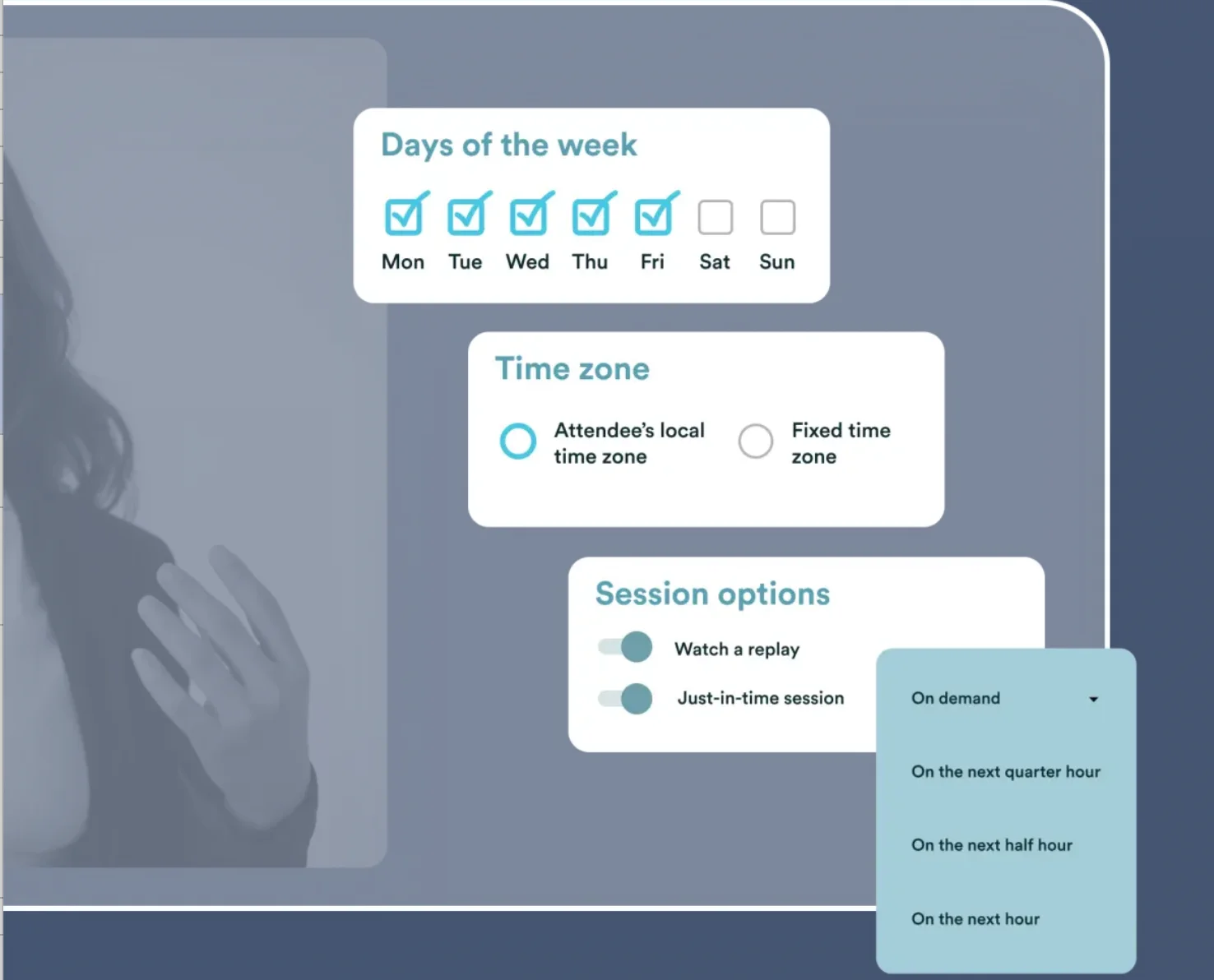
It doesn't have to feel like a boring, passive video, either. You can add interactive polls, quizzes, and quick questions throughout the presentation to keep brokers active and attentive.

If they have questions, they can type them into the chat. Someone on your team can reply in real time if they're available, or the system can automatically route the message to email for a quick follow-up later. You end up giving brokers personalized support without forcing a trainer to host every single session live.
In fact, we record an average attendance rate of 83% for our on-demand sessions, compared to around 40% for live webinars. For a busy brokerage, that's the difference between reaching the majority of your team and only training the few who happened to be free at your live training time.
Want to take eWebinar for a spin? We have a generous 14-day free trial for you to try out today! If you prefer not to start now, register for our on-demand demo at a time that fits your schedule (by the way, our demo is powered by eWebinar itself.)
3. Teach brokers to explain products and rates simply
Knowing the products is one thing. Being able to explain them clearly is what helps a broker win a borrower’s trust. For instance, if a broker can’t explain the difference between an FHA loan and a conventional loan, or why an adjustable rate might make sense for one borrower but not another, the client can get confused and hesitant.
Start with the main loan types.
Your brokers should understand conventional, FHA, VA, USDA and jumbo loans, including who each option may be suitable for.
The key is to teach them to start with the borrower, not the product. A first-time buyer with a small down payment will have different needs from someone refinancing a home they have owned for years. The recommendation should follow the borrower’s situation, not whichever product the broker is most comfortable selling.
They should also be able to explain rate locks, discount points and the difference between the interest rate and APR. These are some of the areas borrowers are most likely to ask about or misunderstand.
Besides, the best brokers do more than repeat numbers. They translate those numbers into something meaningful. A borrower does not care about a 6.75% rate in isolation, for instance. They want to know what the monthly payment will be, whether it fits their budget and how it affects the type of home they can afford. Train your brokers to connect the rate to the payment and the payment to the borrower’s situation.
4. Teach a consultative discovery and pre-approval conversation
The brokers who win long-term aren't the ones who blurt out a rate quote the fastest. They're the ones who ask the best questions first and build a loan strategy around the answers.
Treat the discovery call as a critical skill. Before rate even enters the conversation, a broker should understand the borrower's goals, timeline, credit history, income, debts, and savings. That’s how a broker earns enough trust that the borrower stops shopping and starts listening. A buyer who feels understood is a lot harder for a competitor to peel away with a quarter-point.

The pre-approval conversation needs that same level of care too. Brokers should be able to explain, plainly, why a full pre-approval is far stronger than a quick pre-qualification, and how it gives buyers a real edge in a competitive market. When handled right, the pre-approval process is the exact moment a casual shopper turns into a committed client.
The classic rookie mistake here is leading with rate to sound competitive. All that does is teach the borrower to view the mortgage as a commodity, forcing the broker into a price war they rarely control. Drill that initial conversation until asking deep discovery questions becomes second nature long before any rates are thrown around.
5. Drill objection handling and rate-shopping calls with roleplay
Every broker hits the exact same wall eventually: the dreaded "I found a lower rate somewhere else" phone call. How they handle that single conversation determines a massive chunk of their pipeline, so don't leave their response to guesswork.
Borrowers shop around, and frankly, they should. Research shows that getting just one additional rate quote can save a buyer hundreds of dollars, while getting multiple quotes can save them thousands over the life of the loan. Your brokers can't act like shopping around isn’t a wise choice. They have to respect it.

Instead, train them to compete on the factors a low rate quote usually hides:
- Total Out-of-Pocket Costs: Are there hidden fees pushing the actual cost up?
- Quote Legitimacy: Is it a real, lockable rate, or just a teaser that won't survive underwriting?
- Execution & Speed: Can that other lender close on time? A rate that falls apart a week before closing can cost the buyer the entire deal.
Then there’s the client who wants to wait on the sidelines for rates to drop. Teach your team an honest, advisory approach rather than a high-pressure sales pitch. Walk the client through the realistic math of waiting in a changing market, and explain how a future refinance works so they know they aren't "marrying" today's rate. The goal is to give them clarity.
The only way this sticks is through roleplay. Have brokers practice these calls with each other or review real call recordings together. Script reading doesn't work—saying the words out loud, stumbling a bit, and making adjustments on the fly is the only way to build muscle memory.
6. Build a referral-partner and past-client playbook
Most mortgage business doesn't come from ads. It comes from relationships, and that's a teachable system.
Real estate agents are the biggest single source. NAR's 2025 profile found 88% of buyers used an agent, and 43% found that agent through a referral. Plenty of buyers said the agent handed them a shortlist of lenders, too. If your brokers aren't the name on that shortlist, someone else is.
Train them to build agent relationships, co-market inside the rules, and become the lender an agent trusts to close cleanly, since the agent's reputation rides on it as well.
Let’s revisit the first point here again. Under RESPA, a broker can build all the agent relationships they want and can genuinely share the cost of joint marketing, but they cannot pay for referrals. Teach the difference, because it's an easy line to cross by accident and an expensive one.
Don't let the past-client database gather dust either. A closed loan opens the door to more business down the road. That same client is a future refinance when rates drop, a repeat purchase, and a stream of referrals to friends and family.
So train a simple follow-up cadence. That's a check-in schedule, an annual mortgage review, and a friendly note when rates drop in a client's favor, so nobody who already trusted your broker gets forgotten. The pitfall is treating referrals as a one-off favor you ask for when the pipeline runs dry. The brokers who win at this give first and stay in touch, all year.
Where to start this week
Pick the weakest link and fix that first. If your brokers freeze on rate-shopping calls, start with roleplay. If your pipeline is thin, build the referral playbook. If compliance lives in its own annual silo, wire it into the sales conversation where it belongs.
But maybe the real problem is that you can't get a distributed, independent team into the same room. If so, solve the delivery before you touch the curriculum, because none of it matters if half the team never sees it.
Record your core training once, put it on an on-demand schedule your brokers can join anytime, and let chat handle their questions. Start a free trial of eWebinar and get your next training in front of every broker.
FAQs
What should a mortgage broker sales training program include?
At a minimum, a compliance foundation, product and rate knowledge, a consultative discovery process, objection handling for rate-shopping conversations, and a referral-partner playbook. The strongest programs also cover a past-client follow-up cadence, since repeat business and refinances are some of the cheapest loans a broker will ever originate.
How long does it take to train a new mortgage broker?
Getting licensed takes at least 20 hours of pre-licensure education plus passing the SAFE MLO test, but that's just the start. Real productivity usually takes several months of ongoing coaching, roleplay, and live-loan experience. Plan for continuous training, not a one-time onboarding, because rates and products keep changing under your team.
How do you train brokers who work remotely and set their own hours?
Deliver the training on-demand instead of live. When a session is recorded and runs on a 24/7 schedule, a broker joins whenever they have a gap, between closings or after hours, and still gets to ask questions through chat. That's how distributed brokerages hit real attendance instead of training only whoever was free.
Is compliance training part of sales training?
In mortgage, yes, and separating them is a mistake. So many sales missteps are also compliance missteps, from what a broker says in an ad to how they handle a referral relationship under RESPA. Weaving compliance into the sales conversation, rather than parking it in a once-a-year module, is what keeps a producing team out of trouble.
How frequently should you retrain your brokers?
Keep it ongoing, with a refresh whenever something material changes, like a rate-environment shift, a new loan product, or a rule update. Annual continuing education covers the licensing requirement, but it won't keep a sales team current. The brokerages that stay sharp update the relevant training the same week the change lands.
Curious to see how eWebinar can help run your demos, onboarding, and training sessions on autopilot?
Watch a one-minute explainer video for a quick overview of the eWebinar platform. Or, better yet, join our on-demand demo to learn more!