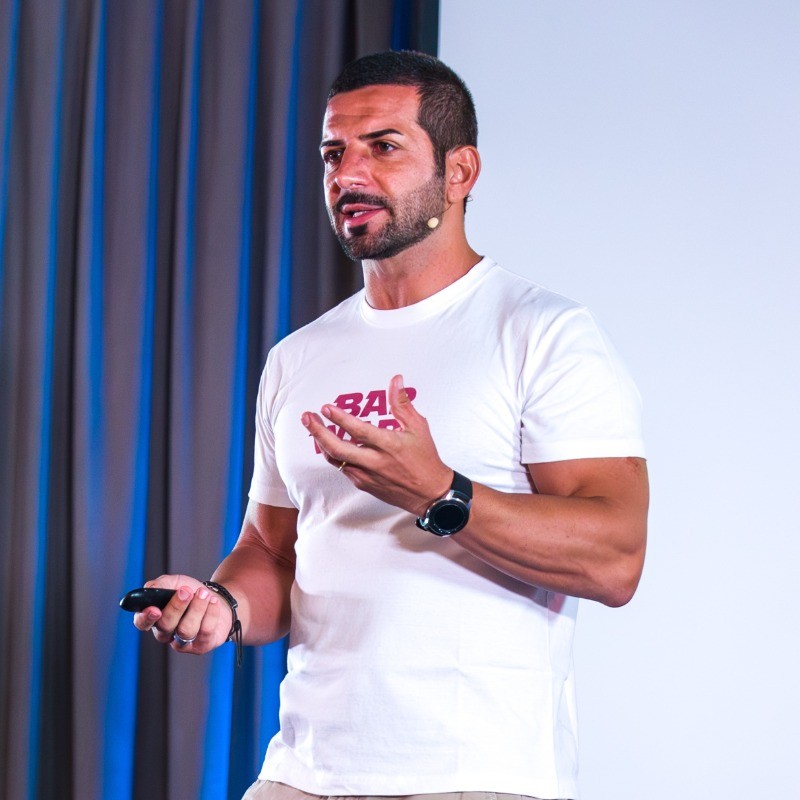
If you want to be happy, all you have to do is lower your expectations.
 If you want to be happy, all you have to do is lower your expectations.
Matt Watson,
Founder and CEO of Full Scale
Resources and Links
- Full Scale: fullscale.io
- Product Driven Newsletter: newsletter.productdriven.com
- Startup Hustle Podcast: startuphustlepodcast.com
- Product Driven Podcast: youtube.com/@ProductDrivenDev/videos
- Matt on LinkedIn: linkedin.com/in/mattwatsonkc/
- Product Driven (book): fullscale.io/product-driven
Key Timestamps
(01:19) Trailer park to flea markets at 5 years old
(03:37) Did he ever dream big
(04:57) When it felt like a real business
(07:45) Selling for $150 million at 29
(07:59) Off the rollercoaster
(08:46) Why the exit made life worse
(11:32) What surprised him about money
(12:28) Why friends stop inviting you over
(13:03) Starting again two months later
(13:51) Solo CEO, hard lessons
(15:36) Being his own VC
(16:42) Diagnosing ADHD at 40
(20:02) His most important company
(23:27) Startups are brain damage
(28:21) Ferraris, a jet, letting go
(30:03) The key to happiness
(30:25) The ingredients to success
Episode Summary
Matt grew up dirt poor. He was born in a trailer park in Oklahoma, the product of a one-night stand, raised by another man he calls his father. From the age of five, he was out at flea markets selling stuff his dad had picked up at garage sales. In high school, when he needed new clothes, his uncle bought them. Money was never something Matt had, and he says looking back he just thought that was normal.
At 22, someone came to him with a problem. A car dealer needed help uploading photos to the internet. Matt said yes. That conversation turned into VinSolutions, a CRM for car dealerships. He never thought about it as a startup. He didn't know venture capital existed as a world he could enter. He just built something to pay the bills. Eight years later, doubling almost every year, they were doing $35 million in revenue when AutoTrader made an offer. They sold for $150 million in 2011. Matt was 29 and the largest shareholder.
He says the day the wire hit felt like getting off a rollercoaster. Not euphoria, not fireworks. More like the empty feeling a parent gets when their kid leaves home. Fifteen years later, he's said publicly that the exit didn't really change his life in the way one would expect. It gave him more freedom, but more money more problems is absolutely the case, he says, especially when it comes to family and friends. Family always wants money. Friends stop inviting you over because they know where you live. The thing most people actually want is peace, and you can have that with nothing.
Two months after the exit, he started Stackify. He was 29 and needed something to do. He thought he could just do it again. He was wrong. Stackify took nine years, sold at a fraction of the previous exit, and taught him that previous success has nothing to do with the next one. He also learned that being his own VC, funding the company out of his own pocket instead of raising, let him avoid solving the real problems for years longer than he should have.
At 40, he self-diagnosed with ADHD after watching too many TikTok videos. Everyone else in his life already knew. He now sees it as the reason he can hyperfocus on a hard problem like a dog on a bone, and also the reason he doesn't feel fear of consequences the way most people do, which is part of what he thinks makes founders founders.
Full Scale, the 350-person software development company he runs now based in the Philippines, is a business he calls one of the best he's ever started. It was an accidental one. He started it in the middle of Stackify because he needed developers. His co-founder ran it. In 2023, that co-founder wanted to sell and Matt didn't. He bought him out and chose to keep building instead. He says startups now sound like brain damage. He'd rather grow what he has than start from zero.
He's simplifying his life. He used to own Ferraris. He used to own part of a private jet with two business partners. He got rid of them. He has five kids now. He can't take them to school in a two-seater. His favorite toy today is a yellow-green Volkswagen ID Buzz minivan covered in flower magnets.
We closed on the question of what he'd tell someone who thinks money is the answer. His answer: the key to happiness is lowering your expectations. He knows people don't want to hear that, but he says there are billions of people whose expectation is just to eat three times a day, and they're extremely happy. Success for him today isn't the number in the account. It's whether his family is happy, whether his marriage is in a good place. Earlier in his career, he says, he had marital issues and hid from them by working more. The stuff that actually matters is the stuff that has nothing to do with money.
Connect with Melissa
- Connect with Melissa at melissakwan.com and subscribe to 'your founder next door', Melissa's weekly newsletter on what it's like to build a company without an abundance of resources and friends in high places.
- Follow Melissa Kwan on LinkedIn where she share stories & lessons from her founder journey weekly.
- Find her on @themelissakwan on Instagram, TikTok, Twitter and YouTube where she shares short videos of business advice and other truth-bomb sound bites.
About ProfitLed
Most startup advice is built around venture capital, hypergrowth, and unicorn exits. ProfitLed is for the rest of us. Hosted by Melissa Kwan, 3x bootstrapped founder and CEO of eWebinar, ProfitLed explores what it's really like to build a company on your own terms, without an abundance of resources and friends in high places.
Season Three goes beyond strategy as we explore the intersection of Passion, Profit, and Purpose and what happens when founders evolve and come into financial success. If you're building something real, this one's for you.
This podcast was brought to you by eWebinar.